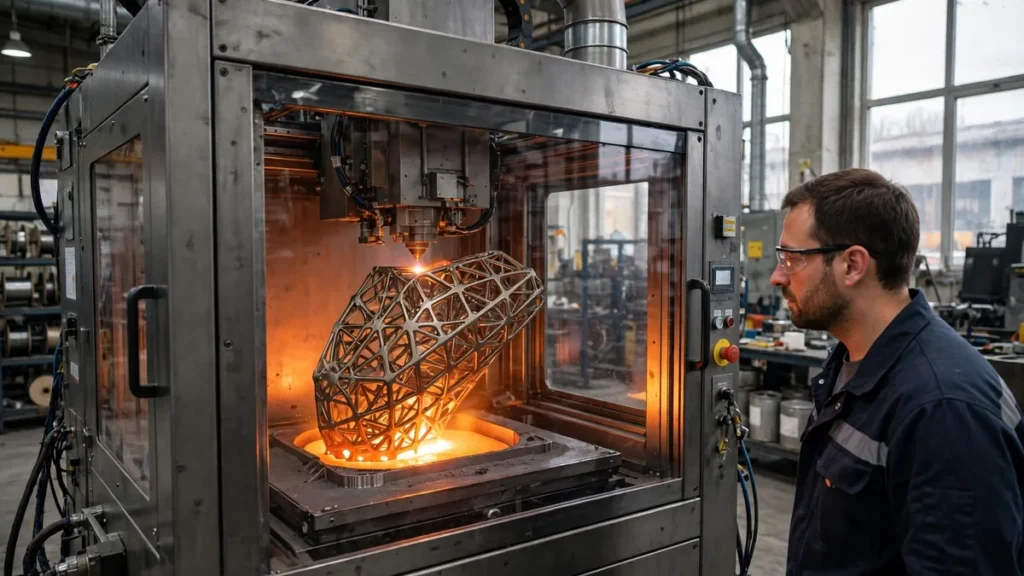
Hold a sheet of it in your hand and nothing seems remarkable: a black, paper-thin panel, light as a feather, stiff as a credit card. Then try to tear it, bend it or snap it, and the illusion breaks. A carbon nanotube composite is stronger, weight for weight, than steel — not by a little, but by a factor that makes engineers reach for superlatives and then apologise for them.
A single carbon nanotube is one of the strongest structures ever measured, but a single tube is useless on its own. The composite is what turns that atomic strength into something you can build with: nanotubes and carbon fibres aligned in a matrix, sharing every load, stopping every crack. This is how a carbon nanotube composite works — how the tubes carry force, how the resin transfers it between them, and why a material made of something as ordinary as carbon can behave like nothing else on Earth.

How Carbon Nanotube Composites Work
Step 1: The tube itself
A carbon nanotube is a sheet of graphene — a single layer of carbon atoms in a honeycomb pattern — rolled into a seamless cylinder. The walls are one atom thick, the diameter is a few nanometres, and the length can be thousands of times greater. Every carbon atom in the wall is bonded to three neighbours by some of the strongest chemical bonds in nature, and because the cylinder has no edges or seams, there is nowhere for a crack to start. Pulled along its length, a single nanotube has a tensile strength measured at over 100 gigapascals, roughly fifty times that of steel at a sixth of the weight. The material story starts here, and the engineering of it is catalogued in carbon nanotube composite materials engineering.
Step 2: From tubes to a usable reinforcement
Raw nanotubes arrive as a tangled black powder, and tangled tubes are weak — they slide past each other instead of sharing a load. So the first job is to untangle and align them. They are dispersed in a solvent, spun into yarns and sheets, or grown in aligned forests on a substrate and drawn off like a ribbon. Alignment is everything: a tube only carries load along its length, so a randomly oriented mat is a fraction as strong as an aligned one.
Step 3: The matrix transfers the load
The reinforcement is useless without the matrix — usually an epoxy resin — that surrounds it. When a load hits the composite, it enters through the resin and is transferred into the tubes and fibres by shear forces along their surfaces. A good bond between tube and resin is what makes the whole thing work: if the tubes slip, the composite fails at the strength of the resin alone. Chemists treat the tube surfaces to help the resin grip, adding chemical groups that link the two together.
Step 4: Laying up the layers
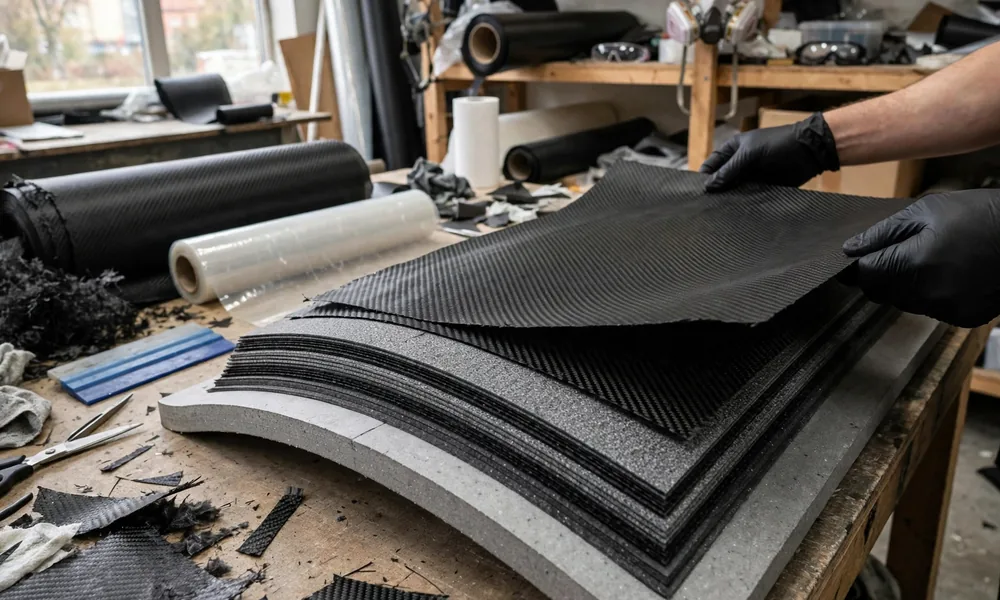
Composites are built like plywood, one layer at a time, and the direction of each layer is a design decision. A layer with fibres running lengthwise is immensely strong in that direction and weak across it, so designers stack layers at 0, 45 and 90 degrees to cover every direction a load might come from. The stack is then vacuum-bagged and cured in an autoclave under heat and pressure, which drives out air bubbles and hardens the resin into a single solid. The layer-by-layer logic is shared with other advanced materials, including the sheets described in how graphene composites work.
Step 5: How it carries a load
In service, the composite behaves like a team. Tension is carried almost entirely by the tubes and fibres; the resin simply passes the load between them. Compression is trickier — thin tubes buckle — so the resin’s job is to hold them straight, like the grout between bricks. Because the stiffness is so high, a nanotube composite part barely flexes under loads that would bend aluminium, which is why it shows up in spacecraft structures, racing car parts and high-end bicycle frames.

Step 6: How it fails — gracefully
Metals fail with a bang: a crack races through, and the part breaks. Composites fail slowly, and that is a feature. A crack hitting a nanotube layer has to break or pull out thousands of tiny tubes, each one absorbing energy as it goes, and the crack is often deflected sideways along a layer boundary instead of cutting straight through. The part may delaminate — layers peeling apart — long before it snaps, giving warning that a metal part would never give.
Step 7: Where the limits still bite
For all its promise, the nanotube composite is still hard to make well. Growing long, defect-free tubes at industrial scale is expensive, and a single defect in a tube wall can halve its strength. Dispersing the tubes evenly without damaging them is a manufacturing headache, and the resins that hold them are still plastics: they soften in heat, absorb moisture over years, and cannot be recycled the way aluminium can. The making of the raw material is a story of its own, covered in how carbon nanotube composites are made.
Carbon Nanotube Composites at a Glance
| Specification | Detail |
|---|---|
| Single tube strength | Over 100 gigapascals tensile, about 50 times steel |
| Tube diameter | 1–50 nanometres, walls one atom thick |
| Density | About 1.3–1.4 grams per cubic centimetre |
| Typical matrix | Epoxy resin, sometimes thermoplastic or metal |
| Key advantage | Extreme specific strength and stiffness, plus conductivity |
| Key weakness | Cost, dispersion difficulty, resin heat and moisture limits |
| Failure mode | Gradual delamination and fibre pull-out, not sudden fracture |
| Main uses | Spacecraft structures, motorsport parts, high-end bicycle frames, sensors |
What Does It Cost?
Carbon nanotube material is still priced like a laboratory product, not a commodity. As rough estimates, research-grade multi-walled nanotubes cost tens to a few hundred dollars per kilogram, while single-walled tubes can cost thousands of dollars per gram in small quantities, though bulk prices fall steeply with volume. A finished nanotube-reinforced composite part — a bicycle frame, a drone arm, a spacecraft bracket — is typically an estimated $500 to $10,000 depending on size, fibre content and certification. Those figures are estimates, not quotes — the real number depends on tube type, purity, volume and how much of the part is nanotube rather than ordinary carbon fibre.
A Rare Fact
A single carbon nanotube is so strong that a cable made of them, just one millimetre thick, could in theory lift a weight of several tonnes — and the same material is the leading candidate for the space elevator cable, the one structure that would need a ribbon 100,000 kilometres long and strong enough to hang from orbit. No other known material comes close to the strength-to-weight ratio the elevator would demand.
Carbon is the most ordinary element in the living world, and in a nanotube it becomes the most extraordinary material in engineering. The composite is how we finally get to use it — not as a curiosity in a microscope, but as a structure you can hold, ride and fly.