Deep below the surface, in a steel tube lit by red light, an alarm sounds that every submariner trains for and hopes never to hear. The order is given, the crew moves to the escape trunk, and everything now depends on a hatch no bigger than a manhole cover — a hatch that has to open against the crushing pressure of the sea and let people out alive.
A submarine escape hatch is the last way out. It sits at the top of an escape trunk, a small chamber that can be flooded and pressurised to match the sea outside, so that a submariner can climb out and rise to the surface. It has to seal perfectly for years, never leaking a drop, and then open flawlessly on the worst day of the crew’s lives.
Its spec sheet reads like a list of contradictions: it must be light enough to open by hand yet strong enough to hold back tonnes of water pressure; it must seal with a single motion yet survive decades of salt water. Here is what the numbers mean.
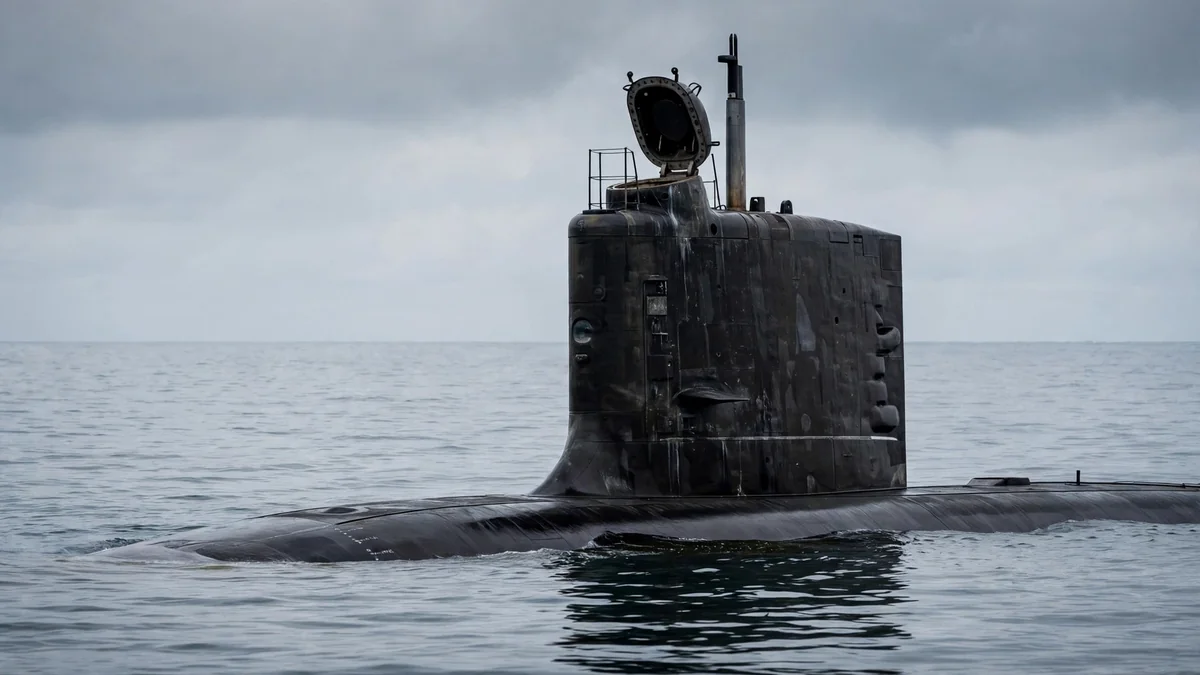
How It Works
Step 1: The escape trunk
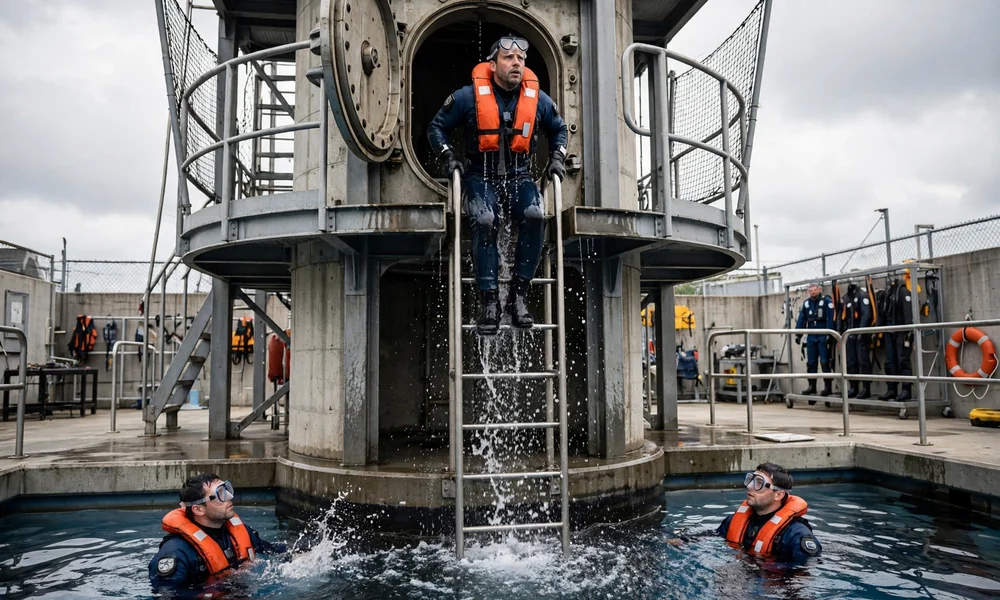
The hatch does not work alone — it is the lid of the escape trunk, a vertical chamber inside the submarine’s sail or hull, big enough for one or two people wearing escape suits. In normal operation the trunk is dry and the hatch is shut, sealing the submarine against the sea. In an emergency, crew members climb into the trunk, shut the lower hatch behind them, and the trunk is flooded with seawater. Only when the pressure inside the trunk equals the pressure outside can the upper hatch — the escape hatch — be opened.
Step 2: Equalising the pressure
This is the key to the whole system. At 100 metres depth, the sea presses on the hatch with about 11 kilograms on every square centimetre — tonnes of force across the hatch’s area. No human could open it against that. But once the trunk is flooded and pressurised to the same depth, the pressure on both sides of the hatch is equal, and it opens with a simple handwheel. The flooding valve is the critical control: open it too fast and the inrushing water can injure the people inside; too slow and the escape takes too long. The steel around the trunk has to withstand the same forces as the rest of the boat, as explained in our guide to how a submarine pressure hull is made.
Step 3: The seal
Between the hatch and its frame sits a rubber O-ring seal, compressed by the hatch’s own weight and by the sea pressure outside. The deeper the submarine goes, the harder the sea pushes the hatch into its seat, and the tighter the seal becomes — pressure that could kill the crew is the same pressure that keeps them safe. The seal must stay flexible in near-freezing water, resist salt and oil, and survive for years without being replaced. A single nick or a grain of sand in the sealing face can cause a slow leak, so the seal is inspected every time the hatch is opened.

Step 4: Locking dogs and the handwheel
The hatch is held shut by locking dogs — heavy steel lugs around its rim that rotate into slots in the frame, like the bolts on a bank vault. A handwheel in the centre drives them all at once through a linkage, so one person can lock or unlock the hatch in seconds. The mechanism is deliberately simple and mechanical: no hydraulics, no electrics, nothing that can fail when the power is out. In the dark, in the cold, wearing gloves, a submariner must be able to open it by feel alone.
Step 5: The escape itself
Once the hatch is open, the submariner exits wearing a survival suit or a breathing apparatus, and rises to the surface — either free-swimming, controlling the ascent by exhaling continuously, or inside a rescue buoy. The hatch must open fully and stay open, with no spring or current slamming it shut on the person climbing through. Some escape trunks have a second hatch below, so that two people can escape in sequence without flooding the whole submarine. The pressure sphere that protects deep-diving crews from the same crushing depths is described in our guide to Alvin’s titanium pressure sphere.
Step 6: Testing and maintenance
An escape hatch is tested more than almost any other fitting on the boat. It is pressure-tested in the yard, opened and closed hundreds of times in training, and inspected on a strict schedule for corrosion, seal wear, and damage to the locking dogs. Submariners drill the escape procedure until it is muscle memory, because in a real emergency there is no time to think — only to act. The hatch is one of the few parts of a submarine whose entire purpose is a day everyone hopes never comes, and it has to work perfectly on that day. The modular construction that lets these systems be built and tested in sections is covered in our guide to modular ship construction.
Submarine Escape Hatch Specs
| Specification | Typical range |
|---|---|
| Hatch diameter | 600 to 800 millimetres |
| Material | High-strength steel or titanium alloy |
| Design depth | 200 to 600 metres, by class |
| Pressure rating | 20 to 60 bar |
| Seal type | Rubber O-ring, double seal on some classes |
| Locking mechanism | Handwheel with 6 to 12 locking dogs |
| Opening time | Under 10 seconds once pressure is equalised |
| Weight | 80 to 200 kilograms |
| Escape capacity | 1 to 2 people per trunk cycle |
What Does an Escape Hatch Cost?
An escape hatch is not sold as a standalone part — it is built into the submarine, and its cost is part of the vessel’s price. As a manufactured assembly, a single escape hatch and trunk is estimated at $100,000 to $500,000, depending on size, depth rating, and materials. Prices are estimates only and vary by class and builder. The cost is small beside the submarine itself, but the engineering behind it — the machining tolerances, the pressure testing, the certification — is among the most demanding of any fitting on the boat.
A Rare Fact
The deepest escape ever made from a submarine happened in 1939, when the American submarine USS Squalus sank in 74 metres of water off New Hampshire. Thirty-three men were trapped inside, and a rescue bell was lowered to the escape hatch to bring them out one group at a time. It took more than a day, but every man in the forward compartment survived. The rescue proved that escape hatches worked in a real disaster, not just in training — and it changed submarine design forever, making escape trunks and hatches standard on every submarine built since.
A submarine escape hatch looks like a heavy steel lid and behaves like a promise — sealed tight for years, then opening in seconds when lives depend on it. Learn to read its numbers, and the most serious piece of equipment on the boat stops being a mystery.


