Two hundred metres down, the ocean is black and silent to human ears — yet a submarine’s crew can hear a freighter twenty kilometres away, tell whether it is a fishing boat or a container ship, and roughly how fast it is moving, all without ever looking outside.
They do it with sonar: sound navigation and ranging. In water, sound travels roughly four and a half times faster than in air, and it carries for enormous distances. A submarine listens with arrays of sensitive microphones and builds a picture of the world from echoes and engine noise alone. It is the submarine’s eyes, and it never blinks.
Sonar sounds like science fiction, but its principles are simple. This is what the specifications on a sonar system actually describe — the arrays, the frequencies, the processing — and why each one matters when you cannot see where you are going.

Listening and Pinging: Passive and Active Sonar
Sonar comes in two kinds. Passive sonar only listens, picking up the sounds other vessels make — propellers, engines, water flowing over hulls — and working out where they are. Because it emits nothing, a submarine using passive sonar stays hidden, which is why it is the default mode. Active sonar sends out a pulse of sound, a ping, and listens for the echo off a hull, the seabed, or a wreck. It gives precise range, but the ping can be heard from far away, so using it announces the submarine’s presence.
The two modes are often combined: a submarine listens passively for hours and uses active sonar only sparingly — to confirm a range or map the seabed before entering shallow water. Think of passive sonar as watching the world by the noise it makes, and active sonar as flashing a torch in a dark room: useful, but everyone sees the light.
What the Numbers Mean
Frequency: low for distance, high for detail
Frequency, measured in hertz, is the most important sonar specification. Low-frequency sound travels for tens of kilometres but paints a blurry picture, good for detecting that something is out there and little else. High-frequency sound gives a sharp, detailed image but fades within a few kilometres. Submarines carry sonar across this whole range, switching frequency the way a camera switches lenses. The choice is a constant compromise between reach and resolution.
Arrays: many ears are better than two
A single underwater microphone can hear a sound but cannot tell where it came from. An array — dozens or hundreds of hydrophones, which are underwater microphones, arranged along the hull, wrapped around the bow, or towed behind on a long cable — can, by comparing the tiny differences in when the same sound reaches each one. The bow sphere in the dome at the front is the main array; flank arrays add wide coverage; and a towed array, streamed hundreds of metres behind, listens in quieter water away from the submarine’s own noise.
Transducers: the voice and the ear
A transducer turns electricity into sound and sound back into electricity — the loudspeaker and microphone of the sonar world, in one package. In active sonar it generates the ping; in passive sonar it is the listening element. Its sensitivity decides how faint a sound the system can detect, and its power handling decides how strong a ping it can send. Modern transducers are made from piezoelectric ceramics, which flex when a voltage is applied and produce a voltage when squeezed by a sound wave.
Signal processing: finding a whisper in a storm
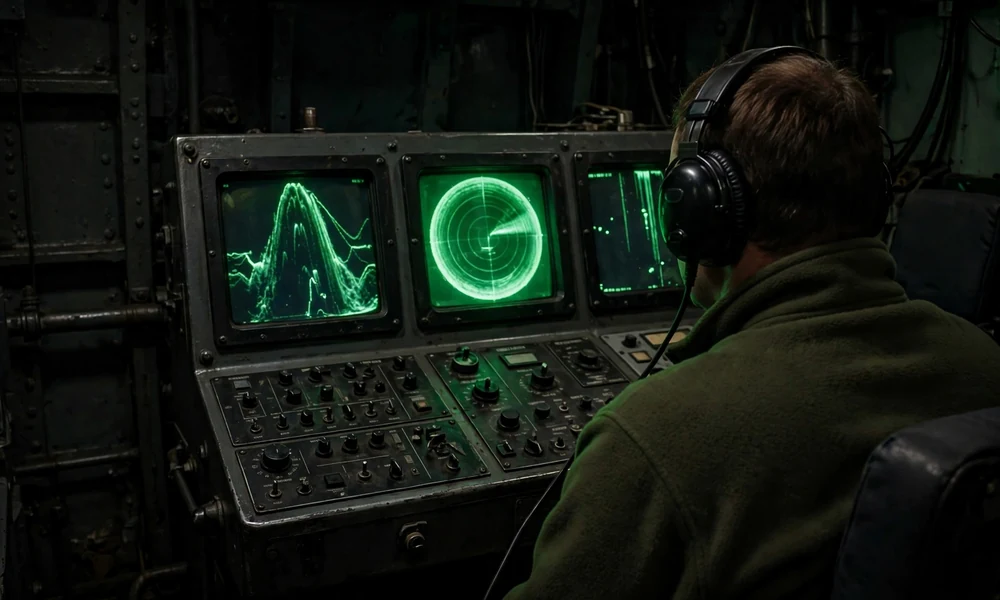
The ocean is noisy. Waves, rain, marine life, distant shipping, and the submarine’s own machinery all compete with the sound the crew wants to hear. Signal processing separates the signal from the noise: filtering background sounds, sharpening the frequencies that matter, and tracking a contact as it moves. Modern systems use beamforming — combining an array’s signals to listen strongly in one direction — and automated classification, which compares a contact’s sound pattern against libraries of known vessel types.
Sound speed and the layers of the sea
Sound does not travel in a straight line underwater. Its speed changes with temperature, salinity, and pressure, bending sound waves into channels where sound travels far and shadow zones where it barely reaches. A layer of warm surface water over cold deep water can trap sound for huge distances, or hide a submarine beneath it. Operators measure temperature and salinity constantly, building a picture of how sound is behaving that day. The hull that carries all of this is an engineering story in itself, covered in our guide to the best submarine propulsion systems.
Submarine Sonar Specs
| Specification | Typical range |
|---|---|
| Passive frequency range | 10 hertz to 10 kilohertz |
| Active frequency range | 1 to 100 kilohertz |
| Bow array hydrophones | Several hundred elements |
| Towed array length | 200 to 800 metres |
| Passive detection range | 10 to 100 kilometres, conditions dependent |
| Active detection range | 5 to 30 kilometres |
| Sound speed in seawater | About 1,500 metres per second |
| Bearing accuracy | Better than 1 degree |
| Operating depth | Surface to 400 metres or more |
Why Sonar Is So Hard to Build Well
A submarine is its own worst enemy when it comes to listening. Its pumps, propeller, and water flowing over its hull all make noise that competes with the faint sounds the sonar is trying to hear. That is why so much submarine engineering is about quieting the boat — mounting machinery on flexible mounts, shaping the propeller to avoid cavitation, and covering the hull in rubber-like anechoic tiles that absorb sound. The quieter the boat, the further its sonar can hear. The same obsession with extreme water pressure shapes the machines in our guide to deep-sea submersible materials, while the hulls that carry sonar into service are covered in our guide to container ship hull specs.
What Does a Sonar System Cost?
There is no showroom price for a submarine sonar suite, but published estimates put a modern integrated system at tens of millions of dollars, with the full sensor and combat system of a large submarine estimated at $100 million or more. Prices are estimates only, drawn from public reporting, and they reflect thousands of hand-tuned transducers and the computing that turns sound into a picture. A small commercial sonar for a survey boat, by contrast, can cost a few thousand dollars — the same physics, at a fraction of the scale.
A Rare Fact
The first practical underwater listening devices were developed during the First World War to detect U-boats, but the idea of navigating by echoes was inspired by bats. In 1793, the Italian scientist Lazzaro Spallanzani discovered that blinded bats could still fly without hitting obstacles, and later researchers proved they were listening to their own echoes. Every sonar ping is, in a sense, a mechanical bat call.
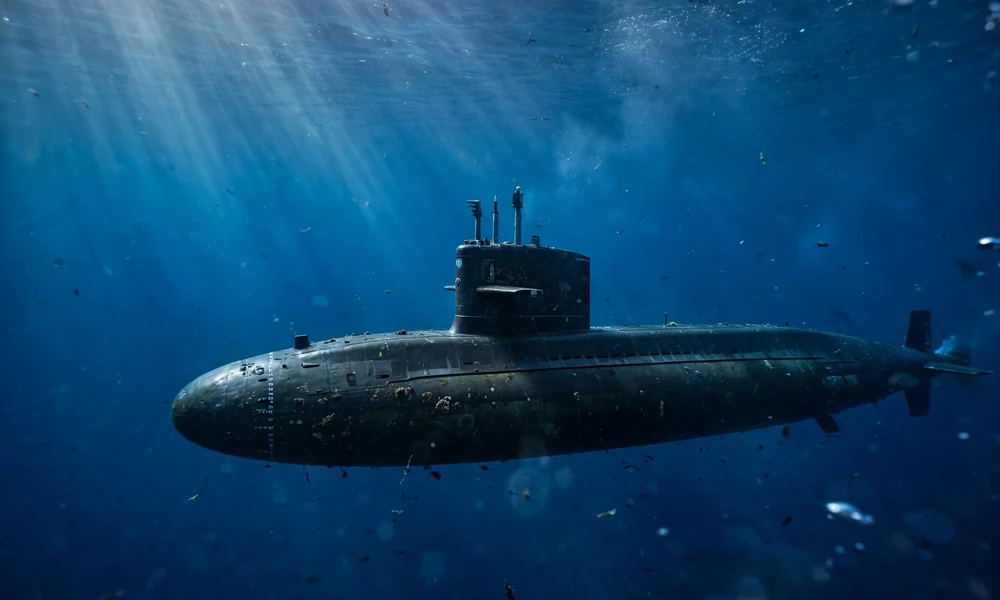
Sonar is often described as the submarine’s eyes, but it is more like its ears, its memory, and its map rolled into one. Frequency sets the reach, arrays set the direction, transducers set the sensitivity, and processing turns a noisy ocean into a picture a crew can trust. In a world without windows, sound is the only light.