Eleven kilometres down, at the bottom of the Mariana Trench, the pressure is more than a thousand times what it is at the surface. A submersible diving there carries the weight of an ocean on a hull no bigger than a small car, in water so cold and dark that sunlight has never reached it. The people inside sit in a metal sphere, listening to the hull creak as it takes the load, trusting materials that were chosen, tested and machined to survive a place that wants to crush them flat.
Deep-sea submersibles are built around one brutal fact: pressure rises by about one atmosphere for every ten metres of depth, so a craft rated for six thousand metres must hold back six hundred atmospheres. Every material on board, from the pressure hull to the viewport to the foam that keeps it afloat, is picked for how it behaves under that squeeze. There is no room for a weak link, because at depth a failure is not a leak — it is instant.
The Materials Behind the Deep-Sea Submersible
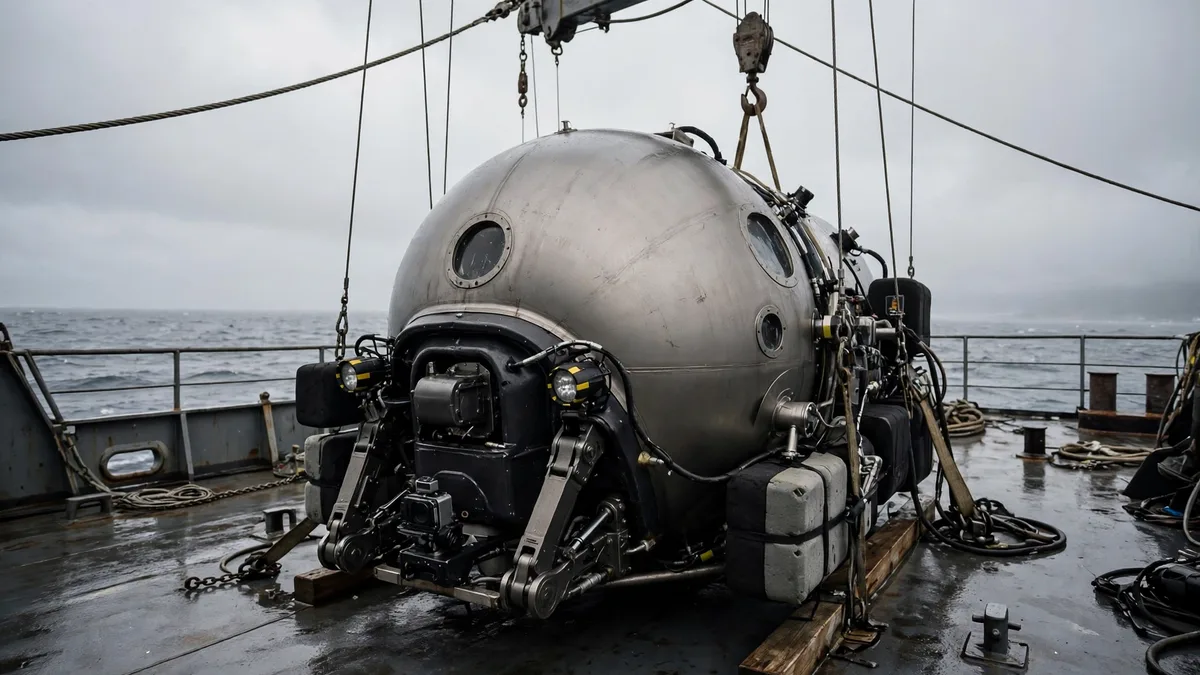
The heart of a deep-sea submersible is its pressure hull, usually a sphere of titanium, sometimes of steel or a composite, built to resist crushing from all sides at once. Around it sit acrylic viewports, syntactic foam for buoyancy, batteries in pressure-proof housings, and thrusters sealed against the cold. The sphere is the only part that keeps the crew alive, but every other material matters too: a seal that fails at six thousand metres is just as fatal as a hull that fails.
Step 1: The titanium sphere
The pressure hull is almost always a sphere, because a sphere spreads pressure evenly and has no corners where stress can gather. Titanium is the metal of choice: it is nearly as strong as steel at about half the weight, it does not rust in salt water, and it keeps its strength in the cold. The sphere is made from two hemispheres, forged and machined to a precise thickness, then welded together and inspected for flaws. The deep-sea submersible that results can dive again and again.
Step 2: Steel and composites where titanium is too dear
Not every submersible can afford a titanium sphere. Smaller or shallower craft use high-strength steel, which is heavier but far cheaper and easier to weld, or carbon-fibre composites, which are light and strong but behave very differently under repeated pressure. Steel hulls are thicker for the same depth rating, and the extra weight has to be carried by more buoyancy foam. Composites promise great savings in weight, but they are harder to inspect for internal damage, and engineers argue fiercely about how many dives a composite hull can safely make before it should be retired.
Step 3: Acrylic viewports and the art of seeing out
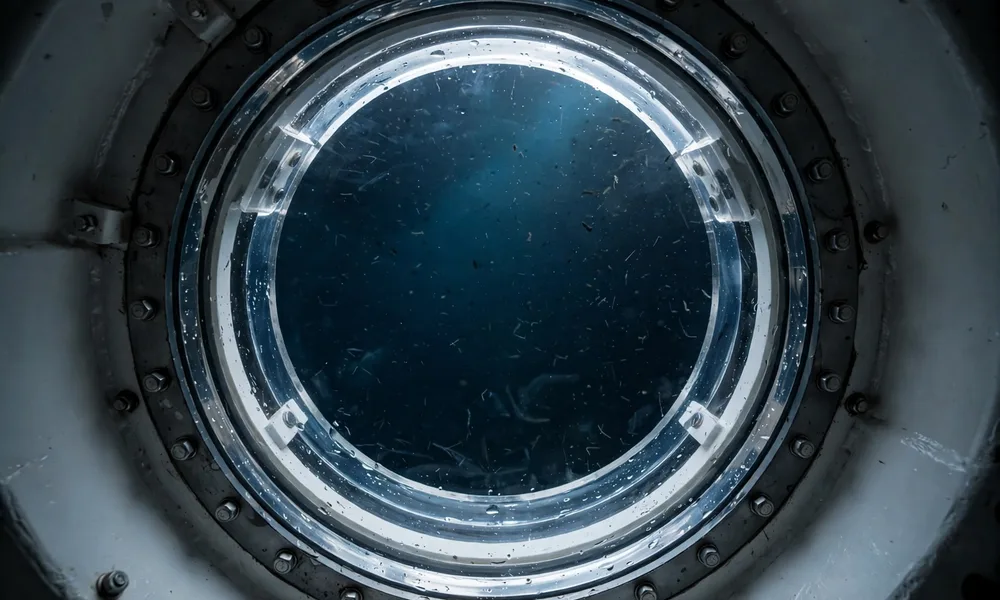
The crew needs to see, so the pressure hull has viewports made from cast acrylic, a clear plastic that is far tougher than glass and can be machined into a thick conical plug. The cone shape is the secret: pressure pushes the plug tighter into its seat, so the deeper the craft goes, the better the seal becomes. The acrylic is many centimetres thick at the centre, and it is polished to optical clarity so the pilots can see the seabed.

Step 4: Syntactic foam, the buoyancy that cannot be crushed
A submersible must float, and ordinary foam would be flattened by the pressure. The answer is syntactic foam: tiny hollow glass spheres, each smaller than a grain of sand, mixed into an epoxy resin. The glass microspheres resist crushing, and the resin holds them together, so the foam keeps almost all of its buoyancy at full depth. Blocks of it are bolted around the pressure hull, shaped to the craft’s body, and painted to resist water. It is the quiet hero of the design: without it, the titanium sphere would sink like a stone and never come back.
Step 5: Batteries, motors and seals in pressure housings
Everything electrical lives in its own pressure-proof housing, usually a cylinder of titanium or aluminium with O-ring seals at each end. Lithium batteries power the thrusters and the lights, and they sit inside housings that must survive both the pressure and the risk of a battery fault. Thruster motors are often filled with oil, which does not compress, so the pressure inside and outside the motor stays equal and no seal is needed.
Step 6: Frames, skids and the parts that can be sacrificed
Not everything on a submersible needs to resist full pressure. The outer frame, the landing skids, the sample baskets and the manipulator arms are usually made from steel, aluminium or plastic, and they are allowed to flood: water flows in and out freely, so there is no pressure difference to resist. This is a deliberate choice, and it saves a great deal of weight and money. The titanium hull is the only part that must stay dry, and everything else is designed to get wet and to be replaced when it corrodes.
Step 7: Testing, certification and the slow road to the deep
No submersible dives deep on trust. The pressure hull is tested in a pressure chamber, taken down in steps to a depth beyond its rating, and listened to with acoustic sensors that hear the tiny cracking sounds of a flaw growing. The whole craft is then dived in stages, a hundred metres, then a thousand, then deeper, with inspections between each dive. Certification bodies set the rules, and the process takes months or years. It is slow, expensive and unglamorous, but it is the reason that crewed submersibles have such a strong safety record: the materials are proven long before a person climbs inside.
Deep-Sea Submersible at a Glance
| Specification | Detail |
|---|---|
| Pressure hull | Titanium sphere, sometimes steel or carbon-fibre composite |
| Viewport | Cast acrylic conical plug, many centimetres thick |
| Buoyancy | Syntactic foam of glass microspheres in epoxy resin |
| Depth rating | Typically 4,500–11,000 metres for crewed craft |
| Pressure at 6,000 m | About 600 atmospheres, roughly 60 MPa |
| Power | Lithium batteries in titanium pressure housings |
| Crew | Usually 2–3 people inside the pressure sphere |
What Does It Cost?
A deep-sea submersible is one of the most expensive machines of its size ever built. A full-ocean-depth crewed submersible can cost tens of millions of dollars (estimate), and the titanium pressure hull alone accounts for a large share of that, because forging and machining a perfect sphere is slow, specialised work. Syntactic foam is priced by the block, and a full set can cost hundreds of thousands of dollars (estimate). The pressure testing and certification add more still.
A Rare Fact
The first crewed dive to the bottom of the Mariana Trench, in 1960, used a pressure sphere made not from titanium but from steel, and a viewport made from a single piece of acrylic so thick that the crew could barely see through it. The craft, the Trieste, carried over a hundred tonnes of iron shot as ballast, and the pilot dropped it, a little at a time, to control the descent. On the way down, one of the acrylic windows cracked with a bang that echoed through the sphere, and the crew kept going anyway. They reached the bottom and came home, and the cracked window is still on display.


