From the quay, a superyacht looks like a single gleaming object, but the white tower rising above the hull is a separate structure with a separate job. The superstructure — the decks, the wheelhouse, the saloons and the cabins stacked above the main deck — carries the people, the glass and the furniture, and it has to do it without making the yacht top-heavy.
That is why the superstructure of a modern superyacht is almost always aluminium. Steel is strong and cheap and it builds the hull, but a steel superstructure would put tonnes of weight exactly where a naval architect least wants it: high above the waterline. Aluminium is roughly a third the weight of steel for the same panel, it does not rust the way steel does, and it can be shaped into the sweeping curves owners expect.

The Materials Behind the Superyacht Aluminium Superstructure
The headline material is marine-grade aluminium alloy, usually from the 5000 series — 5083 and 5086 — with magnesium as the main alloying element, chosen because it keeps its strength in salt water and welds well. The 6000 series, with magnesium and silicon, appears in extrusions: window frames, rails and stiffeners that need to be pushed through a die into a precise profile.
Step 1: Choosing the alloy
Not all aluminium is marine aluminium. The 5083 alloy is the workhorse of superstructure plating because it resists seawater corrosion without a protective coating, it stays tough at low temperatures, and it holds up well under welding. The 6000-series alloys are weaker in the weld zone but stronger in their extruded form, so they are used where a shape matters more than a flat plate: the long extrusions that frame the wheelhouse windows, the mullions between panes of glass, and the tracks that sliding doors run in.
Step 2: Cutting and forming the plates
Superstructure plates are usually between four and twelve millimetres thick — far thinner than the hull plating below them — and they are cut on computer-controlled plasma or water-jet tables, then rolled and pressed into the yacht’s curves. Aluminium springs back more than steel when it is bent, so the yard forms each panel slightly beyond the intended curve and lets it relax into shape.
Step 3: Welding the structure together
The plates are welded, mostly with MIG welding, using 5356 filler wire — an aluminium-magnesium wire chosen because it matches the parent metal and resists cracking as the joint cools. Aluminium welding is unforgiving work: the metal conducts heat away from the weld so fast that the welder must move quickly, and the oxide skin that forms on aluminium in seconds has to be cleaned off before the arc starts, or the weld will be full of pores. The same care that goes into a superyacht steel hull goes into the aluminium above it.

Step 4: Joining aluminium to the steel hull
The hardest joint on the yacht is the one where the aluminium superstructure meets the steel hull. Weld the two metals directly and you create a galvanic cell: in salt water, the aluminium becomes the sacrificial anode and corrodes away. The answer is a bimetallic transition joint — a strip of aluminium explosively bonded to a strip of steel at the factory, so the two metals are locked together without ever being welded to each other. The steel side is welded to the hull, the aluminium side to the superstructure, and the joint is sealed and painted so seawater never reaches it.
Step 5: Stiffening the panels
A flat aluminium panel is a drum skin: it oil-cans and thrums with every wave and every footstep. So the inside of every superstructure panel is stiffened with extruded aluminium profiles — T-bars and flat bars welded to the back of the plate at close spacing — turning a thin skin into a rigid sandwich. Deck panels get the closest spacing, because they carry furniture, people and sometimes a helicopter.
Step 6: Insulation, damping and quiet
Aluminium rings. It transmits sound and vibration far more readily than steel, so a bare aluminium superstructure would carry the thump of every wave and the hum of every generator straight into the cabins. The yard bonds mineral wool and foam insulation to the inside of the plating, adds constrained-layer damping pads — a viscoelastic layer sandwiched between the aluminium and a thin sheet — and mounts the interior joinery on resilient fixings so it does not touch the structure directly.
Step 7: Fairing, painting and the glass
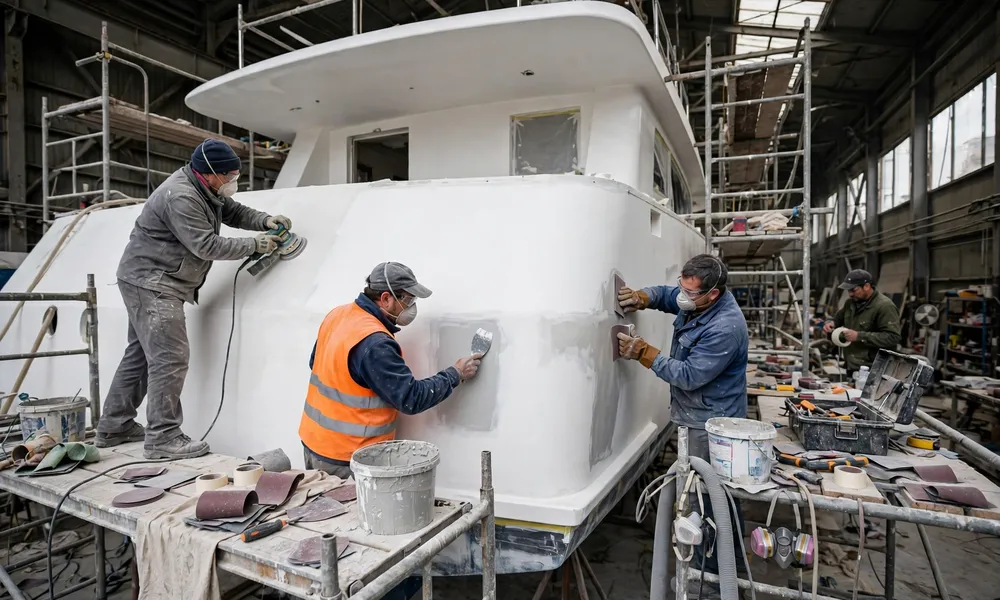
The outside of the superstructure is faired with epoxy filler, sanded to a mirror-flat surface, primed with an epoxy primer that bonds to aluminium, and finished with a polyurethane topcoat — the deep gloss that makes a superyacht look carved from one piece. The paint has to flex: aluminium expands and contracts with temperature far more than the steel hull, and a brittle paint would crack at the joint. Then come the windows, the largest single challenge in the structure. The glass is laminated, tempered and often curved, set into aluminium frames with flexible structural adhesive that lets the glass and the metal move at different rates. The same attention that keeps a superyacht steel hull watertight below is what keeps a superstructure dry, quiet and fair above, and the view from the owner’s suite depends on both — as does the work of the yacht carbon mast standing above it all.
Superyacht Aluminium Superstructure at a Glance
| Specification | Detail |
|---|---|
| Main plating alloy | 5083 / 5086 aluminium-magnesium (5000 series) |
| Extrusions alloy | 6000 series (magnesium-silicon) for frames and rails |
| Plate thickness | Typically 4–12 mm, thinner than hull plating |
| Weight vs steel | Roughly one-third the weight for the same panel |
| Welding | MIG with 5356 filler wire; oxide cleaned before welding |
| Hull joint | Explosively bonded bimetallic transition joint or insulated bolted joint |
| Finish | Epoxy fairing, epoxy primer, polyurethane topcoat |
What Does It Cost?
An aluminium superstructure for a 50-metre superyacht costs several million dollars (estimate) to build, with the alloy, the welding labour and the fairing and paint accounting for the largest shares. The aluminium itself is more expensive per tonne than the steel in the hull, but the weight saved high up is worth paying for: it lets the yacht carry more fuel, more glass and more accommodation without growing the hull. A full repaint of a large superstructure alone can run into hundreds of thousands of dollars (estimate).
A Rare Fact
Aluminium expands with heat almost twice as much as steel, and on a superyacht that is not a footnote — it is a design load. On a hot day in the Mediterranean, a 50-metre aluminium superstructure can grow several centimetres longer than it is at dawn, while the steel hull beneath it barely moves. The bimetallic joint, the flexible paint and the adhesive-set windows are all there to let the two metals slide past each other, millimetre by millimetre, every single day. The yacht quite literally breathes with the sun.