From the dock, a superyacht looks like a floating hotel — white, gleaming, and impossibly smooth. What you cannot see is the part that matters most: below the waterline, a steel hull the length of a football field carries everything above it through oceans that do not forgive mistakes. It is the largest single structure most people will ever stand on, and it is built to survive waves, collisions, and decades of salt water without failing.
A superyacht steel hull is not a scaled-up boat hull.
This guide explains the key numbers on a superyacht steel hull spec sheet in plain English: what the steel grade means, how thick the plates really are, why displacement matters more than length, and which figures tell you whether a hull was built for the open ocean or for calm harbours.
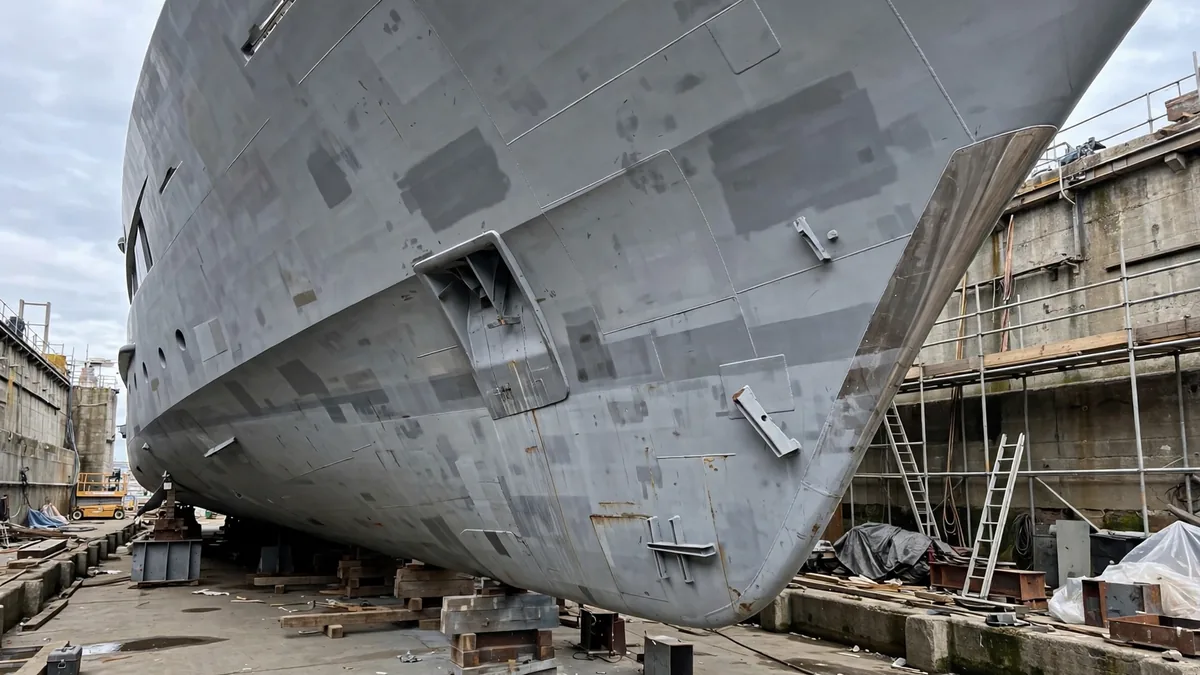
Superyacht Steel Hull Specs Explained
1. Steel grade: what the hull is made of
Superyacht hulls are built from marine-grade mild steel, usually grades such as AH36 or DH36 — high-strength shipbuilding steel with a minimum yield strength of 355 megapascals. The letters and numbers describe the steel’s strength and toughness at low temperatures, which matters when a hull is working in cold northern waters. AH36 is the workhorse grade: strong, weldable, and well understood by every shipyard in the world. The grade is the first line of the spec sheet because everything else — plate thickness, frame spacing, weight — is calculated from it. The way the hull is put together from these plates is covered in how a superyacht steel hull is made.
2. Plate thickness: how thick the steel really is
Hull plating on a superyacht typically ranges from 8 to 20 millimetres thick, with the thickest plates at the bottom of the hull and around the bow, where impacts and grounding are most likely. Eight millimetres sounds thin for a vessel that weighs hundreds of tonnes, but steel is remarkably strong, and the plates are supported by a dense framework of frames and stringers that spread every load. The bottom plating takes the most punishment — it meets the water at speed, carries the weight of the whole yacht when it is lifted in a dock, and is the first thing to touch the seabed if anything goes wrong.
3. Length and displacement: the two numbers that define the yacht
Length overall is the headline figure — superyachts are defined as vessels over 24 metres, and the largest exceed 180 metres — but displacement is the number that tells you what the yacht really is. Displacement is the weight of the water the hull pushes aside, which equals the weight of the yacht itself: a 60-metre steel superyacht typically displaces 800 to 1,200 tonnes, while a 100-metre vessel can displace 4,000 tonnes or more. Displacement drives everything else: the size of the engines, the fuel capacity, the stability, and the cost.
4. Scantlings: the skeleton inside the skin
Scantlings is the shipbuilder’s word for the dimensions of the hull’s internal structure: the frames, floors, stringers, and bulkheads that turn a steel skin into a rigid box. Frame spacing on a superyacht is typically 500 to 700 millimetres, and the frames themselves are built from steel sections several hundred millimetres deep. The materials chosen for this structure, and why steel wins over aluminium for larger hulls, are explained in the materials engineering of the superyacht steel hull.
5. Draft and beam: how the hull meets the water
Draft is how deep the hull sits below the waterline — typically 3 to 5 metres for a superyacht — and beam is its width, often 10 to 15 metres on a 60-metre yacht. Beam is the main driver of stability and interior space: a wider hull is more stable and holds bigger cabins, but it also creates more drag and needs more power. The ratio between length and beam, usually around 5:1 or 6:1, is the designer’s compromise between speed, comfort, and space. A narrow hull is faster and more efficient; a wide hull is steadier at anchor and roomier inside.

6. Speed and range: what the hull allows
A steel superyacht typically cruises at 12 to 15 knots and reaches a top speed of 16 to 20 knots, with a range of 4,000 to 6,000 nautical miles at cruising speed. Range is the more important number, and it comes from fuel capacity — often 100,000 to 300,000 litres on a large yacht — divided by consumption. The cost of building a hull to these standards is covered in why the superyacht steel hull is so expensive.
7. Classification and coating: the proof and the protection
Every serious superyacht hull is built to the rules of a classification society — Lloyd’s Register, DNV, Bureau Veritas, or the American Bureau of Shipping — and the class certificate is the proof that the hull was designed, welded, and inspected to a published standard. Surveyors check the steel as it arrives, watch the welding, and test the finished hull, and the certificate is what insurers and buyers demand. Steel in salt water wants to rust, and the coating system is the only thing standing between a hull and the sea.
Superyacht Steel Hull Specs
| Specification | Typical range |
|---|---|
| Steel grade | AH36 / DH36, 355 MPa yield strength |
| Plate thickness | 8 to 20 mm |
| Length overall | 24 to 180+ metres |
| Displacement | 800 to 4,000+ tonnes |
| Frame spacing | 500 to 700 mm |
| Draft | 3 to 5 metres |
| Cruising speed | 12 to 15 knots |
| Range | 4,000 to 6,000 nautical miles |
What Does a Superyacht Steel Hull Cost?
A steel hull alone is estimated at roughly $10 million to $40 million depending on size, with a complete 60-metre steel superyacht estimated at $50 million to $100 million or more. The hull typically accounts for 15 to 25 percent of the total build cost, with the rest going to the superstructure, interior, machinery, and systems. All prices are estimates only and vary widely by size, yard, and specification. Every tonne of steel is accounted for before the first plate is cut.
A Rare Fact
The largest steel hull ever built for a private yacht is also one of the most secretive. Azzam, at 180 metres, is the longest private yacht in the world, and her steel hull was built in a German shipyard under extraordinary security, with the yard’s windows reportedly blacked out during construction. Azzam proves the point of the whole spec sheet: a steel hull is not a limitation, it is a platform, and what a designer does with it decides whether the result is a floating hotel or the fastest large yacht ever built.

The hull is the one part of a superyacht that can never be upgraded. That is why the spec sheet matters more here than anywhere else on board: grade, thickness, displacement, and class are not marketing numbers, they are the promises the shipyard made about the only part of the yacht that has to survive the sea.


