The yacht heels in a gust and the mast bends — not breaks, bends — curving like a fishing rod under the load of the sails. From the cockpit it looks alarming, as if the tallest thing on the boat might fold. Then the gust passes, the mast springs back straight, and the boat surges forward, faster than before. That bend is not a flaw. It is the design.
A carbon mast is the spine of a modern yacht. Where an aluminium mast is a heavy extrusion that resists bending by sheer bulk, a carbon mast is a tapered tube of woven fibre, engineered to flex in exactly the right places and stay rigid in the others. It can be half the weight of the aluminium mast it replaces, and that missing weight sits sixty feet above the water, where it matters more than anywhere else on the boat.
Cutting weight aloft changes everything: the boat heels less, rights itself faster, and carries more sail in stronger wind. The numbers on a carbon mast’s spec sheet describe that trade-off in detail — how much it weighs, how far it bends, and how much load it can take before it fails. Here is what they mean.

How It Works
Step 1: Carrying the sail load
A mast’s main job is compression. The sails pull down and sideways on it through the halyards and the rigging, trying to push it down into the deck and bend it sideways at the same time. A carbon mast carries these loads through its fibre: the carbon strands run lengthwise to resist compression, and wrapped around the tube to resist twisting. Because carbon is far stiffer per kilogram than aluminium, the mast can be slimmer and lighter while carrying the same loads — or carry bigger sails at the same weight.
Step 2: Bending on purpose
Unlike an aluminium mast, which is built to stay as straight as possible, a carbon mast is designed to bend in a controlled curve. When a gust hits, the top of the mast bends away from the wind, spilling air from the top of the sail and depowering the rig automatically. The sail flattens, the boat stays upright, and the crew does not have to reef as early. This built-in gust response is one of the main reasons racing yachts switched to carbon — the mast does some of the sail trimming by itself. The hull it stands on is built to the same philosophy, as explained in our guide to superyacht hull construction.
Step 3: Tapering the tube
A mast is not a uniform tube. It is thickest and stiffest at the deck, where the bending loads are greatest, and tapers towards the top, where the loads are lighter and flexibility is welcome. Carbon makes this taper easy: the builders simply lay fewer layers of fibre towards the top of the mould. The result is a mast that is strong where it needs to be and light where it can afford to be, with no wasted material anywhere. An aluminium mast, by contrast, has the same wall thickness from bottom to top unless it is expensively machined afterwards.
Step 4: Building it in a mould
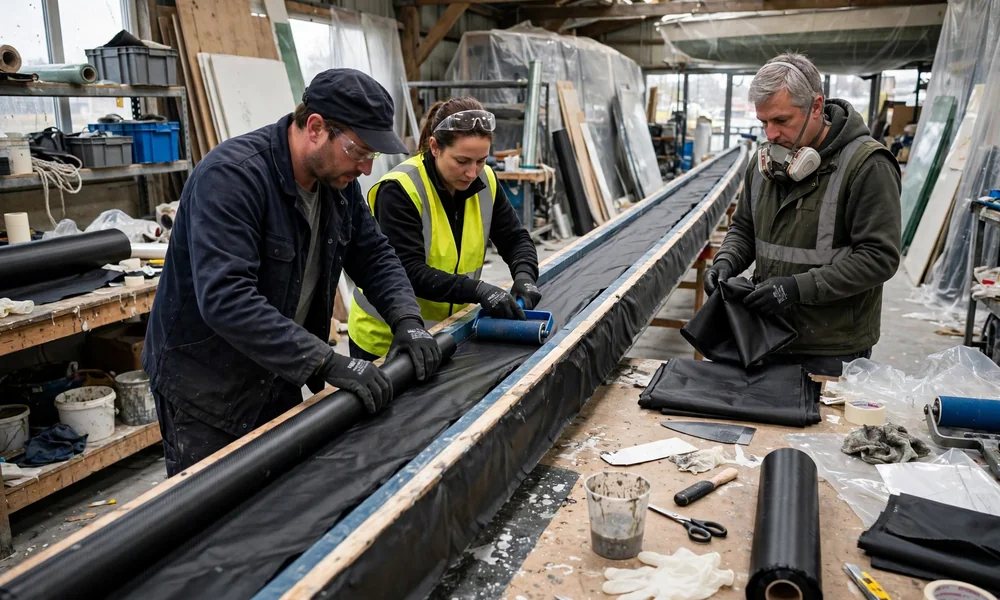
A carbon mast is built like a giant piece of sculpture. Carbon fibre cloth, pre-impregnated with resin, is laid by hand into a long mould — sometimes in two halves that are joined later, sometimes as a single piece around a mandrel. The layup schedule, the exact number and direction of each layer, is the mast’s engineering: more lengthwise fibre where compression is high, more hoop fibre where the rigging attaches. The whole assembly is then cured in a large oven or autoclave, hardening the resin into a single rigid structure.
Step 5: Fittings and rigging
A bare tube is useless without fittings — the spreaders that hold the rigging out, the track the mainsail slides up, the halyard exits, and the masthead crane. On a carbon mast these are bonded or bolted on with care, because drilling a hole in carbon creates a weak point that can spread. Fittings are often bonded with structural adhesive and reinforced with extra fibre patches, and stainless steel parts are isolated to prevent galvanic corrosion between the carbon and the metal. The rigging itself, and the sails it carries, is covered in our guide to yacht sail rigging materials, where every line has a job.
Step 6: Inspection and lifespan
Carbon does not rust or fatigue the way aluminium does, but it can hide damage. A hard impact — a dropped winch handle, a collision with a dock — can crack fibres under the surface while the outside looks fine. So carbon masts are inspected regularly with tap testing, listening for the dull thud that marks delamination, and sometimes with ultrasound. A well-looked-after carbon mast can last decades, and its stability in a seaway is helped by the same systems that keep the boat level, including the gyroscopic stabilizers that smooth the ride below deck.
Yacht Carbon Mast Specs
| Specification | Typical range |
|---|---|
| Height | 15 to 40 metres above deck |
| Weight | 150 to 800 kilograms |
| Weight saving vs aluminium | 40 to 60 percent |
| Material | Carbon fibre with epoxy resin |
| Wall thickness | 8 to 30 millimetres, tapering with height |
| Deflection under load | Up to 1 metre at the masthead in a gust |
| Compression load | 10 to 60 tonnes |
| UV protection | Clear coat or painted finish |
| Service life | 20 to 30 years with inspection |
What Does a Carbon Mast Cost?
A carbon mast is one of the most expensive single parts of a yacht, and the price climbs steeply with height. A carbon mast for a 40-foot cruising yacht is estimated at $30,000 to $60,000, one for a 60-foot performance yacht at $80,000 to $200,000, and a superyacht mast at $500,000 to well over $1 million. Prices are estimates only and vary with length, fittings, and the builder. The saving in weight aloft is worth it for racing and performance cruising, but for a casual cruiser the aluminium mast it replaces often does the job at a fraction of the price.
A Rare Fact
The first carbon masts appeared on racing yachts in the 1980s, and they were so fragile that crews carried a spare aluminium mast on deck for long ocean races — just in case. The early carbon tubes could fail without warning if they were hit or overloaded, and the technology was not trusted. It took two decades of better resins, better layup schedules, and better inspection before carbon masts became the standard on grand-prix racers and then on production performance yachts. Today, a carbon mast is one of the most reliable parts of the boat — the spare on deck is long gone.

A carbon mast looks like a black pole and behaves like a spring — bending in a gust, springing back, and carrying a sail plan that a heavier mast could never support. Learn to read its numbers, and the way a yacht seems to shrug off a gust stops being a mystery.