There was a time when a cruise ship was a ship that carried people on a voyage. Today the largest cruise ships are floating resorts that happen to float, carrying several thousand passengers, with water parks, ice rinks, shopping streets and a dozen restaurants aboard. The industry celebrates each new record-breaker as progress. It is not progress. It is a scale that damages the places ships visit, crowds the experience it sells, and turns a journey by sea into a queue.
The case against giant cruise ships is not a case against cruising. A well-run cruise on a sensibly sized ship can be a fine holiday. The problem is the relentless growth: ships so large that ports must be rebuilt for them, towns must absorb thousands of visitors at once, and the sea itself becomes an afterthought. Bigger ships do not deliver a better holiday. They deliver a bigger version of the same holiday, with more of the drawbacks.

Ports and towns pay the price
A giant cruise ship does not just visit a port; it overwhelms it. When several thousand passengers step ashore at once, a small town’s streets, cafes, buses and toilets are suddenly full, and the people who live there cannot move through their own streets. The ship’s passengers spend a few hours, buy a few souvenirs, and leave.
Ports have to change to accommodate these ships, too. Quays are extended, channels are dredged deeper, and terminals are built to process thousands of people at a time. That work costs public money and reshapes the waterfront for a single industry. Some ports have started to push back, limiting ship numbers or ship size, and they are right to do so. A harbour that exists for one giant ship at a time has stopped being a harbour and become a car park for a floating hotel. The case for smaller cruise ships argues the other side of the same coin: ships that fit the places they visit are better for everyone, including the passengers.
The experience gets worse, not better
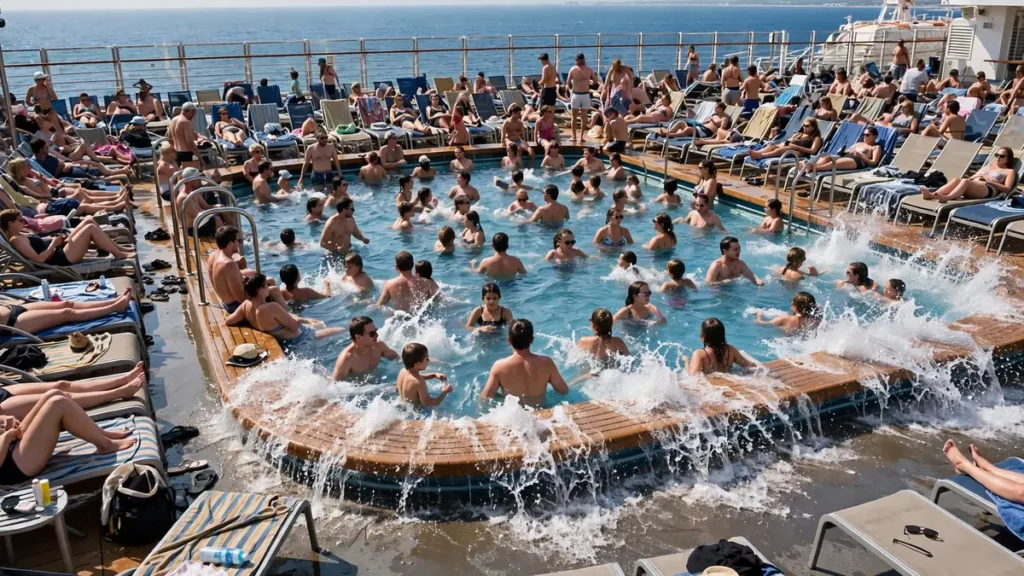
Everything a cruise sells — relaxation, space, service, a sense of escape — gets harder to deliver as the passenger count rises. On a giant ship, the pool is crowded, the buffet has a queue, the theatre needs booking days ahead, and the sun deck is a contest for loungers. The ship offers more facilities, but each one is shared with thousands of other people, so the experience of using them is worse than on a smaller ship with fewer facilities.
Service suffers in the same way. A crew can look after a few hundred passengers with real attention; looking after several thousand becomes industrial catering and crowd management. Passengers become cabin numbers, and the personal touches that make a voyage memorable disappear. The industry answers by adding more facilities, but the crowd grows to fill them, and the feeling of space never arrives.
The environmental load is concentrated
A large ship is efficient per passenger in some respects, and the industry is quick to say so. But efficiency per passenger is not the whole story. A giant cruise ship concentrates its impact in one place at one time: fuel burned, waste produced, and emissions released in a single port, on a single day, in a single bay. The total load on that one place is enormous, even if the arithmetic per passenger looks tidy.
Waste is the clearest example. Thousands of passengers produce a huge volume of sewage, grey water, food waste and rubbish in a few days, and all of it must be treated, stored or discharged. Modern ships have treatment systems, but the sheer scale leaves little margin for error. How cruise ship waste systems work shows the engineering involved, and it is impressive — but it is engineering built to cope with a problem the industry created by building ships this big in the first place. Smaller ships produce smaller problems, and smaller problems are easier to manage well.
Embarkation is a chore, not a holiday
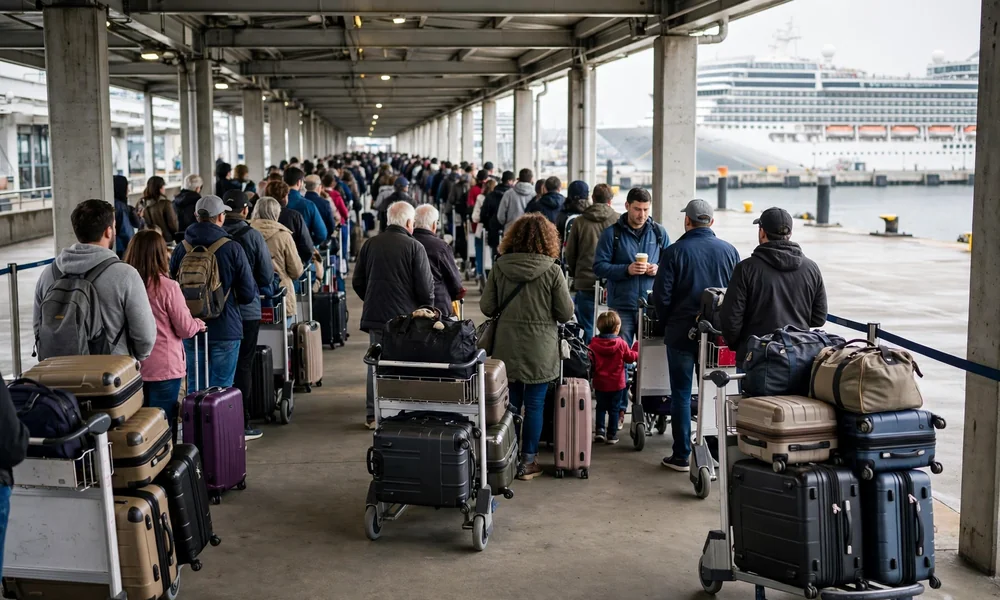
The holiday on a giant cruise ship begins with a queue. Thousands of passengers must be checked in, security-screened and boarded, which takes hours and requires a terminal the size of an airport. The same happens in reverse at the end, and again at every port, where passengers queue for tenders or gangways, wait for shore excursions to be called, and file back aboard in long lines.
That queuing is not a minor inconvenience; it shapes the whole holiday. Passengers plan their days around boarding times, excursion slots and dinner sittings, because a ship of this size cannot run on spontaneity. The freedom that a sea voyage promises — stepping ashore when you please, eating when you are hungry — is replaced by a timetable. A smaller ship boards in minutes, lets passengers come and go freely, and leaves the schedule to the passenger rather than the other way round.
When things go wrong, scale makes it worse
Every ship carries risks, and large ships carry them at large scale. An outbreak of illness spreads faster among thousands of people sharing dining rooms, lifts and pools. A mechanical failure strands thousands rather than hundreds. An evacuation, should one ever be needed, is a vastly harder operation from a ship carrying several thousand passengers and crew than from a smaller vessel.
None of this means giant ships are unsafe. They are built to strict rules and run by professionals. But the consequences of any incident grow with the number of people aboard, and a smaller ship never has to solve the problem of evacuating a small town at sea.

The honest counter-case
Giant cruise ships exist because passengers book them, and it would be dishonest to pretend they offer nothing. They offer choice: a dozen restaurants, shows every night, activities for every age, and a price per night that smaller ships struggle to match. For a family with children of different ages, or a first-time cruiser who wants everything in one place, that choice is genuinely attractive. The economies of scale are real, and they keep fares down.
They also offer stability in rough weather, and their size lets them carry facilities — a proper theatre, a large spa, a water park — that a smaller vessel cannot fit. For many passengers, the ship is the destination, and the ports are a bonus. That is a legitimate way to take a holiday, and millions of people enjoy it every year.
The verdict
Cruising does not need to be giant to be good. The best voyages are the ones where the ship fits the sea, the ports and the passengers, and a ship carrying several thousand people fits none of them well. It overwhelms towns, crowds its own decks, concentrates its waste, and turns boarding into an airport queue. The extra facilities it offers are real, but they are shared with so many people that the experience of them is poorer.
The industry should stop chasing the next size record and start chasing the best experience per passenger, which is a different race and one that smaller ships are already winning. Ports should keep setting limits, passengers should keep choosing ships they can actually enjoy, and the giant ship should be remembered as an experiment that went too far. The best cruise ship suites ranked shows how good a cabin can be — but even the finest suite cannot fix a ship that is simply too big for its own good.