Electric boats were supposed to make boating simpler. No gears to grind, no clutch to slip, no choke to fiddle with on a cold morning. Instead, many of them arrived with something stranger: a throttle that is not really a throttle at all, but a small electronic lever, or a slider on a touchscreen, or a dial that sends a signal to a computer that decides how much power the motor should make. It works, most of the time. But the case for a manual throttle in an electric boat is that a lever you can feel, with a definite position and a mechanical connection to the thing it controls, is still the best way to drive a boat, and giving it up was a mistake.
A throttle is not a volume knob. It is the skipper’s hand on the boat’s speed, and on a boat speed is everything: the difference between a clean docking and a crunch against the pontoon, between holding station in a current and being swept sideways, between a gentle wake past moored boats and an angry wave that rocks them all. The control that sets that speed should be immediate, predictable, and honest about where it is. A manual throttle is all three. An electronic one often is none of them.

Feel is information
The first thing a manual throttle gives you is feel. A good lever has weight to it, a detent at neutral you can find without looking, and resistance that grows as you push forward. The skipper knows where the throttle is by the position of their hand and the tension in their arm, without taking their eyes off the water. That matters most in the moments that matter most: coming alongside a pontoon in a crosswind, threading between moored boats, or holding the boat still while a passenger steps aboard. In those moments the skipper’s eyes are everywhere except the dashboard, and the throttle has to be readable by touch alone.
An electronic throttle gives back far less. A small lever with no resistance feels the same at idle and at full power. A touchscreen slider gives nothing at all: no position, no weight, no feedback, just a picture of a slider that may or may not be where your finger left it. The skipper ends up glancing down to check, and every glance down is a glance away from the boat’s path. On a crowded marina on a Saturday afternoon, those glances add up to the difference between a smooth arrival and an embarrassing one.
Precision is the other half of feel. Docking an electric boat is a game of small adjustments: a touch of power forward, a pause, a touch astern. A manual lever lets the skipper make those adjustments in tiny, repeatable steps, because the hand learns exactly how far to move for exactly how much thrust. How an electric boat motor works makes this easier, not harder: an electric motor answers instantly, with full torque from a standstill, so a small movement of the lever gives a small, immediate response. The motor is ready for fine control. The throttle should be too.
A lever fails gracefully
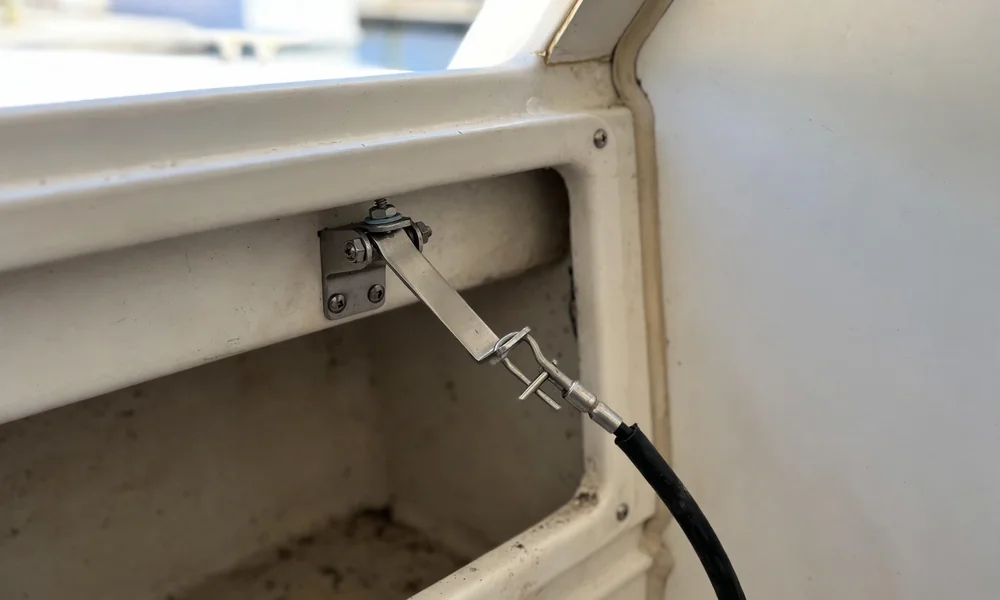
The second argument is about failure, and it is the one that should worry every boat owner. An electronic throttle depends on a chain of things working: a sensor, a wire, a controller, software, and power to all of them. If any link in that chain fails, the throttle can go dead, or worse, stick. A manual throttle, with a cable or a direct linkage, has far fewer ways to fail, and the ways it does fail tend to be gradual and obvious: a cable stiffens, a pivot loosens, and the skipper notices long before it becomes a problem.
That difference matters at sea in a way it does not matter on land. A car with a dead throttle can coast to the side of the road. A boat with a dead throttle in a tidal channel, or approaching a lock, or crossing a busy fairway, has no safe place to stop. It is drifting, and the current decides where it goes. A throttle that fails gracefully, that can be nursed, jiggled, or worked around, is worth more than a throttle that is cleverer on the days it works and helpless on the day it does not.
There is also the question of who can fix it. A manual throttle can be understood, adjusted, and repaired by any competent marine mechanic with ordinary tools. An electronic throttle fault often means a diagnostic computer, a software update, a replacement sensor ordered from one supplier, and a bill that makes the owner wince. Boats live in damp, salty, vibrating environments that are unkind to electronics, and every electronic component is another thing to go wrong. The simplest control on the boat should be the one that breaks least and costs least to mend.
Muscle memory beats menus
The third argument is about the person driving. Boating is a physical skill, learned by doing, and the body remembers what the mind forgets. A skipper who has docked the same boat a hundred times does it by muscle memory: the hand knows the lever, the boat knows the response, and the whole manoeuvre happens without conscious thought. That is not a flaw in the system. It is the system working as it should. A manual throttle rewards that learning, because it is the same every time, in the same place, with the same feel.
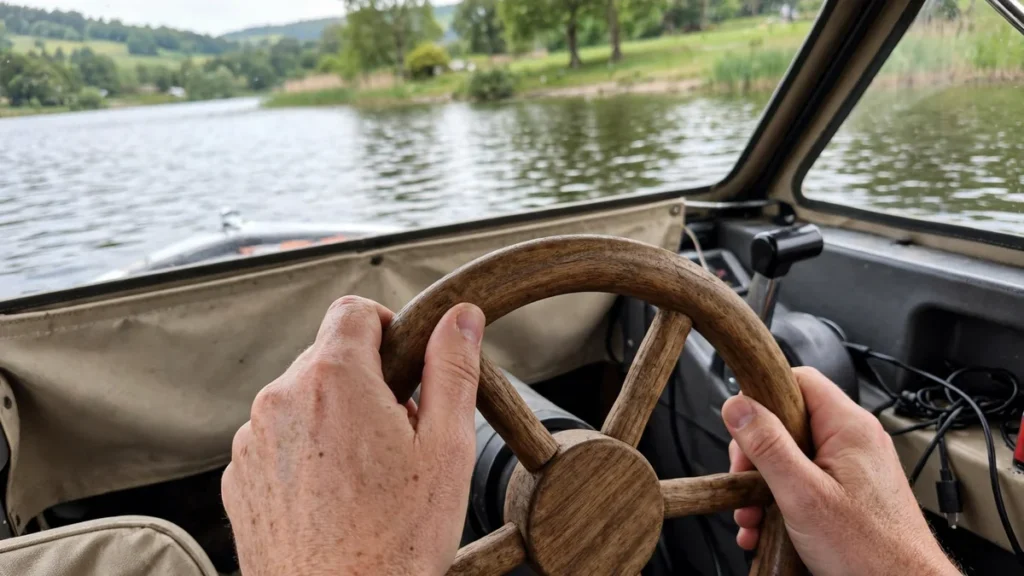
Electronic controls break that learning. A throttle whose response changes with a software update, or whose feel changes with a drive mode, or whose slider sits in a different place after a menu redesign, forces the skipper to relearn the boat. How electric boat steering works on a well-set-up boat follows the same principle: the wheel is always the wheel, in the same place, doing the same thing, so the skipper’s hands know it in the dark. The throttle deserves the same respect.
Cars have already had this argument, and the drivers won it. The case for physical buttons in cars is that a control you can find by feel is safer and faster than one buried in a screen, and the same logic holds on the water, where the skipper’s hands are wet, the boat is moving, and there is no time to look down. A boat is not a phone. Its controls should be built for hands, not for fingertips on glass.
The verdict
Manual throttles in electric boats are not nostalgia. They are the right control for the job: immediate, predictable, readable by touch, graceful in failure, and cheap to fix. The electric motor is a genuine advance, instant and silent and clean. It deserves a throttle that is just as honest, and a lever with a cable and a detent is the most honest control ever fitted to a boat.
Builders who fit electronic throttles to save a cable and a bracket are saving pennies and spending trust. Give the skipper a lever they can feel, in the same place every time, and the boat becomes easier to drive, easier to dock, and easier to trust on the day something goes wrong. That is what a throttle is for, and a manual one does it better than anything that has replaced it.