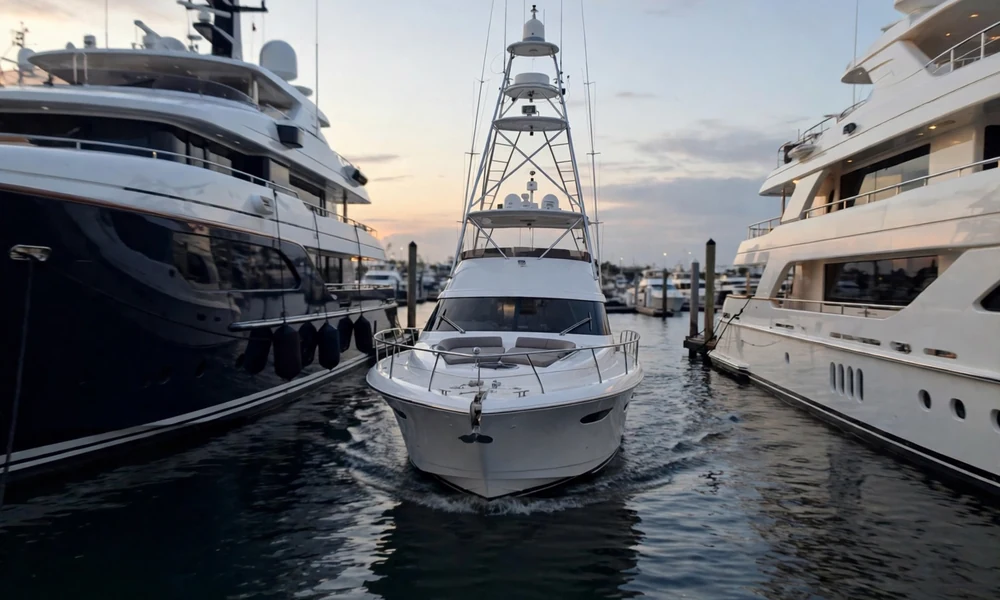
Imagine standing on the deck of a yacht that is steering itself. The helm is empty, the screens are alive with charts and sensor pictures, and the boat is easing into a berth between two superyachts without a hand on the wheel. It looks like the future, and it is, but the price of that future is the reason so few of these yachts exist. A luxury autonomous yacht can cost many millions more than a crewed yacht of the same size.
The extra cost is not a single gadget. It is a whole second yacht hiding inside the first: sensors, computers, redundant systems, and years of testing, all wrapped in a hand-finished luxury interior. This guide explains why a luxury autonomous yacht is so expensive, and where the money goes.

Step 1: The sensors see everything, all the time
An autonomous yacht must see its surroundings better than a human crew, and that takes a wall of sensors. Radar, lidar, cameras, and sonar work together to build a picture of the sea around the yacht, tracking other vessels, buoys, the coastline, and floating debris. The sensors are marine grade, stabilised against the motion of the boat, and fitted in several places so that no single blind spot can hide a danger.
The sensor set alone can cost hundreds of thousands of dollars, and it needs cleaning, calibration, and protection from salt spray. The sensors must also work at night, in rain, and in bright glare, which rules out the cheap units used on land.
Step 2: The computers decide, and they must never fail
Behind the sensors sit the computers, and they are the brain of the yacht. They fuse the sensor pictures into one model of the world, plan a route, and steer the yacht along it, adjusting for wind, current, and other traffic. The software is written for the sea, not for a road, and it must handle situations no road vehicle ever meets, from a fishing net to a sudden squall.
The computers are duplicated, so that if one fails, another takes over without the yacht noticing. How autonomous yacht docking works shows one part of this system in action, and the whole-yacht version multiplies the complexity many times over.
Step 3: Testing takes years and costs millions
The largest hidden cost is testing. An autonomous yacht cannot be launched after a few sea trials; it must be proven in thousands of hours of sailing, in harbours, in open water, and in bad weather, with safety crews aboard watching every decision. The yard must log the data, fix the faults, and test again, and the cycle repeats for years before the yacht is trusted to sail alone.
The testing also involves lawyers, insurers, and regulators, because no country has simple rules for a yacht with no one at the helm. The builder must prove the yacht is safe, insure it against the unknown, and satisfy a different set of rules in every port it visits. The cost of that proof is written into the price of the first yachts, and it is one of the reasons they are so rare.
Step 4: Redundancy is built into everything
A crewed yacht can tolerate a failure, because a person can improvise. An autonomous yacht cannot, so everything important is doubled. Two steering systems, two power supplies, two navigation computers, and two sets of sensors mean that no single fault can leave the yacht helpless. The duplication adds weight, takes up space, and costs a fortune in parts and installation.
The yacht also carries a satellite link, so that a shore team can watch it and take control if needed, and the communication system must work far from land. The luxury autonomous car specifications, explained show the same doubling on land, and the sea version is harder still.
Step 5: The hull and the interior are still a luxury yacht
Underneath the technology, the yacht is still a luxury yacht, and it is priced like one. The hull is built from carbon fibre or advanced composites, the interior is hand-finished in wood, stone, and leather, and the cabins are designed for owners who expect superyacht comfort. The technology does not replace the luxury; it sits on top of it, and the owner pays for both.
The sensors and computers must also be hidden, so the yacht still looks like a yacht rather than a laboratory. The radar is faired into the mast, the cameras sit behind glass, and the computers are tucked into a cooled compartment below deck.
Step 6: Small numbers and specialist crews
The final reason is the simplest: almost nobody builds these yachts. A yard may build one autonomous yacht in several years, so there is no production line, no bulk buying, and no shared cost. The designers, the software engineers, and the test crews are paid for years, and the cost of all of them lands on a single hull.
The owner must also employ specialists to maintain the yacht, because a normal boatyard cannot service its sensors and software. The case against autonomous yachts argues that the technology is not yet worth its cost, and the price tag is the heart of that argument. The yacht is a glimpse of the future, built by hand, in single figures.

Key specifications at a glance
| Item | Typical figure |
|---|---|
| Length | 20 to 30 metres |
| Sensors | Radar, lidar, cameras, sonar, duplicated |
| Computers | Redundant navigation computers with shore link |
| Propulsion | Electric or hybrid, 200 to 400 kilowatts |
| Cruising speed | 8 to 10 knots |
| Build and test time | 3 years or more |
| Guests | 8 to 12, with minimal crew aboard |
What a luxury autonomous yacht costs
As an estimate, a new luxury autonomous yacht typically costs between 10 million and 25 million dollars, depending on size, sensor fit, and the level of autonomy. The sensors and computers can account for several million dollars of that total, the testing and certification for more, and the luxury hull and interior for the rest. The running costs include specialist maintenance and a shore team on call, so the yacht stays expensive long after it is bought.
A rare fact
Here is a rare fact: the first luxury autonomous yachts spend most of their sea trials with a full crew aboard, watching the computers work and ready to take over at any moment, which means the yacht built to sail without a crew is tested by the largest crew a yacht can carry. The crew logs every decision the computer makes, and the yacht only earns its autonomy after thousands of hours of being watched. The future, it turns out, arrives with an audience.
The expense of a luxury autonomous yacht is the cost of a second yacht hidden inside the first: sensors that never blink, computers that never fail, years of testing, and everything doubled for safety, all wrapped in a luxury hull built in single figures. Take the autonomy away and the yacht becomes far cheaper, but it also becomes an ordinary yacht. The price is the future, built by hand, and charged in full.