There is a number that hypercar makers love to announce, and it is the wrong number. Not the weight. Not the lap time. The top speed. Two hundred and fifty miles per hour. Two hundred and sixty. Three hundred, claimed, on a car you can buy and drive to the shops. The Bugatti Chiron is limited to 261 miles per hour. The Rimac Nevera, an electric car with 1,914 horsepower, tops out at 258. The Koenigsegg Jesko claims more than 300. These are astonishing engineering achievements, and they are also, for the people who actually buy these cars, almost entirely useless. The case for slower hypercars is simple: a hypercar capped at 180 miles per hour would be a better car in every way that matters, and the industry should build it.
This is not an argument against fast cars. It is an argument against a number that has stopped meaning anything. No public road in the world allows a driver to legally exceed 200 miles per hour. On the autobahn, where some stretches have no limit, speeds over 200 are still rare and dangerous, and everywhere else the owner is breaking the law long before the car reaches its limit. A hypercar that can do 260 miles per hour is a car whose defining feature can never be used — not once, not legally, not anywhere its owner actually drives.

The speed you can actually use
Consider what a hypercar is actually for. The owner drives it on public roads, on a track day perhaps twice a year, and to events where it is admired. On a public road, the speeds that matter are zero to sixty, sixty to a hundred, and the way the car feels at the speeds the law allows. A car that reaches sixty in 2.4 seconds is already faster than almost anything else on the road. A car that reaches sixty in 1.85 seconds, like the Nevera, is faster than the driver’s reactions can fully exploit on a damp street.
Everything above 180 miles per hour is a different engineering problem from everything below it. To go from 180 to 260, a car needs longer gearing, active aerodynamics that reshape the body at speed, tyres rated for forces no road tyre should ever see, and cooling systems sized for an engine running flat out for minutes at a time. All of that weight and complexity stays on the car at every speed, including the speeds the owner actually drives at. The top-speed chase makes the car worse at the speeds that exist.
A slower hypercar — call it 180 miles per hour, with the same violent acceleration — could be lighter, simpler and more responsive. Shorter gearing would make it quicker where it counts, from a standstill to the speed limit and back. Smaller brakes could stop a lighter car just as well. The aero could be tuned for downforce and stability rather than for cheating the wind at speeds no tyre is truly happy at. The car would be more alive at 70 miles per hour, which is where it spends its life.
Weight is the enemy, and speed adds it
The second argument is weight. A car built to survive 260 miles per hour must be built like a vault. The Chiron weighs 4,358 pounds. The Nevera weighs 4,734 pounds, most of it battery. These are heavy cars, and weight is the enemy of everything a driver actually feels: steering, braking, changing direction, the way the car talks back through the seat.
The best materials for a hypercar chassis are carbon fibre and its cousins, and they are chosen precisely because they save weight — yet the top-speed requirement spends those savings before the driver ever feels them. A car capped at a lower speed could use the same materials to be genuinely light instead of merely less heavy. A lighter hypercar would brake shorter, turn sharper and feel more alive, and it would do all of that on ordinary roads, at ordinary speeds, every single day.
What the top-speed chase actually buys
Defenders of the top-speed race have a real point, and it should be heard. The chase drives engineering forward. The tyres, the aerodynamics, the cooling and the structural work that make 260 miles per hour possible do trickle down — into sports cars, into electric cars, into the ordinary machines the rest of us drive. The Veyron’s engineering taught the industry things about high-speed stability that no wind tunnel alone could teach. The record matters as a statement of what is possible.
But the dream has a cost, and the cost is paid in the driving. A car engineered around a number its owner can never use is a car engineered around a fantasy, and fantasies make poor handling. The best hypercar steering systems are the ones that talk to the driver at real speeds, and a car that is lighter and simpler steers better than a car carrying the armour of a top-speed run. The the best hypercar braking systems are the ones that stop a car repeatedly without fading, and a lighter car asks less of its brakes on every single stop.
The track day test
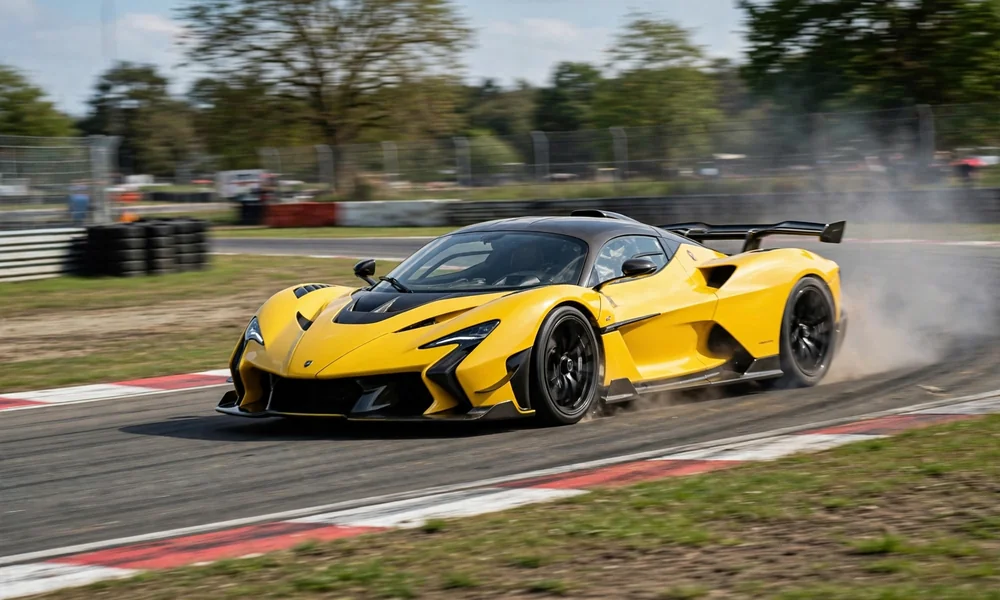
Take the strongest case for the fast hypercar: the track day. On a circuit, surely, the top speed matters. But even there, it matters less than the brochure suggests. Most circuits have one straight long enough for a top-speed run, and on that straight the car spends a few seconds at its maximum before braking hard for the next corner. The rest of the lap — the corners, the braking zones, the changes of direction — is where the lap time is made, and it is made by weight, grip and balance, not by top speed.
The fastest lap times in the world are set by cars that are light and balanced, not by cars with the highest top speed. A slower hypercar, lighter by hundreds of pounds, would be quicker around almost any circuit than its heavier, faster sibling — and it would be more fun to drive there, because its limits would be approachable instead of terrifying. The driver could explore the car instead of merely surviving it.
The hypercar that should exist
So what would the slower hypercar look like? It would still be a hypercar: a carbon-fibre body, a magnificent engine or a brilliant electric powertrain, acceleration that pins its occupants to their seats. It would simply stop chasing the last eighty miles per hour. Its top speed would be 180, maybe 190 — still far beyond any legal limit, still more than enough to feel extraordinary, but no longer the organising principle of the whole machine.

The verdict
The top-speed race has given the hypercar its mythology, but it has also given it weight, complexity and a defining number that no owner can ever use. A hypercar capped at 180 miles per hour would be lighter, sharper, cheaper and more enjoyable — a better car, not a lesser one. It is the same instinct behind the case for manual gearboxes in hypercars: control the driver can feel beats a number they cannot use. The industry should have the confidence to build it: the fastest car is not the one with the biggest number on the brochure, but the one that is most alive at the speeds where driving actually happens.


