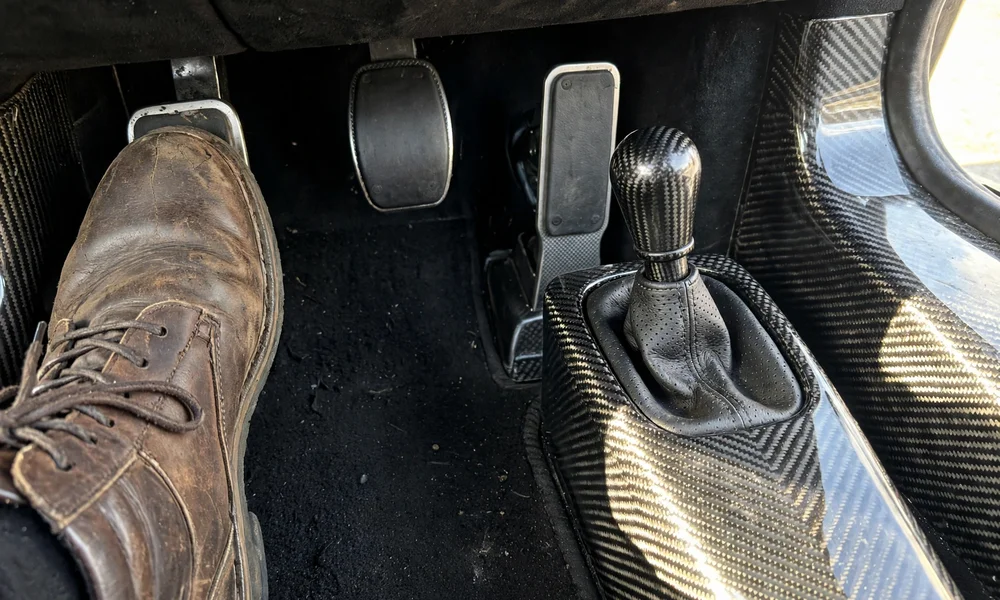
There is a moment, on a good road, when a hypercar stops being a specification sheet and starts being a conversation, and that moment has a clutch pedal in it. The left foot goes down, the right hand moves a lever through a metal gate, the engine note rises and falls with the driver’s own timing, and for a few seconds the car is not doing something to the driver. The driver is doing something to the car. That is the whole case for manual gearboxes in hypercars, and it is a case the industry keeps trying to close with a faster shift time, as if speed were the only thing a gearbox is for. It is not. A gearbox is also the place where the driver touches the machine, and a hypercar that removes that touch has removed the best part of itself.

The evidence is on the road, not the spreadsheet
Look at the cars that still offer a manual, and the pattern is impossible to ignore. The Gordon Murray T.50 pairs a naturally aspirated Cosworth V12 that revs to twelve thousand one hundred revolutions per minute with a six-speed manual gearbox, in a car that weighs about nine hundred and ninety-seven kilograms and makes six hundred and sixty-three horsepower. It is, by the judgement of almost everyone who has driven it, one of the defining cars of its era, and the manual is not a nostalgic extra. It is the point. The engine is the voice and the gearbox is the conversation, and Murray understood that a car built around the driver has to let the driver do the driving.
The Pagani Utopia tells the same story from the other end of the price list. Its twin-turbocharged V12 makes eight hundred and sixty-four horsepower, and buyers can choose a seven-speed manual developed with Xtrac, with an exposed linkage that Pagani treats as a piece of sculpture. More than seventy percent of Utopia buyers have chosen the manual, according to Pagani’s own commercial director, on a car where the alternative is a perfectly good automated gearbox. That is not a rounding error. It is a verdict, delivered by the richest and best-informed buyers in the world, that the manual is worth having even when it costs nothing extra and saves nothing on the stopwatch.
A manual makes a hypercar lighter, simpler and more honest
The engineering case is as strong as the emotional one. A manual gearbox is lighter than a dual-clutch unit, simpler to cool, simpler to service and harder to break in the ways that matter. Pagani has said plainly that a dual-clutch gearbox is too heavy for the Utopia and robs the driver of precise control, and the same logic runs through the T.50, where every gram was fought over. Hypercar gearbox specs show how much complexity a modern automated gearbox carries: multiple clutches, hydraulic actuators, cooling circuits and software that must be tuned for every mode. A manual carries a clutch, a set of gears and a lever. It is engineering you can understand by looking at it, and that understanding is part of the pleasure.
Simplicity is also durability. A dual-clutch gearbox that overheats in traffic, or that needs a software update to shift properly, is a familiar story to owners of high-performance cars. A manual gearbox, driven with respect, will outlast the car around it, and when it does need work, any good specialist can do it without a factory laptop. How a hypercar gearbox works explains the machinery inside both kinds, and the contrast is instructive. One is a machine. The other is a machine plus a computer pretending to be a driver. The manual trusts the driver. The automated gearbox replaces them, and then asks to be thanked for the speed.
The skill is the point
This is why the manual survives at the very top of the market while it dies everywhere else. A family hatchback does not need a manual, and nobody is arguing that it does. But a hypercar is not transport. It is a machine bought for the experience of operating it, and the experience of operating it is mostly the gearbox, the steering and the pedals. Remove one of those three and you have removed a third of the experience, and no amount of horsepower can buy it back. The case for analogue gauges in hypercars makes the same argument about the dashboard: the things you touch and read directly are the things that make a car feel alive, and the gearbox is the most direct touch of all.

The counter-argument, answered honestly
The honest counter-argument is speed, and it deserves respect. A dual-clutch gearbox will beat a manual around any circuit, by a margin no human can close, and in a racing car that is the end of the discussion. But a hypercar is not a racing car, and its owner is not a racing driver. The lap time that matters to a hypercar buyer is the one they set themselves, on a road they love, in a car they understand. The Koenigsegg CC850 tries to have it both ways, with a gearbox that can behave like a six-speed manual, clutch pedal and all, while remaining an automatic underneath. It is a brilliant piece of engineering, and it proves the point by imitation. If the manual experience were worthless, nobody would spend millions simulating it.
What manufacturers should do
The answer is simple, and it costs less than the industry pretends. Offer the manual as a real choice, not a grudging option buried in the configurator, and engineer the car around it from the start rather than bolting it on as an afterthought. A hypercar designed for a manual has a pedal box that fits three pedals, a gear lever placed where the hand falls naturally, and a clutch that is weighted for feel rather than for traffic. A hypercar designed for paddles and then given a manual as a concession will always feel like a compromise, and buyers will notice.
There is also a commercial case that the accountants should love. Manual hypercars hold their value better, because they are rarer and because the people who want them want them badly. A limited run of manual cars will sell out faster than the same run with paddles, and the second-hand market will reward the choice for decades. The manual is not a cost. It is a selling point, and the manufacturers who have understood that, Gordon Murray and Pagani above all, are the ones whose cars are talked about as the greats of their generation.
The verdict
Hypercars are the last place where driving still matters more than arriving, and the manual gearbox is the last control that makes the driver a participant rather than a passenger with a steering wheel. The dual-clutch gearbox is faster, cleverer and more efficient, and it is also, for the person who loves driving, less. Less involving, less satisfying and less memorable. The T.50 and the Utopia prove that the manual is not dead. It is waiting, in the hands of the few manufacturers brave enough to trust their customers with a clutch pedal. Buy the manual, learn it properly, and you will understand in one corner what a thousand horsepower figures can never tell you. The car is not fast because of you. It is fast with you, and that is the whole difference.


