On a freezing night, a firefighter walks into a smoke-filled building and sees straight through the darkness. Walls glow faintly, a doorway stands out, and the warm shape of a person appears behind a cloud of smoke that no torch could cut through. The firefighter is not seeing light at all. A thermal camera is reading heat itself, and the sensor inside it is built from materials so sensitive that they can feel the warmth of a hand from across a room.
The modern version fits in a phone case or a firefighter’s helmet. It works because of a wafer of exotic semiconductor that changes its electrical resistance the moment infrared radiation touches it. The materials in that wafer decide whether the camera sees a person or just a blur, and they are some of the strangest substances ever put into a consumer device.
The Materials Behind the Sensor
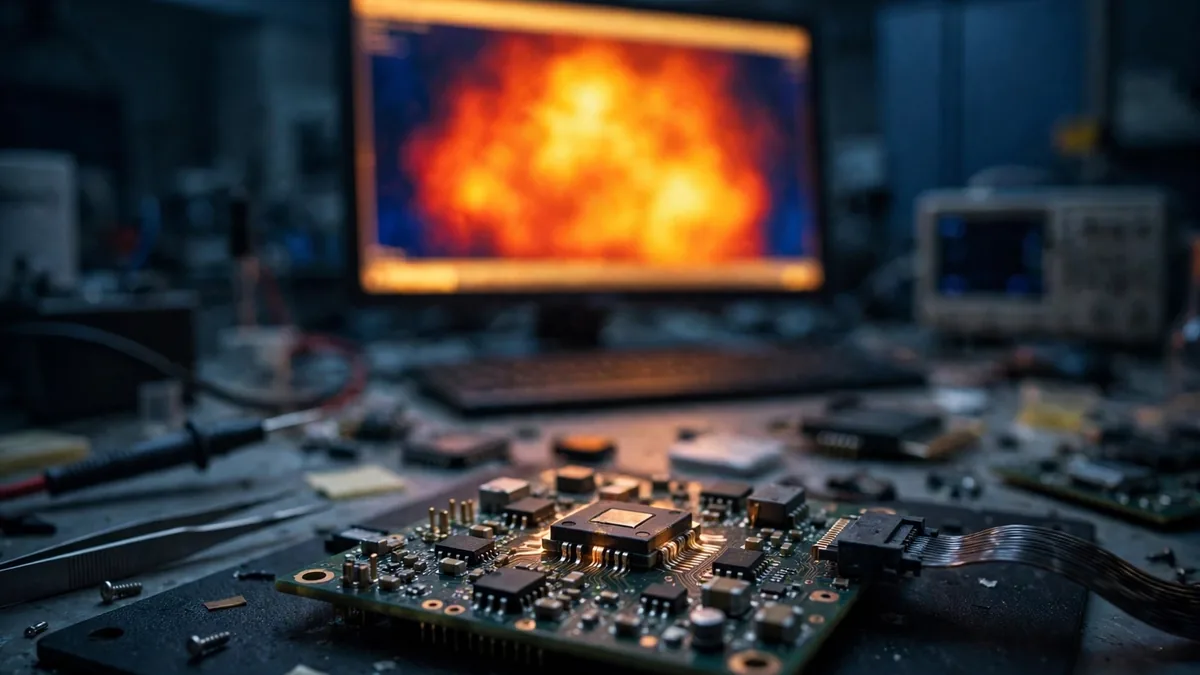
A thermal camera sensor, called a microbolometer, is built from materials chosen for one talent: feeling heat. Vanadium oxide is the most common sensing material, a ceramic whose electrical resistance changes sharply with temperature. Amorphous silicon is the alternative, cheaper and easier to make but slightly less sensitive. The sensing layer sits on a silicon readout chip, suspended on microscopic legs above a reflective cavity, and the whole array is sealed inside a vacuum package behind a germanium lens. Germanium was chosen because ordinary glass is opaque to infrared light, while germanium lets heat radiation pass through as clearly as window glass lets through daylight.
Step 1: Growing vanadium oxide on a silicon wafer
Everything starts on a silicon wafer, the same foundation used for computer chips. A thin film of vanadium oxide is deposited onto the wafer by sputtering, a process that knocks atoms off a vanadium target and lets them settle into a layer only a few hundred nanometres thick. Vanadium oxide was chosen because its resistance changes by about two percent for every degree of temperature change, a sensitivity no ordinary metal can match.
Step 2: Etching the microbolometer pixels
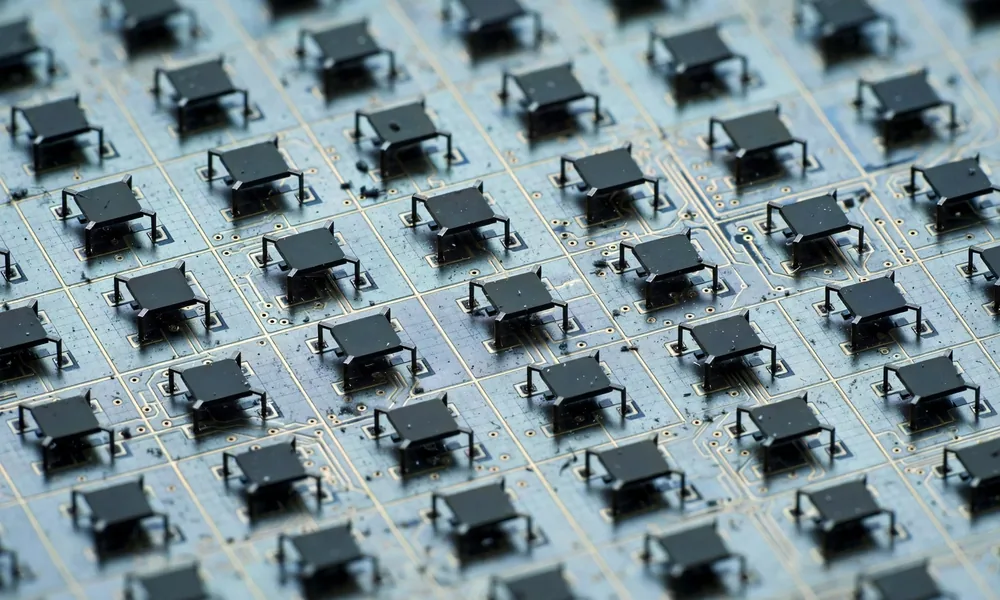
Photolithography and plasma etching then carve the film into a grid of tiny pixels, each one a miniature thermometer about twelve microns across. Each pixel is a thin membrane held above the wafer by two slender legs, like a trampoline. The legs are made from silicon nitride, a ceramic chosen because it is strong yet conducts almost no heat, so the warmth a pixel absorbs stays in the pixel instead of leaking away into the chip below.
Step 3: Building the readout circuit beneath
Under the pixel array sits a silicon readout chip, built with the same transistor technology as a phone processor. It measures the resistance of every pixel many times a second and turns those readings into a temperature map. Engineers bury the electronics deep in the silicon and keep the power consumption low, because a warm chip would blind its own sensor, just as a laser sensor must be shielded from its own stray light to see clearly.
Step 4: Sealing the sensor in a vacuum package
The pixel array is sealed inside a vacuum package, a metal or ceramic enclosure pumped down to remove all the air. Air would carry heat away from the pixels by conduction and convection, drowning the faint signal from the scene. The vacuum is held for the life of the camera by a getter, a small pellet of reactive metal that absorbs any gas that slowly leaks in.
Step 5: Fitting the germanium lens
Ordinary camera glass blocks infrared radiation completely, so a thermal camera needs a lens made from germanium, a silvery semiconductor that is transparent to heat. The lens is heavy and expensive, and it is the single most costly part of many thermal cameras. It is also the reason a thermal camera can see through smoke and darkness where a health sensor must sit against the skin to read anything at all: the germanium gathers heat radiation from metres away and focuses it onto the pixel array.
Step 6: Calibrating every pixel against a known temperature
Before the camera leaves the factory, it stares at a blackbody target, a plate held at a precisely known temperature, while the software records what every pixel reports. Pixels that read too hot or too cold are corrected in software, and a mechanical shutter inside the camera periodically closes to give the sensor a fresh reference during use.
Why These Materials Win
Vanadium oxide was chosen because its resistance responds to temperature more strongly than almost any other practical material, and because it can be deposited as a thin film on silicon. Silicon nitride was chosen for the support legs because it is strong, insulating and nearly transparent to heat flow. Germanium was chosen because it is one of the few materials that lets infrared radiation through while being hard enough to polish into a lens.
The trade-off is fragility and cost. Amorphous silicon sensors are cheaper but noisier, which is why they appear in budget cameras while vanadium oxide dominates professional ones. It is the same balance of cost and performance that decides why a phone camera lens costs what it does: the material that sees best is rarely the cheapest.
Specifications
| Specification | Detail |
|---|---|
| Sensor type | Uncooled microbolometer array |
| Sensing material | Vanadium oxide (VOx) or amorphous silicon |
| Pixel size | About 12 microns |
| Resolution | 160 x 120 to 640 x 512 pixels |
| Spectral range | 7.5 to 14 microns (long-wave infrared) |
| Temperature sensitivity | Below 0.05 degrees Celsius |
| Support legs | Silicon nitride membranes |
| Lens material | Germanium with diamond-like carbon coating |
| Package | Hermetic vacuum enclosure with getter |
| Frame rate | Up to 60 frames per second |
Price
Thermal cameras span an enormous price range. A clip-on phone accessory such as the FLIR One Pro sells for around 450 dollars (estimate), while a professional handheld camera such as the FLIR C5 costs roughly 700 dollars (estimate). Industrial and firefighting cameras with larger germanium lenses and higher resolution run from 2,000 to 10,000 dollars (estimate).

Rare Fact
A thermal camera sensor can detect a temperature difference of less than a twentieth of a degree Celsius, which is sensitive enough to see the faint warmth left on a chair by someone who stood up a minute earlier. The trick is the vacuum: with no air to carry heat away, even the whisper of warmth from a distant hand is enough to change the pixel’s resistance and paint a picture out of heat itself.
That is the quiet marvel of the thermal camera sensor: a grid of ceramic membranes, each one a thermometer finer than a hair, sealed in a vacuum behind a lens of germanium, reading the invisible world of heat. The materials are exotic, the engineering is delicate, and the result is a camera that sees what no eye ever could.


