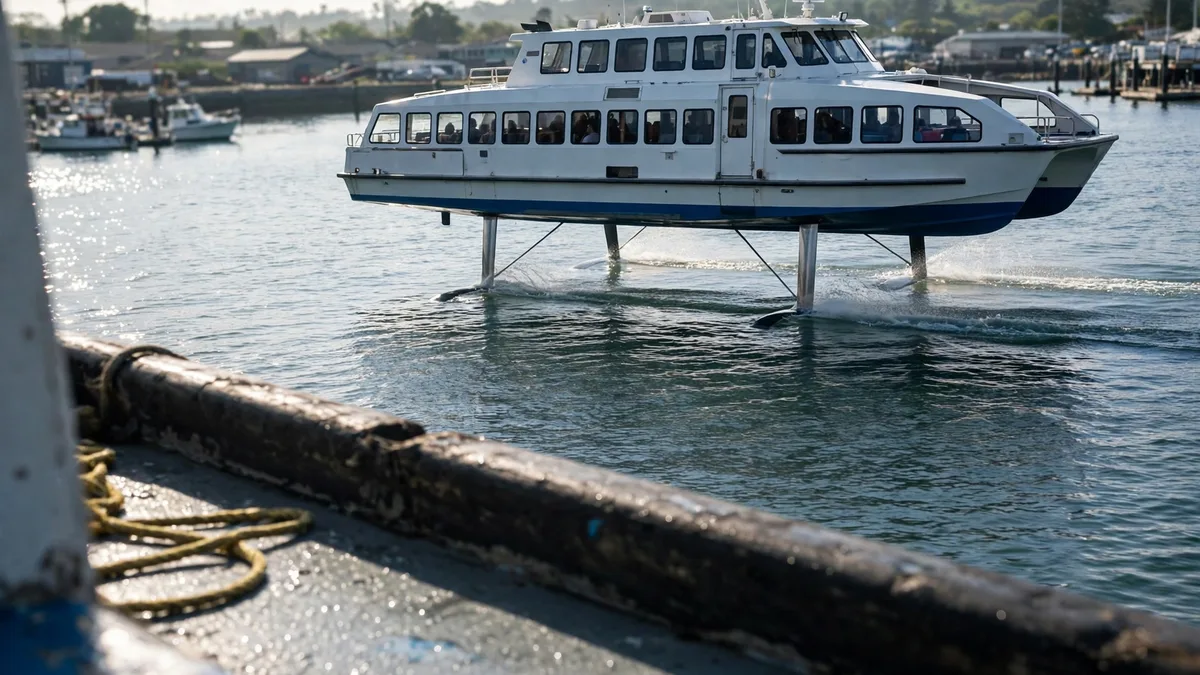
On a calm morning in a busy harbour, a ferry pulls away from the quay and something odd happens. At first it pushes through the water like any other boat, bow wave rolling, hull dragging. Then, as it gathers speed, the whole hull rises clear of the surface and the boat seems to fly, skimming along on two thin struts with only a whisper of spray behind it. Passengers feel the ride go suddenly smooth, as if the sea had turned to glass. Nothing about the engine has changed. What has changed is what is touching the water.
The reason it matters is simple. Water is about eight hundred times denser than air, so dragging a hull through it takes an enormous amount of energy. Most of a boat’s fuel goes into pushing water aside. Lift the hull out, and that drag mostly disappears. A hydrofoil ferry can cruise faster, burn less fuel for its speed, and cut through chop that would have slower boats pitching and rolling. That is why the idea keeps coming back, from racing sailboats to commuter ferries to the electric boats now appearing on city waterways.
What a Hydrofoil Actually Is
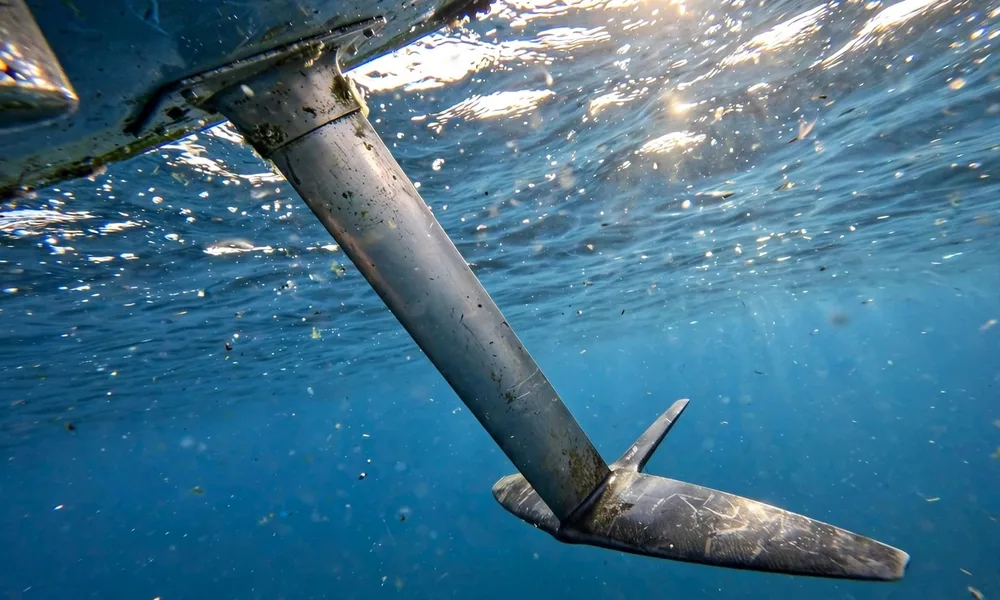
Strip away the boat, and a hydrofoil is a shaped blade, usually made of steel, aluminium, or carbon fibre, with a curved top surface and a flatter underside, just like an aircraft wing. It is mounted at the bottom of one or more struts that hang down from the hull. At low speed it does nothing much at all; the boat floats on its hull like any other. But as water flows faster over the foil, pressure falls above it and rises below it, and the difference pushes the foil upward. When that upward push, called lift, grows stronger than the weight of the boat, the hull rises out of the water.
Once the hull is clear, only the foils and the thin struts are still in the water. The wetted area — the amount of surface dragging through the sea — shrinks to a fraction of what it was. That is the whole secret. The boat is no longer a hull pushing water aside; it is a wing flying just beneath the surface, carrying the hull above it like a passenger. The crew often call the moment the hull breaks free “take-off”, and on a well-tuned boat you can feel it as a gentle step upward, followed by an eerie quiet.
How the Lift Is Controlled
Getting a boat up on its foils is only half the job. Keeping it there, level and steady, is the harder half, because the sea is never perfectly flat and the lift changes with speed. Early hydrofoils used fixed foils shaped so that lift fell away naturally as the foil rose toward the surface — a self-levelling trick, since a foil near the surface simply has less water above it to work with. If a wave lifted the boat, the foil rose, lift dropped, and the boat settled back down. It was simple, robust, and it worked, though it limited how fast and how smooth the ride could be.
Why the Hull Leaves the Water
The payoff for all this complexity is measured in three things: speed, comfort, and efficiency. A conventional ferry of a given size might cruise at twenty knots; its foiling equivalent can cruise at thirty-five or forty on similar power, because the drag it fights is so much smaller. For passengers, the gain is comfort: with the hull above the waves, the boat no longer slams into chop, and seasickness drops sharply.
Efficiency is the quieter argument, and lately the more important one. Because a foiling hull wastes so little energy on drag, it needs a smaller engine, or a smaller battery, to reach a given speed. That is why electric foiling ferries and water taxis are now appearing in cities: a battery that would give a conventional boat a short, slow range can give a foiling boat a useful working day. The same logic applies to the way stabilizer fins steady a yacht, where a small underwater surface does an outsized job of calming a much larger vessel. In both cases, a little wing in the water buys a lot of comfort above it.
The Different Kinds You Will Meet
Not all hydrofoils look alike, and the differences tell you what each one is for. The surface-piercing type, with its V-shaped foils breaking the surface, is the workhorse of ferry fleets: simple, self-stabilising, and happy to run all day with minimal fuss. The fully submerged type, with foils that stay deep and are controlled by flaps and sensors, is the choice for racing yachts and high-performance craft, where speed matters more than simplicity and a crew is on hand to manage the complexity.
Then there is the newest family, the electric foiling boats, which are smaller, lighter, and built around batteries rather than diesel. Their foils are often retractable, folding up for docking in shallow marinas, and their control systems are fully automatic: the passenger presses a button, the boat accelerates, takes off, and cruises with no input at all. They are a long way from the noisy experimental craft of the last century, and they point to where the technology is heading — not just faster ferries, but quieter, cleaner ones that fit into cities rather than just crossing open water.
Where You Find Them
Hydrofoils turn up wherever speed across water is worth paying for. Island ferry routes are the classic home: in the Mediterranean, in Southeast Asia, and on lakes and rivers around the world, foiling ferries have carried commuters for decades. The hulls themselves are still built the traditional way, as the guide to how a superyacht steel hull is made shows. Harbour services and water taxis use them where a fast, smooth crossing beats a slow, rolling one. And the military has experimented with them for patrol craft, for exactly the same reasons — speed and a stable platform in rough water.
The connection to the rest of a boat matters too. A foiling hull still needs a propeller, and the way that propeller is shaped and driven decides how efficiently the boat reaches take-off speed in the first place. The details are covered in the guide to yacht propeller specifications, and the same thinking applies: every part of the underwater package has to work together, because a foil that lifts beautifully is useless if the propeller cannot push the boat fast enough to make it fly.
What It Feels Like, and What Comes Next

A hydrofoil, in the end, is a reminder that the best engineering often works by subtraction. It does not add power to beat the water; it removes the boat from the water, and lets a small wing do the work instead. The hull is still there, carrying the passengers and the cargo, but for the fastest part of the journey it is just along for the ride, held up by physics, flying a few feet above the sea it used to plough through. That is a neat trick, and a century after it was first tried, it still feels like one.


