A luxury electric catamaran is a twin-hulled yacht driven by electric motors, built for owners who want space, stability and silence in equal measure. It has two hulls instead of one, a wide beam that gives it the living area of a much larger monohull, and a propulsion system that runs on batteries rather than diesel. The combination is becoming one of the most popular shapes in modern yachting.
The type is defined by three things at once: the catamaran hull form, the electric drivetrain, and the luxury fit-out. Take away any one of them and it becomes a different boat — a diesel catamaran, an electric monohull, or a working electric ferry. This explainer looks at what each part brings, and why the three work so well together.
The twin-hull advantage
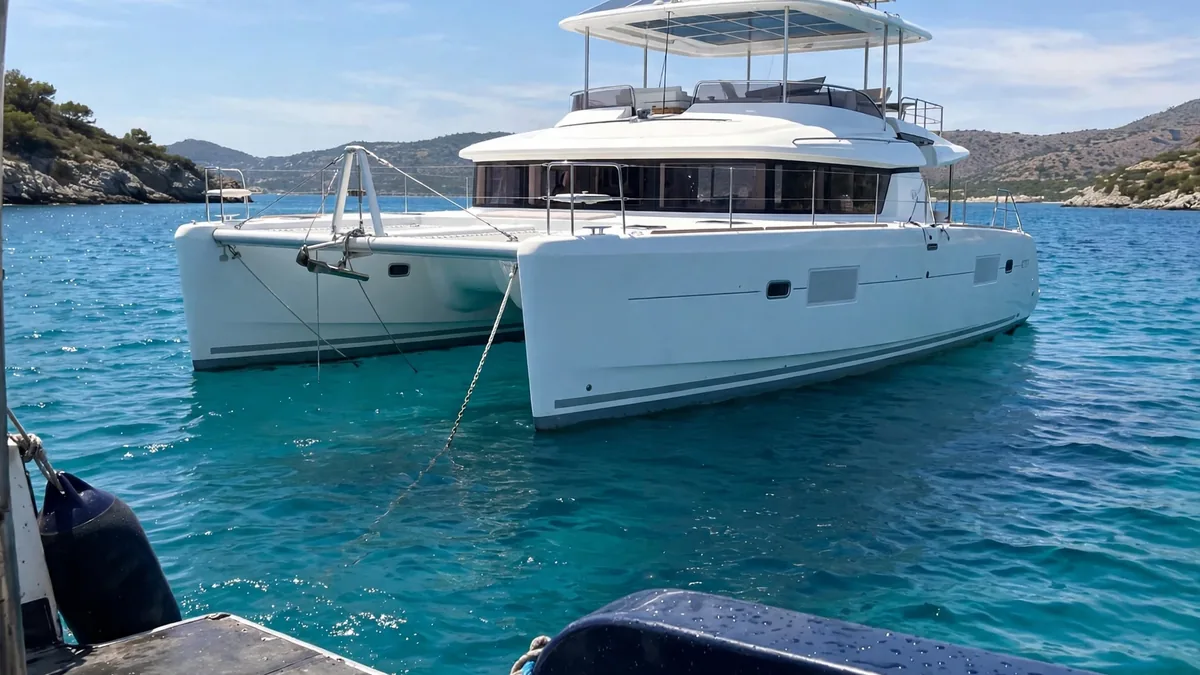
A catamaran’s two hulls give it a beam far wider than a monohull of the same length. That width becomes living space: a saloon that spans the full beam, cabins in each hull, and a cockpit that flows into the interior without steps. On a luxury model the saloon can feel like a small apartment, with a proper galley, a dining area and a lounge, all on one level.
The hull form also brings stability. A catamaran does not heel the way a monohull does, and it rolls far less at anchor, because the two hulls are spaced wide apart. Guests who dislike the motion of a single-hull yacht often find a catamaran far more comfortable. The shallow draught is a bonus: with no deep keel, the boat can anchor close to a beach in water a monohull could never enter.
There are trade-offs. A wide catamaran needs a wide berth, and marina fees are charged by the area the boat occupies, so berthing costs more. The structure that joins the two hulls — the bridge deck — has to be strong enough to resist the twisting forces of waves, which adds weight and engineering. And in a big confused sea, a catamaran can slam under the bridge deck, though modern designs keep the clearance high to reduce this.
The electric drivetrain
The propulsion on a luxury electric catamaran is usually one electric motor in each hull, driving a propeller or a saildrive leg. Two motors give redundancy — if one fails, the other can still bring the boat home — and they give precise control in a marina, because the skipper can drive one hull forward and the other astern to turn the boat in its own length.
Power comes from a large lithium battery bank, usually housed low in the hulls, with solar panels on the roof and a diesel generator as backup. The solar array tops the bank up at anchor and stretches the range under way, while the generator covers long passages or cloudy weeks. Some owners run the boat as a pure electric day boat, charging from shore power; others treat it as a hybrid, using the generator for the passages and the battery for silent running inshore.
Charging is part of daily life with the boat. In a marina the battery refills from shore power overnight, and a full charge from a standard pedestal takes several hours, depending on the size of the bank. At anchor the solar panels do the work, and an energy management screen shows the owner exactly what is coming in from the sun, what the air conditioning is using, and how many hours of motoring remain. That visibility changes how people use the boat: they learn to run the water-maker at midday when the sun is strongest, and to save the battery for the evening.
Speed and range follow the same rule as every electric boat: slow is efficient, fast is expensive. A luxury electric catamaran cruises happily at six to eight knots on battery power, with a range measured in tens of nautical miles. Push it to fifteen knots and the power draw climbs steeply, draining the bank quickly. Owners plan around this, treating the electric range as the daily cruising budget and the generator as the reserve.

Life on board
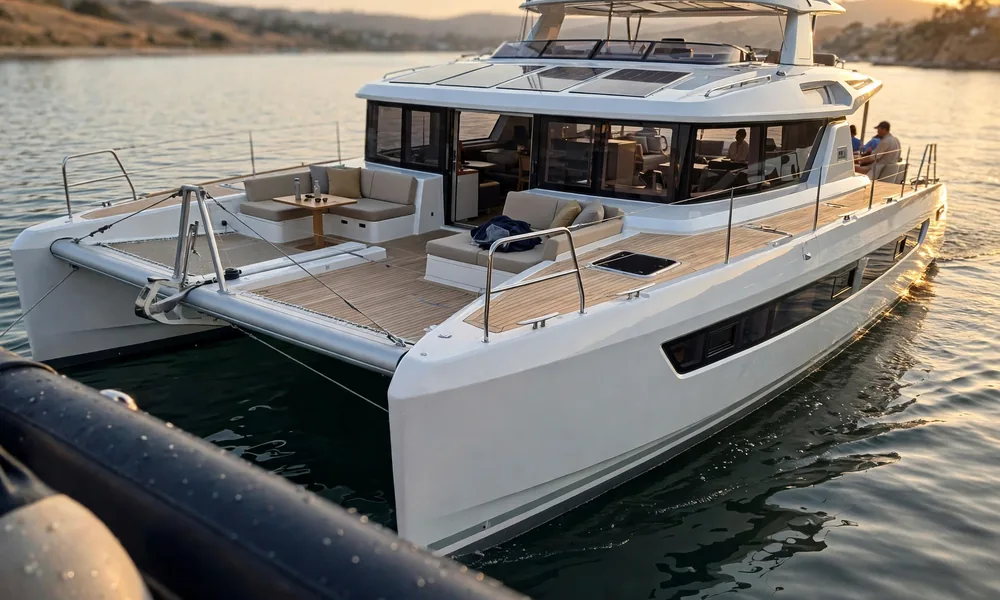
The luxury part of the name is about more than size. These yachts are fitted like a high-end apartment: large windows, pale woods, stone worktops, proper beds rather than bunks, and air conditioning that runs silently off the battery at anchor. The galley is big enough to cook properly, the cabins have standing headroom and en-suite bathrooms, and the flybridge adds a second living area above.
The electric drivetrain changes the atmosphere as much as the layout does. At anchor there is no generator rumble unless the owner chooses to run it, and under way at low speed the boat is almost silent. That quiet suits the way these boats are used: slow mornings in a bay, a swim off the stern platform between the hulls, and evenings with the lights on and the battery topped up by the day’s sun.
The stern platform deserves a mention, because it is one of the best features of the type. Between the two hulls, at water level, sits a wide platform that makes getting in and out of the water easy, and it is the natural place for a tender, paddleboards and diving gear. On a luxury model it is often fitted with a hydraulic lift, so the tender can be launched without a crane.
Who it suits — and who it does not
A luxury electric catamaran suits an owner who cruises slowly in warm, sunny waters, values space and stability over speed, and spends most nights at anchor rather than in a marina. It suits families, because the cabins are separate and the deck is safe for children, and it suits charter operators, because guests pay for space and quiet. It is also a good fit for owners who want to cut their fuel use without giving up comfort.
It does not suit everyone. An owner who wants to cross oceans at speed, or cruise in cold northern waters where the solar panels produce little in winter, will find the range limiting. A sailor who loves the heel and feel of a monohull will find a catamaran’s flat, level ride dull. And the purchase price is high: two hulls, a big battery bank and a luxury fit-out cost more than a comparable monohull, though the running costs are lower.
The Takeaway
A luxury electric catamaran is a twin-hulled yacht with an electric drivetrain and a high-end fit-out: the two hulls give it space, stability and shallow draught, the batteries and motors give it silent running, and the luxury interior makes it a floating apartment. Its honest limits are speed, range and price, but for slow cruising in sunny waters it is hard to beat. The brands building them are ranked in the best electric catamaran brands ranked, the hull form itself is explained in what a twin-hull catamaran is, and the electric systems in how an electric catamaran works.


