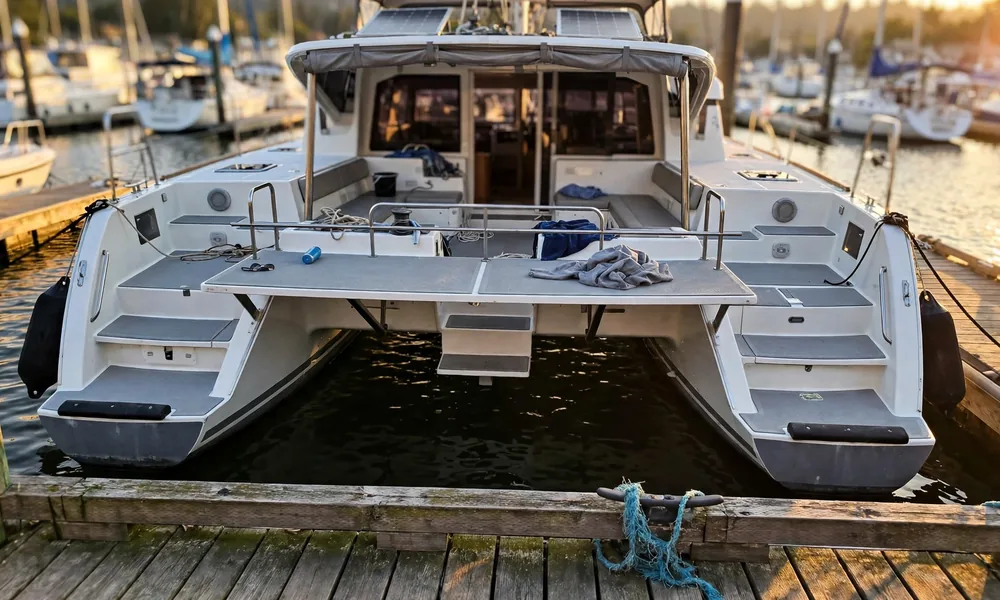
A catamaran looks wrong the first time you see one. A boat is supposed to have one hull, and a catamaran has two, joined by a deck that bridges across the gap between them like a tabletop on two legs. It looks as if it should be unstable, or awkward, or both. In practice it is the opposite: the twin-hull layout is one of the most stable, spacious and efficient ways to build a boat, and it has moved from racing and charter fleets into the mainstream of cruising, ferries and superyachts.
The name comes from the Tamil word kattumaram, meaning tied logs, and the idea is ancient: two narrow hulls lashed together. A modern catamaran is a long way from tied logs, but the physics is the same. Each hull is long and narrow, so it slips through the water easily, and the distance between the two hulls gives the boat its stability. Understanding a catamaran means understanding that trade: narrow hulls for speed and efficiency, wide spacing for stability and space.

Two narrow hulls instead of one wide one
A single-hull boat, a monohull, gets its stability from a heavy keel hanging below it, which pulls the boat upright whenever it heels over. A catamaran has no keel. Instead it gets its stability from its width. The two hulls are far apart, so when a wave or a gust tries to tip the boat, the hull on the rising side has to lift a long way out of the water, and the weight of the boat resists that. Engineers call this form stability, and it works without any ballast at all, which is why a catamaran can be much lighter than a monohull of the same size.
That somewhere else is the bridgedeck, the structure that spans the gap between the hulls. On a cruising catamaran the bridgedeck holds the saloon and the cockpit, giving a single level living space as wide as the whole boat. The result is a boat that feels more like a small apartment than a boat: a wide saloon, a big cockpit, and cabins in each hull. It is the main reason families and charter companies love them, and the main reason a catamaran of a given length feels far bigger inside than a monohull.
Stability: the great advantage
The most obvious difference when you step aboard a catamaran is that it barely heels. A monohull under sail leans over, sometimes steeply, and everything inside slides and tilts. A catamaran stays almost level, because its stability comes from width rather than weight, and the two hulls resist rolling together. At anchor the difference is even more obvious: a catamaran sits flat while a monohull rolls from side to side in a swell, and people who get seasick on monohulls often feel fine on a catamaran.
That flatness has a limit, and it is important to be honest about it. A monohull that is knocked over will usually right itself, because the heavy keel pulls it back upright. A catamaran has no keel to do that, and if it is capsized it stays upside down. Modern cruising catamarans are designed so that capsizing takes an extreme event, far beyond normal sailing, and their wide beam makes it very hard to reach that point, but the difference in recovery is real and it shapes how catamarans are sailed: conservatively, with the sails reefed early, rather than pushed to the edge.
Space and layout
Space is where the twin-hull layout wins outright. The bridgedeck gives a saloon the full width of the boat, and the hulls give private cabins at each corner, usually four cabins on a cruising catamaran, each with its own head. Two families can share a boat and barely meet, which is why catamarans dominate the charter market. The cockpit is wide too, and it connects to the saloon on one level, so the whole boat feels open in a way a monohull, with its narrow cockpit and companionway steps, cannot match.

The trade-offs: wind, draft and cost
A catamaran’s shallow draft is one of its quiet advantages. With no keel, a cruising catamaran may draw a metre or less, compared with two metres or more for a monohull of the same size. That opens up anchorages a monohull cannot enter, lets the boat sit on a beach at low tide, and makes it easier to explore shallow coasts. The hulls are also less likely to snag a rope or a fishing net, because there is nothing hanging below them except the rudders and the saildrives.
Cost is the last trade-off. A catamaran uses roughly twice the hull material of a monohull, needs two engines, two rudders and two of many systems, and costs more to build, to berth and to maintain. Buyers pay for the space and the stability, and they accept the higher price because nothing else gives the same combination. The electric versions of the layout show the same logic at work, and the best electric catamaran brands ranked show how builders are applying twin-hull thinking to battery power.
Power, sail and hybrid cousins
Catamarans come in sailing and power versions, and the twin-hull layout suits both. A sailing catamaran carries its rig on the bridgedeck, and because the boat stays level, the sails work efficiently and the crew stays comfortable. A power catamaran uses the narrow hulls to cruise fast on modest power, and it is popular as a ferry, a workboat and a long-range cruiser. Some of the fastest ferries in service are power catamarans, and some of the most comfortable long-range cruisers are too.
It is worth keeping the hull form separate from the propulsion. A catamaran can be powered by diesel, by sails, by electric motors or by a combination, and the hulls do not care which. That distinction matters because a catamaran with hybrid propulsion is a different subject from a catamaran as a hull shape, and the two are often confused. The propulsion question is covered in its own right in what a hybrid catamaran is, which looks at how diesel and electric drive work together on a twin-hull boat.
Who a catamaran suits
A catamaran suits anyone who values space and a level deck over the traditional feel of a monohull. Families, charter crews, liveaboards and anyone who gets seasick will notice the difference on the first day. It suits shallow cruising grounds, warm climates where the big cockpit is used all day, and owners who want to anchor where monohulls cannot. It suits less the sailor who loves the heel of a monohull, the feel of a keel, and the ability to squeeze into a narrow marina berth anywhere in the world.
The layout is not a gimmick and not a compromise. It is a different answer to the same question every boat designer faces: how to carry people across the water safely, quickly and comfortably. The monohull answers with a deep keel and a single hull. The catamaran answers with two narrow hulls and a bridge between them, and for a growing number of owners that answer is the better one. For a wider view of how the layout fits into the electric future, the best electric boat brands ranked include several twin-hull builders among the most interesting names on the water.


