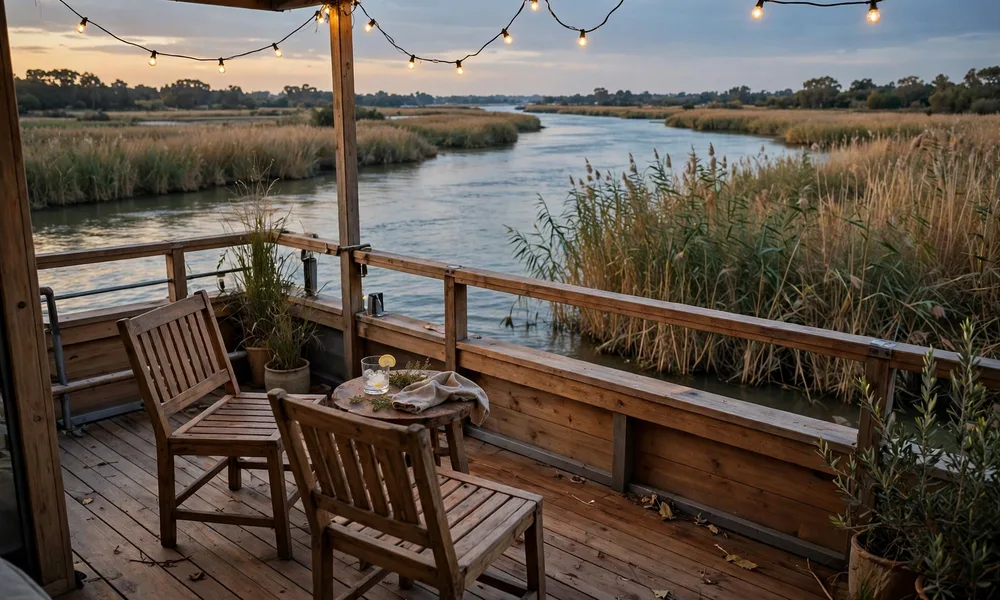
A luxury houseboat is a floating home built for comfort, not a boat with a bed squeezed in. It has the space, the fittings and the feel of a good apartment — a proper kitchen, a real bathroom, a bedroom you can stand up in, and a living area with windows on the water — but it floats, and it can move. The luxury part is not just the size or the price. It is the difference between a houseboat that happens to have a roof and one that was designed from the start to be lived in well, with the same attention to light, materials and quiet that a good house gets on land.

What makes it a houseboat, not just a boat
The defining feature of a houseboat is that it is a home first and a boat second. A yacht is designed to travel, with a hull shaped for speed and a cabin fitted around the machinery. A houseboat is designed to stay put, with a flat-bottomed hull that gives it a stable platform and a superstructure that is essentially a house built on top. The hull is wide and shallow, so the boat sits steadily in the water and the floor inside is flat and level. There is no engine room taking up the middle of the boat, no mast, and no rigging — the space that a yacht gives to sailing, a houseboat gives to living.
Inside a luxury houseboat
Step inside a luxury houseboat and the first thing you notice is the light. Large windows run along the sides, and the living area is usually open-plan, with the kitchen at one end and the seating at the other, so the water is visible from almost everywhere. The materials are chosen to feel like a home: solid wood floors, stone worktops, proper doors and wardrobes, and a bathroom with a full-size shower. The ceilings are high enough to stand in comfortably, which sounds like a small thing until you have spent time on a boat where you cannot.
The luxury touches are in the details. A houseboat built for comfort will have good insulation, so it is warm in winter and cool in summer without the heating or cooling running constantly. It will have double glazing, so the sound of rain on the roof is a patter rather than a drumbeat. It will have a washing machine, a dishwasher, and enough hot water for a long shower. The best luxury yacht interiors, ranked shows what happens when the same attention is paid to a yacht’s cabins, and a luxury houseboat borrows freely from that world — the same woods, the same fabrics, the same lighting — applied to a home that does not need to go fast.
Power, water and the practical systems
Living on a houseboat means managing the same services as a house, but with tanks and batteries instead of mains connections. Electricity usually comes from a combination of shore power at the mooring, solar panels on the roof, and a battery bank that stores power for the night. A well-set-up luxury houseboat can run its lights, fridge and laptops on solar for much of the year, with a generator or shore power as a backup for cloudy weeks and heavy loads. The inverter that turns battery power into mains power is one of the most important pieces of equipment on board, and it is sized to run everything at once.
Mooring and where it sits
A houseboat needs a mooring, and the mooring is half the decision. A residential mooring gives the owner a permanent place with water, electricity and a pump-out station, and usually a postal address. A leisure mooring is for boats that are used as holiday homes, and it may have fewer services. Some houseboats sit in marinas, alongside yachts and cruisers; others sit on riverbanks, in canal basins, or on quiet stretches of lake where the only neighbours are the birds. The mooring determines the view, the services, the cost, and often the rules about what the boat can look like and how it can be used.
Mooring costs vary enormously by location. A mooring on a popular stretch of river in a city can cost as much as a small flat to rent, while a mooring on a quiet canal in the countryside can be modest. Some moorings are owned outright, some are leased, and some are held on a licence that has to be renewed. Before buying a luxury houseboat, the mooring is the first thing to sort out, because a beautiful boat with nowhere to put it is a problem, not a home. The luxury research yacht faces the opposite problem — it is built to go anywhere and stay away for months — but the houseboat’s lesson is the reverse: pick the place first, and the boat second.
Houseboat or pontoon boat?
The confusion most often comes from the pontoon boat, which is also a flat-decked boat with a comfortable layout. The difference is purpose. A pontoon boat is a boat for a day on the water: it has an open deck, seating, and a powerful outboard, and it goes back to a trailer or a slip at the end of the day. A houseboat is a home: it has bedrooms, a kitchen, a bathroom, and the systems to live aboard for weeks or months. The luxury pontoon boat’s specifications show a craft built around its deck and its engine, while a houseboat is built around its rooms and its tanks. They share the flat-deck idea and little else, and they are bought by different people for different reasons.

Costs and the reality of owning one
A luxury houseboat is not a cheap way to live, and anyone who buys one to save money is likely to be disappointed. A new luxury houseboat typically costs as much as a small house in the same area, and a well-fitted used one is not far behind. Running costs include the mooring, insurance, maintenance of the hull and the systems, and the occasional lift-out for hull inspection and repainting. The hull needs to be checked regularly, because a leak in a houseboat is a leak in a home, and steel hulls need protection against rust while wooden hulls need protection against rot.
Who it is for
A luxury houseboat suits the person who wants a home with a view that no house can offer, and who is willing to trade a garden and a garage for a deck and a mooring. It suits people who work from home and can choose where they live, people who have retired and want to slow down, and people who love the water enough to live on it rather than visit it. It does not suit everyone: if you want a large garden, a driveway, or a house you can extend, a houseboat will frustrate you. If you want to wake up to the sound of water and eat breakfast looking at a river, it is hard to beat.