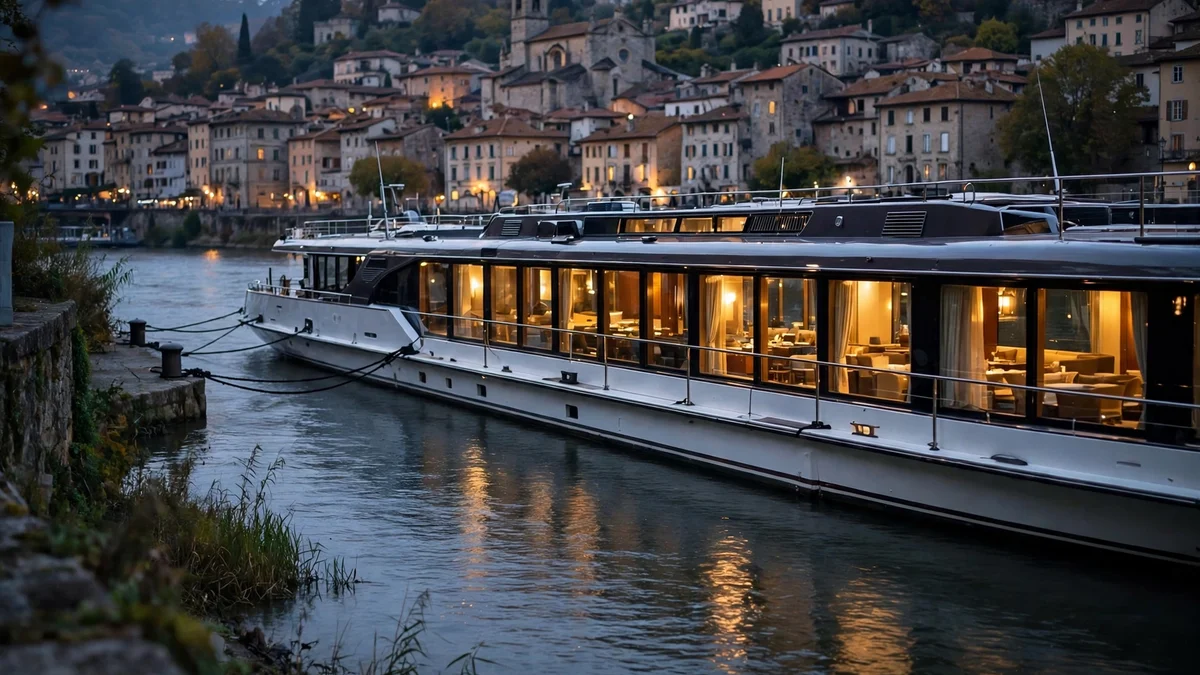
A luxury river cruiser is a ship built for rivers, not oceans, and built for comfort, not capacity. It is long and low, with wide windows, generous cabins, and a small number of passengers — usually somewhere between a hundred and two hundred — and it travels slowly through the heart of a country, stopping at towns and cities that ocean ships can never reach.
If you have seen a river cruise ship gliding past a cathedral or under an old stone bridge, you have seen a luxury river cruiser. It looks like a floating hotel, because that is what it is. But the details matter: the shallow draft, the low air draft, the quiet propulsion, and the itinerary are all engineered around the river itself. This guide explains what a luxury river cruiser is, how it differs from its cousins, and what life on board is actually like.
A ship shaped by the river
Every dimension of a luxury river cruiser is set by the river it sails. The hull is long and narrow, often around 135 metres long and just 11.5 metres wide, because that is the largest size that fits the locks on rivers like the Rhine, the Danube, and the Seine. The draft, the depth of the hull below the waterline, is shallow, often under two metres, so the ship can sail in low water in summer without grounding.
Inside, the layout is the opposite of an ocean cruise ship. There are no vast atriums and no thousand-seat theatres. Instead there is a single main restaurant, a lounge with panoramic windows, a small spa and fitness room, and cabins along the sides. The ship is designed so that the river is always visible, and the public rooms face outwards rather than inwards.
How a river cruiser differs from a canal boat
The closest relative of the river cruiser is the canal boat, and the two are easy to confuse, but they are built for different waters. A canal boat is small, narrow, and slow, made for canals a few metres wide, and it carries a handful of people. A river cruiser is a ship, many times larger, built for wide navigable rivers and carrying a hundred or more guests.
The experience differs just as much. A canal boat trip is hands-on: passengers often steer, work the locks, and moor up in the evening wherever they find space. A river cruiser is a fully crewed hotel: the crew navigates, the kitchen cooks, and the passengers watch the countryside from the lounge. What a luxury canal boat is covers the smaller craft in detail, and the contrast is the point — the canal boat is a cottage, the river cruiser is a hotel.
The cabins and the life on board
Cabins on a luxury river cruiser are small by hotel standards but generous by ship standards. Most are around 15 to 20 square metres, with a large window or a French balcony, a proper bed, a bathroom with a real shower, and storage that is cleverly fitted into every corner. The top suites are larger, sometimes with a separate sitting area and a full balcony.
The day on board follows a gentle rhythm. Breakfast is served as the ship sails, lunch is taken on deck or in the restaurant, and the afternoon is for the shore excursion: a walking tour of a town, a visit to a vineyard, a concert in a palace. In the evening there is dinner, often with local dishes and local wines, and then a talk, a tasting, or quiet time in the lounge as the river slides past.
Propulsion, power, and the quiet ship
Most luxury river cruisers are diesel-powered, driving either conventional propellers or azimuth pods that rotate to steer the ship, and many newer ships are hybrid, using batteries to run silently through towns and at night. Quiet matters on a river: the ship passes houses and moors beside towns, and the difference between a humming diesel and a silent battery glide is the difference between a neighbour and a nuisance.
The wheelhouse deserves a mention, because it is where the river is actually navigated. The captain works with charts, radar, and a river information system that shows the position of every other vessel, and the ship is steered through locks that can be only a metre wider than the hull. How a river cruise ship is made explains how these ships are built, and the wheelhouse is where that engineering meets the river day by day.
Locks, itineraries, and the geography of a cruise
Locks are the defining feature of river cruising, and a single itinerary can pass through dozens of them. The ship enters a concrete chamber, the gates close behind it, and the water level rises or falls until it matches the next stretch of river. A rise of ten metres or more is common, and the whole operation takes less than half an hour.
Itineraries are built around this geography. A typical Danube cruise runs from Passau to Budapest over seven nights, calling at Vienna, Bratislava, and a string of smaller towns. A Rhine cruise runs from Amsterdam to Basel. A Seine cruise loops out of Paris. The river decides the route, and the route decides the holiday. What a luxury houseboat is is the small, private version of the same idea: a home on the water, but one you drive yourself.

Who a river cruise suits, and who it does not
A luxury river cruise suits travellers who like to unpack once and wake up somewhere new each morning, who enjoy history, food, and scenery more than nightlife, and who prefer a small group to a floating resort. The pace is slow by design, and the ship is the destination as much as the shore.
It suits older travellers particularly well, because the ship is flat, the distances are short, and everything is close at hand. But it is not a cruise for everyone. There is no casino, no water slide, no big show, and the entertainment is modest. Children are welcome on most ships but rare, and the atmosphere is quiet rather than lively.
What it costs and what is included
A luxury river cruise is not cheap, and it is worth understanding what the fare covers. A seven-night cruise on a European river typically costs several thousand pounds or dollars per person, and that usually includes the cabin, all meals, drinks with meals, excursions, Wi-Fi, and tips. Some operators include everything, even flights and transfers.
The future: greener rivers
The next generation of river cruisers is getting greener, and the river is the reason. Batteries suit short, slow passages through towns, hydrogen is being tested for longer stretches, and shore power is spreading at moorings along the Rhine and Danube. Some new ships are designed to run emission-free in sensitive areas, switching to battery power as they approach a town.
The idea, though, is unchanged. A luxury river cruiser is a comfortable ship, shaped by its river, carrying a small number of people slowly through the middle of a country. The river does the work, the ship does the comfort, and the passengers just watch the world go by.