A nuclear submarine reactor is a small nuclear power plant built into the hull of a submarine. It makes heat by splitting uranium atoms, turns that heat into steam, and uses the steam to spin turbines that drive the propeller and generate electricity. It is the reason a nuclear submarine can stay submerged for months at a time: unlike a diesel submarine, it never needs to surface for air, and unlike a battery-powered one, it never runs out of charge. The reactor is the heart of the boat, and everything else about the submarine is arranged around it.
The reactor itself is not much bigger than a large car engine, but it sits inside a steel pressure vessel that is itself wrapped in layers of shielding, and the whole assembly sits inside a dedicated compartment in the middle of the submarine. The fuel is uranium, enriched far more than the fuel used in a civilian power station, which is what allows the reactor to run for years, sometimes for the whole life of the submarine, without refuelling. A typical naval reactor core lasts between twenty and thirty years, and some modern designs are built to last the full service life of the boat, which means the submarine never needs its hull cut open to change the fuel.
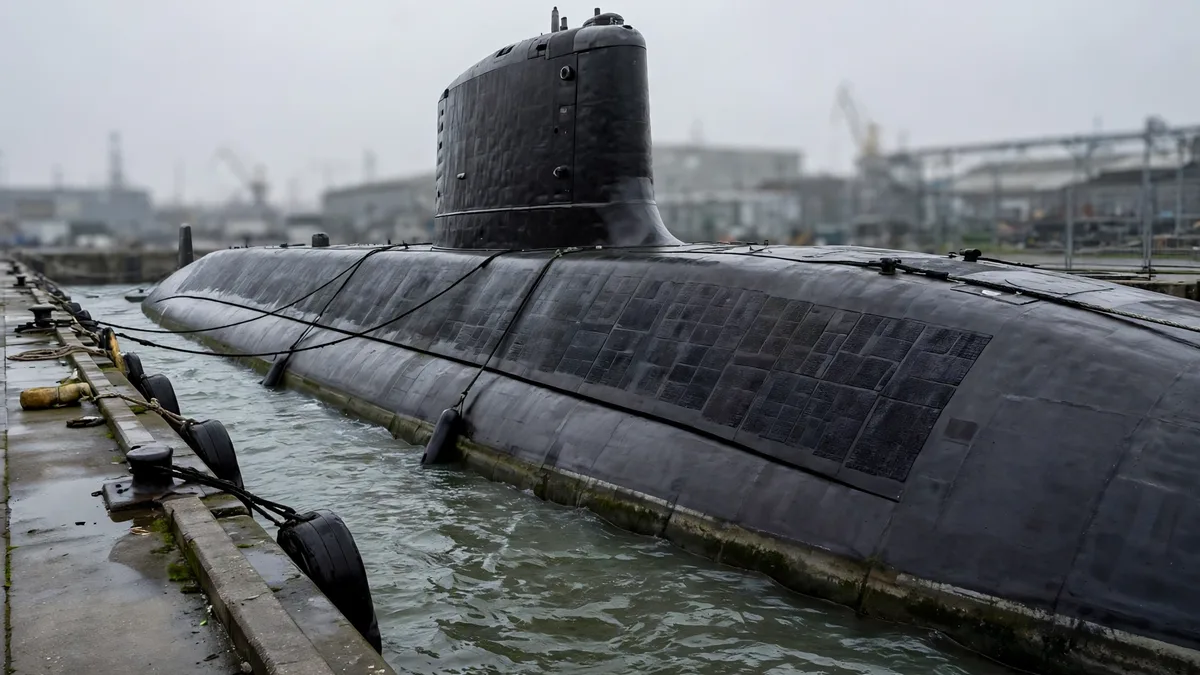
How the reactor makes heat
The reactor works by nuclear fission, the splitting of uranium-235 atoms. When a neutron strikes a uranium-235 nucleus, the nucleus splits into two smaller fragments and releases two or three more neutrons, along with a large amount of energy in the form of heat. Those new neutrons go on to strike other uranium atoms, and the chain reaction continues. The trick of running a reactor is controlling that chain: keep it going steadily, never let it run away, and shut it down instantly if anything goes wrong.
Control is done with control rods, long rods made of a material such as hafnium that absorbs neutrons. When the rods are lowered into the core, they soak up neutrons and slow the reaction down. When they are raised, more neutrons are free to split atoms and the reaction speeds up. The reactor operator adjusts the rods to match the power the submarine needs: more power for high speed, less for slow patrol. If the reactor needs to stop, the rods drop fully into the core in seconds, a process called a scram, and the chain reaction halts.
The pressurised water loop
Almost every submarine reactor in service today is a pressurised water reactor, or PWR. The name describes the cooling system: ordinary water, kept under very high pressure so that it stays liquid even at temperatures well above the normal boiling point. The primary loop circulates this water through the reactor core, where it picks up heat, and then through a heat exchanger called a steam generator, where it gives that heat up and returns to the core to be heated again.
The steam generator is where the two water systems meet but never mix. Hot primary-loop water flows through thousands of thin tubes inside the generator, and cooler water from a separate secondary loop flows around the outside of those tubes. The heat passes through the tube walls and boils the secondary water into steam. The primary water, which has passed through the reactor core, stays sealed inside its own loop. The steam in the secondary loop is clean, and it is this steam that goes on to do the work.
From steam to propulsion
The steam from the generator flows to turbines, and this is where heat finally becomes motion. A submarine has two main kinds of turbine. The propulsion turbines are large machines connected to the propeller shaft, either directly through a gearbox or through an electric generator that powers a motor on the shaft. On modern submarines, the trend is toward electric drive: the steam spins a turbine, the turbine spins a generator, and the generator powers a quiet electric motor that turns the propeller. Removing the mechanical gearbox removes one of the loudest parts of the boat.
Shielding and the reactor compartment
A working reactor produces intense radiation, and the shielding around it is one of the heaviest and most carefully designed parts of the submarine. The shielding has several layers. Closest to the core is the steel of the pressure vessel itself, which is many centimetres thick. Around that is a tank of water, which absorbs neutrons, and then layers of steel and lead that absorb gamma rays. The shielding is arranged so that the radiation reaching the crew spaces is a tiny fraction of natural background levels, far below the limits set for radiation workers.

Why a reactor changes what a submarine can do
The reactor’s biggest gift is endurance. A diesel submarine must surface or raise a snorkel every day or two to run its engines and recharge its batteries, and every time it does, it can be seen and heard. A nuclear submarine makes its own power continuously, so it can stay submerged for as long as its food lasts, which is usually around three months. It can also travel at high speed underwater for as long as it wants, because speed costs nothing but a turn of the control rods, whereas a diesel boat at high speed drains its batteries in hours.
That endurance changes how a submarine is used. A nuclear submarine can cross an ocean submerged, arrive on station without ever being seen, and stay there for weeks. It can keep up with a fast surface fleet, something a diesel boat cannot do for long. And because it makes its own electricity in large quantities, it can run powerful sonar, communications, and life-support systems without worrying about the battery. The research submarine sonar works on the same principle of listening in the deep, but a nuclear boat can carry far more of it and run it for far longer.
Safety systems and what happens when things go wrong
Naval reactors are built with multiple layers of safety, because a reactor accident at sea would be very hard to deal with. The first layer is the design itself: the pressurised water reactor is self-limiting, in that a rise in temperature makes the water less dense, which slows the reaction down. This negative feedback means the reactor naturally resists running away. The second layer is the control rods, which drop automatically if power rises too fast or if the operators lose control. The third layer is the containment: the reactor compartment is built to hold in the contents of the primary loop even if a pipe breaks.
The honest summary is that a nuclear submarine reactor is a compact power station that trades complexity and cost for freedom. It gives a submarine the ability to stay down, move fast, and operate anywhere on Earth without refuelling or surfacing, and it does so with a safety record built on layers of design, shielding, and training. It is not the right choice for every navy or every mission, but for the boats that carry it, the reactor is the reason they can do what they do. The mini submarine has none of this complexity, which is part of its appeal, but it also has none of the endurance. The cost of a tourist submarine is high for entirely different reasons, but the scale of the engineering is a reminder that anything that goes deep underwater is expensive to build, run, and retire.


