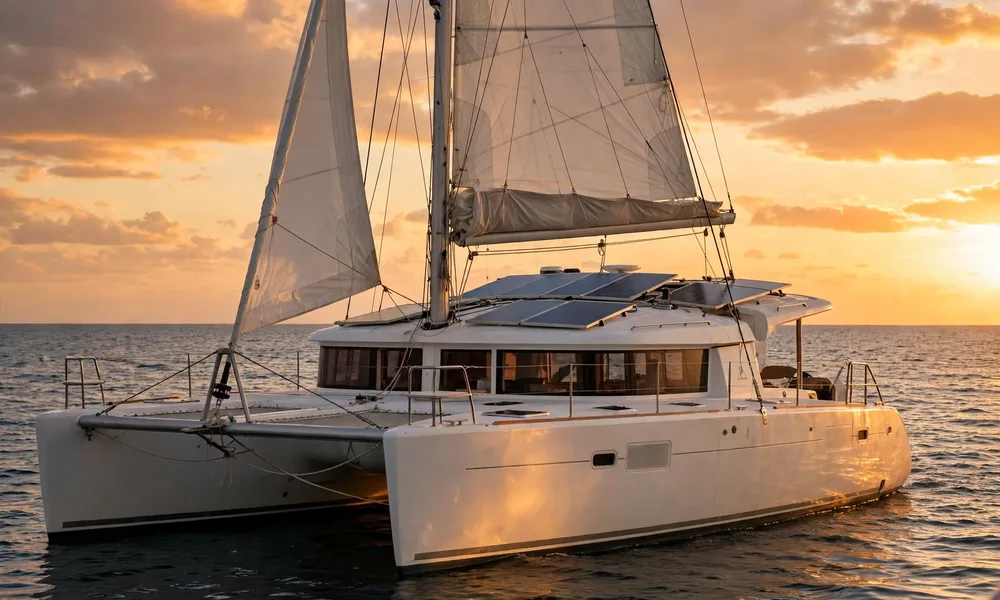
A solar-powered catamaran is a twin-hulled boat that makes much of its electricity from the sun. Solar panels cover the roof, the coachroof and sometimes the decks, feeding batteries that drive electric motors in each hull. On a good day the panels can run the boat’s lights, fridge, navigation and watermaker, and add useful range to the motors as well.
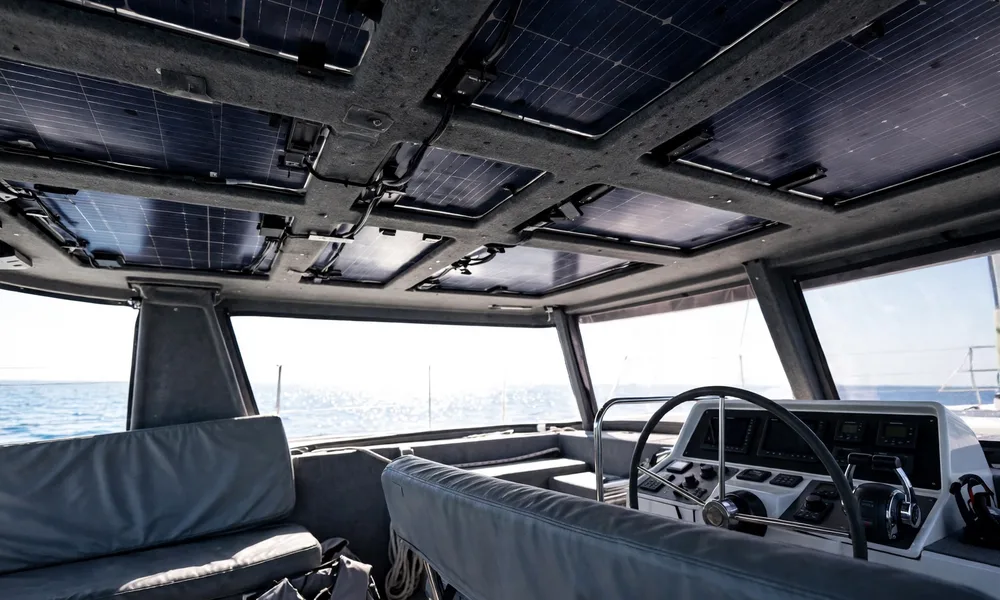
The catamaran is the natural home for solar power. A single-hulled yacht has limited flat roof area and a mast and rigging that throw shadows across it. A catamaran has a wide, flat bridge deck between two hulls, a large hardtop over the cockpit, and a broad coachroof, all of which take panels without getting in the way of sailing. That area is the difference between a token solar setup and one that genuinely powers the boat.

How the solar system works
The system has four parts: panels, a charge controller, batteries and motors. The panels convert sunlight into direct current. The charge controller, usually a maximum power point tracker, squeezes the most power from the panels as the light changes, and manages the flow into the batteries. The batteries store the energy, and the motors draw on it when the boat moves. House loads like refrigeration and lighting draw from the same bank, so the solar array serves the whole boat, not just propulsion.
Panel output depends on area and sun. A well-equipped cruising catamaran carries 2 to 4 kilowatts of panels, which on a sunny day in the tropics can produce 10 to 20 kilowatt-hours, enough to run the house loads and add several hours of slow motoring. The numbers are estimates, not promises: clouds, shading, panel angle and latitude all change them, and a panel lying flat on a roof produces less than one tilted toward the sun. Owners who care about range learn to read the sky the way sailors once read the wind.
Why two hulls help
The twin-hull layout helps in more ways than roof space. Each hull carries its own electric motor and propeller, so the boat has two independent drives. That gives precise manoeuvring in a marina, with one motor ahead and one astern, and it gives redundancy: if one motor fails, the other still moves the boat. The hulls are also narrow and efficient, so the boat needs less power to hold a given speed than a single hull of the same size, which stretches the solar energy further.
Weight is the constraint. Solar panels, batteries and motors add kilos, and a catamaran’s performance is sensitive to load. Designers keep the battery bank as light as the budget allows, usually lithium iron phosphate for its energy density and safety, and they place it low in the hulls to keep the centre of gravity down. How an electric catamaran works explains the twin-motor layout, the battery placement and the hull efficiency that make the solar version possible in the first place.
Solar versus sails versus generator
A solar catamaran is usually also a sailing catamaran, and the two power sources complement each other. The sails do the heavy work of moving the boat when the wind is fair, and the solar panels quietly recharge the batteries while the boat sails. When the wind dies, the motors take over for a few hours on stored sunshine. Some designs add hydrogeneration: the propellers spin in the water while sailing and generate electricity back into the batteries, turning the boat’s speed into charge.
A generator is still common as a backup, and honest builders say so. Solar alone cannot push a large catamaran at cruising speed for a full day, and a week of cloud will drain the batteries. The generator is there for those days, and for the air conditioning at anchor. The goal of the solar system is not to remove the generator entirely, but to make it run rarely: a few hours a week instead of a few hours a day. That is a large saving in fuel, noise and maintenance over a season.
Panels, shading and the real world
Panel technology keeps improving, but the physics stays the same. A square metre of good marine panel makes roughly 200 watts in full sun, so the roof area sets the ceiling. Larger catamarans, with more roof, can carry more solar, which is one reason the biggest solar cats are the most convincing. Smaller cats make do with less and lean more on their sails. How solar sailing yacht systems work covers the panel wiring, the controllers and the shading problem on a single-hulled yacht, where the roof is smaller and the shadows worse.
Batteries, range and speed
Range is where expectations need managing. A solar catamaran with a 40-kilowatt-hour battery bank and twin 10-kilowatt motors can motor at 4 to 5 knots for roughly four to five hours on batteries alone, and the panels add range while the sun shines. Push the speed to 7 or 8 knots and the power demand rises steeply, because water resistance grows with the square of speed, and the range falls to an hour or two. Slow and steady is the solar way.
That sounds limiting until you compare it with how cruising cats are actually used. Most passages are sailed, not motored, and the motors are used for entering and leaving anchorages, for calm spells, and for manoeuvring. For that pattern the solar setup is generous: the boat arrives at an anchorage with full batteries, runs the fridge and lights all night, and leaves in the morning with the panels already topping the bank up. The range limit only bites on a long, windless motoring passage, which is exactly when the generator earns its place.
Life aboard a solar catamaran
Daily life changes in small, pleasant ways. The boat is quieter, because the generator runs less and the motors make little noise. The air smells cleaner at anchor, with no diesel exhaust drifting across the cockpit. The energy display becomes part of the morning routine, alongside the weather forecast: how much the panels made yesterday, how full the batteries are, and whether today is a motoring day or a sailing day.
Costs and what to check before buying
A solar catamaran costs more than a diesel equivalent, mostly because of the batteries and the panels, and the premium is usually in the tens of thousands of euros. The running costs are lower: no diesel for the generator most days, less engine servicing, and no fuel stops in remote anchorages. Whether the maths works depends on how the boat is used. A boat that sails the tropics and anchors out for weeks will pay the premium back faster than one that sits in a marina on shore power, and how a luxury catamaran is made shows the build quality that premium buys.
The honest summary
A solar-powered catamaran is not a boat that runs on sunshine alone. It is a boat that uses sunshine well: the wide roof gathers it, the batteries store it, the efficient hulls stretch it, and the sails do the heavy lifting. For a cruising sailor who anchors out, sails when there is wind and motors gently when there is not, it is a convincing combination, quieter and cleaner than the diesel alternative.


