A sailing yacht at anchor is a small power station that never plugs in. The fridge hums, the lights burn and the instruments stay awake, all running on sunlight that fell on the deck a few hours earlier and was stored in a bank of batteries below. The system behind it is not one gadget but a chain of parts, each doing a narrow job, and the chain is only as strong as its weakest link. Solar power on a yacht is different from solar on a roof, because a roof never moves, never heels and never gets washed in salt spray, while a yacht does all of that every day under a mast that casts a moving shadow.
Here is how the system works, from the sunlight on the deck to the phone charging in the cabin.
The Parts of a Yacht Solar System
1. The panels, where sunlight becomes electricity
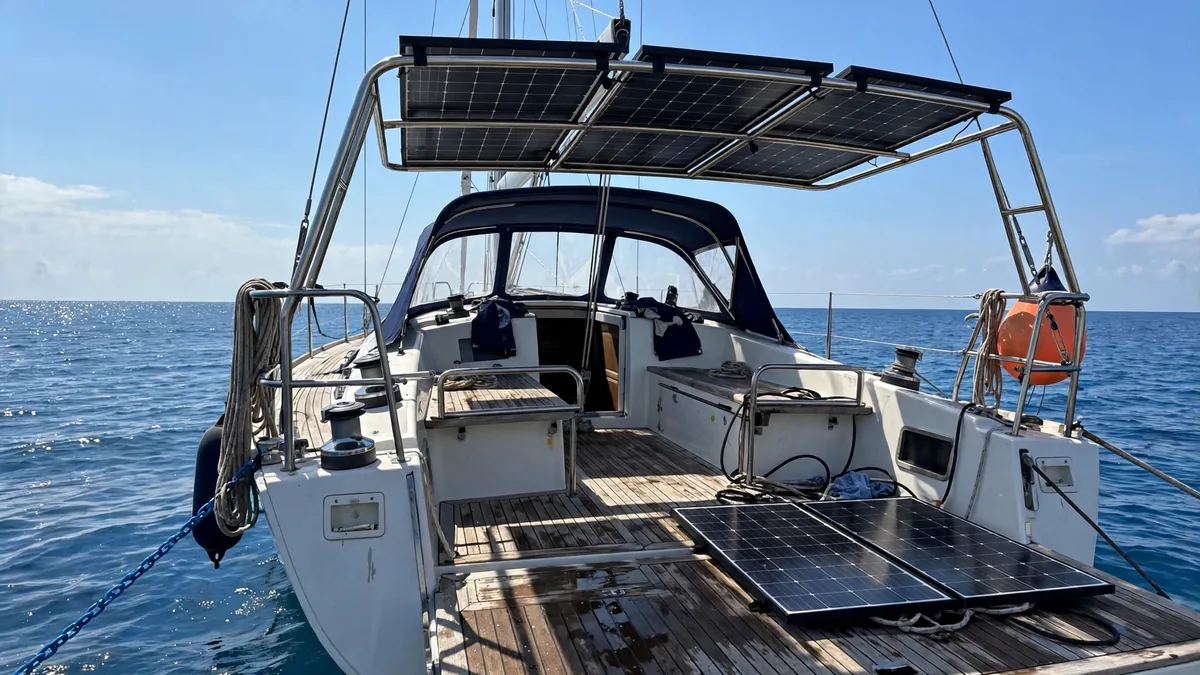
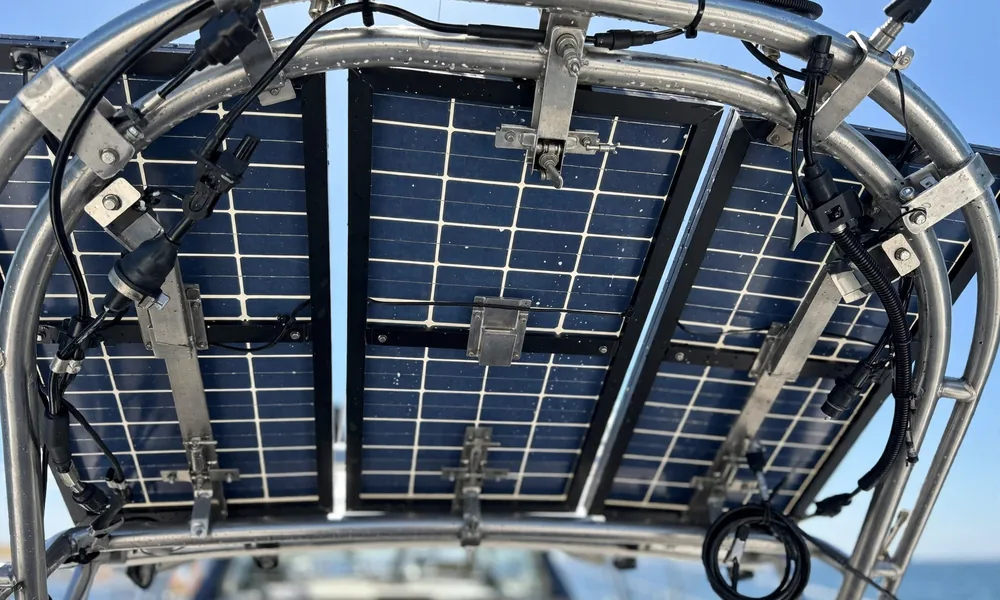
The panels are the harvest. Most yacht panels use monocrystalline silicon cells, the dark squares that squeeze the most power out of a small area, which matters when deck space is the scarcest thing on a boat. Rigid glass-and-aluminium panels are the most efficient and longest-lived, and they usually live on a stern arch, a hard bimini or a coachroof, where they can be tilted toward the sun. A cruising yacht typically carries 300 to 800 watts of panels, enough on a sunny day to replace what the fridge, lights and instruments used overnight. Where the panels sit is a design decision in the same way the rig is: the mast, the boom and the sails decide how much sun the panels ever see, as the guide to superyacht mast specifications shows in the way a mast is engineered from the deck up.
2. The charge controller, the brain of the system
Raw panel power is too wild to feed a battery directly. A panel’s voltage swings with the light, and a battery that is overcharged will gas, swell or, in the case of lithium, be permanently damaged. The charge controller sits between the two and decides, moment by moment, how much power the battery is allowed to take. A PWM controller simply connects the panel to the battery and chops the connection on and off to hold the voltage down; it is cheap and simple, but it wastes the extra voltage a panel produces above battery voltage. An MPPT controller, maximum power point tracking, is a small computer that constantly hunts for the voltage at which the panel produces its most power, then converts the extra voltage into extra charging current. On a cool, bright day an MPPT controller can harvest a quarter to a third more energy from the same panels than a PWM one, and it is the standard choice on any serious cruising yacht.
3. The battery bank, the reservoir
Panels make power only while the sun shines, so the battery bank is what lets a boat use power at night. The bank is a set of cells wired together, usually at 12 or 24 volts, and its size is measured in amp-hours, which is a way of saying how much charge it can hand out before it is empty. The modern choice is lithium iron phosphate, LiFePO4, which can be drained to about 80 percent, charges far faster, and lasts thousands of cycles instead of hundreds, at roughly a third of the weight. Every lithium bank needs a battery management system, a BMS, a small circuit that watches each cell’s voltage and temperature and cuts the power if any cell goes too high, too low or too hot. Sizing the bank starts not with the panels but with the loads: add up everything the boat uses in a day, in watt-hours, and the bank needs to hold at least two days of that, so a cloudy day does not leave the crew in the dark.
4. The inverter, turning stored power into mains power
Batteries and panels speak direct current, DC, but most of the things people want to run, a laptop charger, a coffee machine, a watermaker, speak alternating current, AC, the mains power of a house. The inverter translates. It takes the steady DC from the battery and chops it into AC at the voltage and frequency the boat’s sockets expect, usually 230 volts at 50 hertz or 120 volts at 60 hertz. Many yachts use an inverter-charger, a single box that also works in reverse: plug into shore power at a marina and it charges the battery bank from the mains. The inverter is sized by the biggest load it must run at once, not by the average, because a watermaker or a microwave can pull two thousand watts for a few minutes even though the boat’s daily average is a tenth of that.
5. Sizing the system: the daily energy budget
The one number that decides whether a solar system works is the daily energy budget, measured in watt-hours. A typical cruising couple at anchor uses 1,000 to 2,000 watt-hours a day, and a boat underway with the autopilot steering can use double that. The quiet test of any system is what it does while the boat is doing nothing at all: a yacht sitting on its anchor, with the crew ashore and the fridge running, is living entirely on stored sunlight, and it is the anchoring gear that holds the boat in that spot while the panels do their work, as the guide to how a yacht anchor system works explains from the windlass to the chain. Some sailing yachts add a fourth charging source: regeneration under sail, where the spinning propeller works as a water turbine to generate power, and the way that propeller is shaped decides how well it works in either direction, as the guide to yacht propeller specifications shows in the numbers behind the blades.
6. Shading, salt and the marine reality
A yacht panel’s worst enemy is not cloud but shade. Panels are wired in series, so one shaded cell acts like a kink in a hose and throttles the whole string, and on a sailing yacht the shade is always moving: the mast, the boom, the sails and the rigging sweep shadows across the deck all day. Designers fight this by splitting the array into separate strings, each with its own controller, so a shadow on one panel cannot steal the output of the others, and by fitting bypass diodes that let current route around a shaded cell. Salt is the second enemy. Salt spray dries into a crust that blocks light and corrodes every exposed connection, so marine panels are sealed, their frames are anodised, and every junction box and cable gland is waterproofed.

The result, when the chain is built properly, is a boat that makes its own power as quietly as it sails. The panels harvest, the controller protects, the bank stores, and the inverter delivers, and none of it asks for attention beyond a wipe of the panels and a glance at the monitor. Get the sizing right, keep the shade off, and the sun does the rest.


