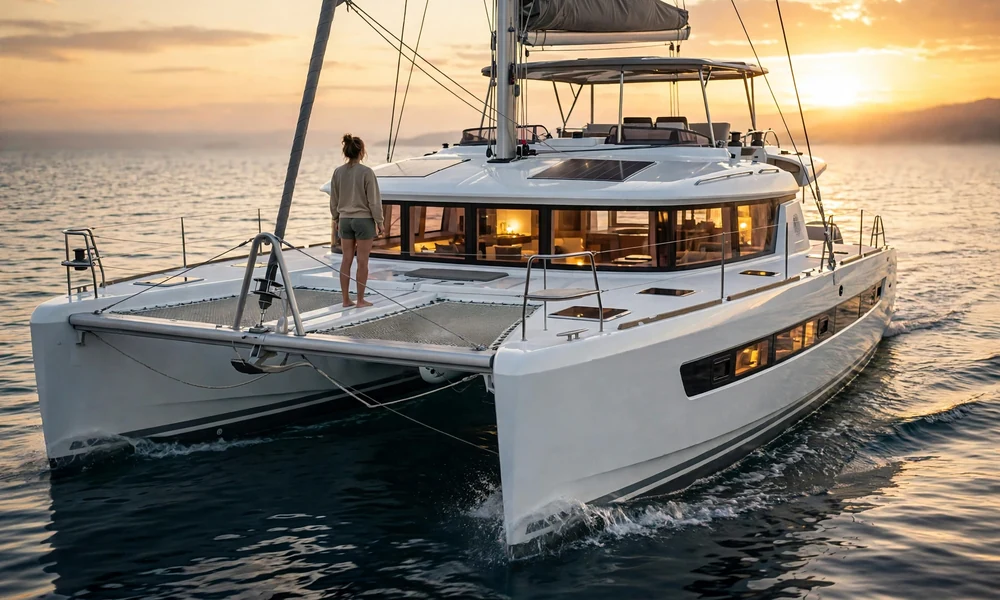
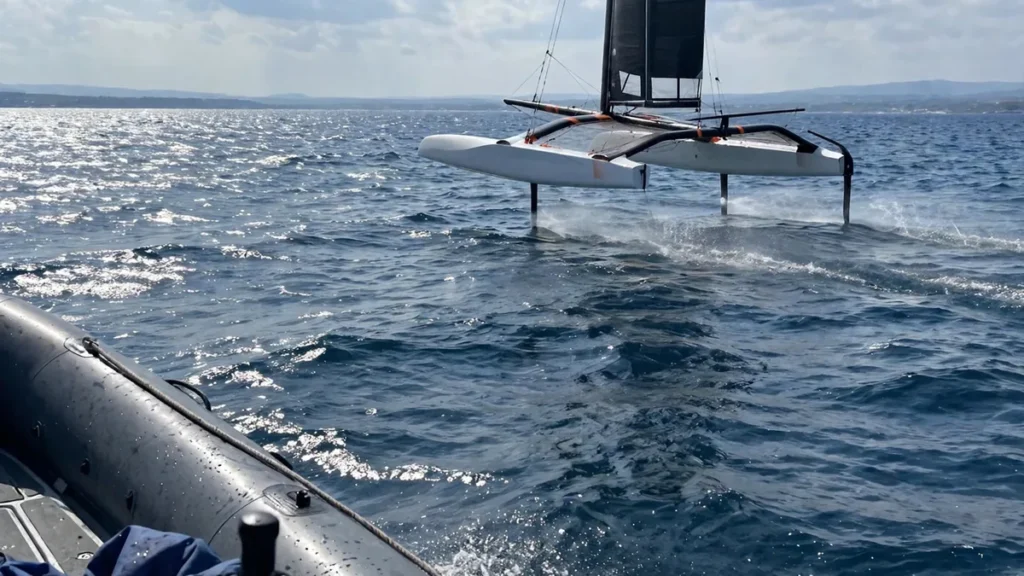
The catamaran sat on the hard standing with both hulls in the air, and from the dock it did not look like a boat at all. It looked like two long, narrow canoes held apart by a bridge, with a wide open deck between them that caught the evening light. A couple walked across that deck, stepping from one hull to the other without ducking through a single doorway, and the owner kept pointing at the space, not at the woodwork or the sails. That is the whole point of a luxury catamaran: the space. Where a single-hull yacht squeezes its rooms into a tube, a catamaran spreads them across a platform the width of a small house, and it stays almost flat while it does it.
A luxury catamaran is not a big boat with two hulls bolted on. It is a different kind of structure altogether, and building one means solving problems a normal yacht never meets. The two hulls have to stay perfectly aligned under twisting loads from the sea, the bridge deck between them has to carry the weight of the saloon, the mast, and the crew without flexing, and the whole platform has to be light enough to sail well and strong enough to survive an ocean crossing.
How a Luxury Catamaran Is Made
The build starts in the mould hall, where the hulls are shaped long before any cabin or deck appears. A catamaran yard keeps a set of female moulds, one for each hull, and a separate mould for the bridge deck, and the quality of the finished boat is decided in these moulds. The gelcoat goes in first, then layer after layer of glass fibre, foam core, and resin, until the hull shell is a stiff sandwich that is light, strong, and smooth on the outside.
Step 1: Laying up the twin hulls
The first job is the laminate. Workers roll glass fibre cloth and foam core into the mould by hand, wetting each layer with resin, and the work is done in a temperature-controlled hall so the resin cures evenly. Vacuum bagging pulls the layers tight against the mould and squeezes out excess resin, leaving a hull shell that is both lighter and stronger than a hand-laid one. When the shell cures, it is lifted from the mould and set on cradles, and the inside is fitted with bulkheads, stringers, and the engine beds that will carry the twin diesels.
Step 2: Building the bridge deck and crossbeam structure
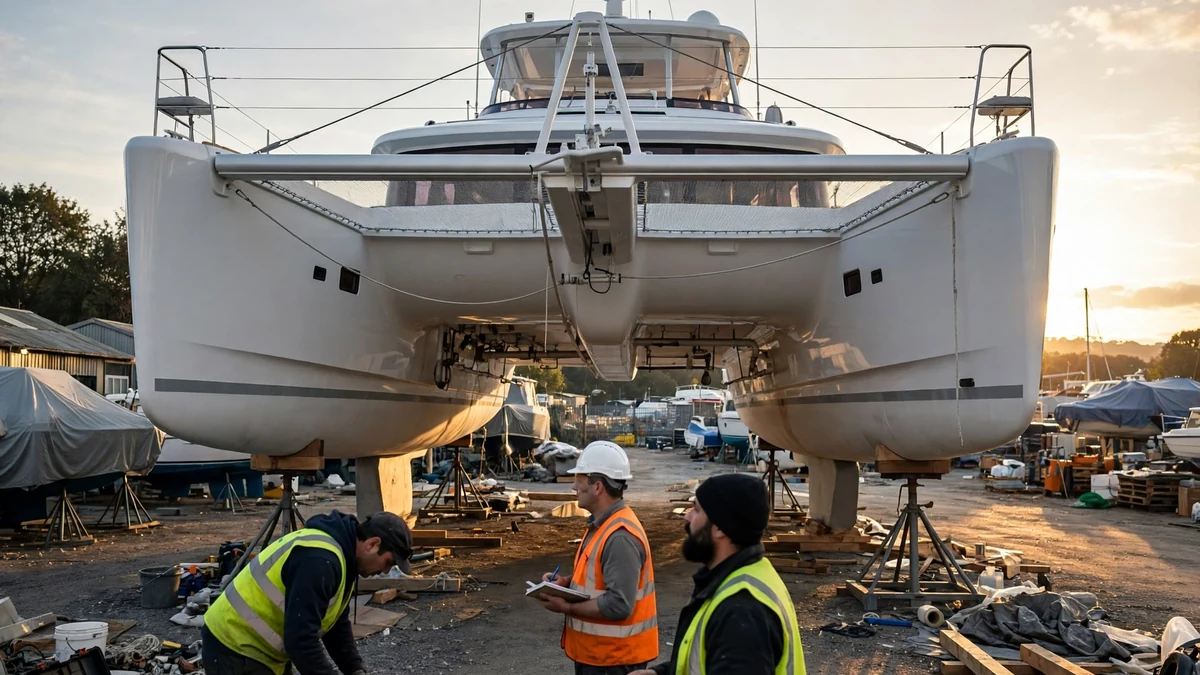
The bridge deck is the part that makes a catamaran a catamaran, and it is the hardest structure on the boat. It spans the gap between the hulls, carries the saloon and the mast step, and takes the twisting forces every time a wave lifts one hull and not the other. A luxury cruise ship suite is built as a module that slots into a steel frame, but a catamaran bridge deck has to be joined to the hulls so firmly that the whole platform behaves as a single rigid structure.
Step 3: Joining the platform and stepping the mast
Once the deck is bonded, the two hulls and the deck become one platform, and the yard checks the alignment with lasers before anything else is fitted. The mast step is positioned over the strongest part of the bridge deck, usually above a reinforced beam, because the mast pushes down with tonnes of force and pulls sideways through the rigging at the same time. On a luxury catamaran the mast is often carbon fibre, stepped through the deck and seated on a ball or a fixed base that lets it be tuned under load.
Step 4: Fitting the saloon and the hull interiors
With the structure complete, the interior goes in, and this is where a luxury catamaran shows its advantage. The saloon sits on the bridge deck with windows on three sides, and the galley, the dining table, and the helm can all share one open space that would be impossible in a single hull. The hulls below hold the cabins, each with its own bathroom, and the layout is almost always symmetrical: an owner suite in one hull, guest cabins in the other, with the crew quarters tucked forward. A luxury yacht galley faces the same space puzzle on a smaller scale, but a catamaran galley gets a full wall of windows and a worktop the size of a kitchen island.
Step 5: Installing engines, systems, and the flybridge
A luxury catamaran usually carries two engines, one in each hull, which gives it both redundancy and remarkable manoeuvrability in a marina. The engines are saildrives or shaft drives, fitted on beds that were laminated into the hulls at the mould stage, and each has its own fuel tank, exhaust, and cooling intake. The electrical system is sized like a small house, with a large lithium battery bank, an inverter, solar panels on the coachroof, and a generator for air conditioning at anchor. The flybridge, if the design has one, is fitted last, with its own helm, seating, and sun pads, and it is the highest point on the boat, so the wiring for its instruments and lights is run through conduits laid into the deck during the laminate stage.

Step 6: Sea trials, tuning, and handover
The finished catamaran is launched and taken through sea trials that test everything the yard built. The crew sails it on every point of wind, checks the rigging tension, measures the speed, and watches for any flex or noise in the bridge deck under load. The best electric yacht brands are pushing some of these systems towards full electric drive, but most luxury catamarans still hand over with twin diesels and a hybrid-ready electrical system. Only when the trial list is clear does the owner take the helm, usually for a short delivery sail with a yard captain on board to answer the first questions.
Luxury Catamaran Specifications
| Specification | Typical figure |
|---|---|
| Overall length | 15 to 24 metres for a luxury cruising catamaran |
| Beam | 8 to 12 metres, roughly half the length |
| Displacement | 18 to 35 tonnes, fully loaded |
| Hull construction | Glass fibre and foam core sandwich, carbon reinforcement |
| Engines | Twin diesels, 50 to 150 horsepower each |
| Cabins | Four to six, each with a private bathroom |
| Saloon area | 25 to 45 square metres of open living space |
| Cruising speed under power | 8 to 10 knots |
What a Luxury Catamaran Costs
A new luxury catamaran in the 15 to 20 metre range typically costs an estimated $2 million to $6 million, depending on length, build material, and the level of finish, with larger carbon-built models reaching an estimated $8 million to $12 million. The build alone accounts for most of that price, because the moulding, the bridge deck structure, and the hand-fitted interior are all labour-heavy work.
A Rare Fact About Luxury Catamarans
Because the two hulls are so narrow, a catamaran has almost no room for a traditional engine room, so on many luxury models the engines sit under the aft cabins, beneath the beds, with sound insulation so thick that the owners sleep directly above a running diesel and never notice. Even stranger, some catamarans are built with a completely open bridgedeck, a trampoline of netting stretched between the hulls forward of the saloon, where the crew sometimes sleep on calm tropical nights with nothing but mesh between them and the sea.