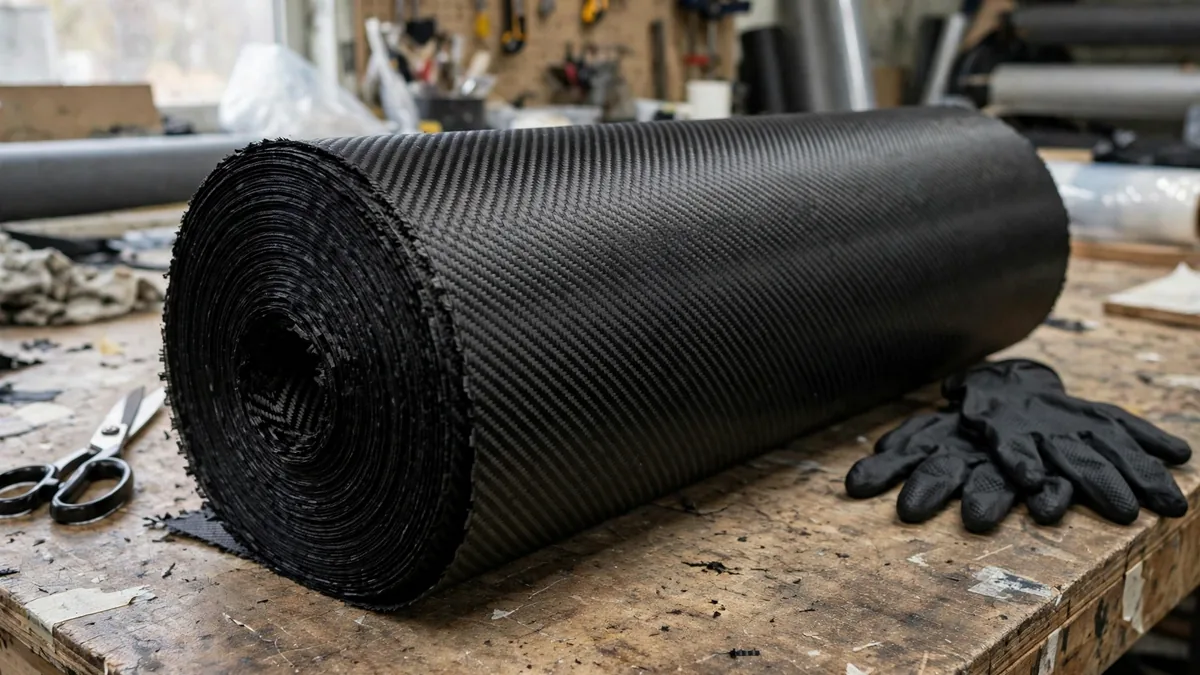
Hold a roll of carbon fibre cloth and your hands will argue with your eyes. It feels like ordinary fabric — light, flexible, a little rough at the edges — yet this black cloth is the starting point for parts stronger than steel. Formula 1 cars, fighter jets, racing bicycles and superyacht masts are all built from it. The question is not whether carbon fibre is expensive. It is why something that looks like a roll of fabric costs so much.
The answer is a chain of extreme processes. The fibre starts as a cheap plastic thread and is baked until almost nothing but carbon remains, spun thinner than a hair, woven on specialised looms, soaked in resin, laid by hand and cured in a pressurised oven.
1. The Fibre Starts as Plastic and Ends as Almost Pure Carbon
Almost all carbon fibre begins as polyacrylonitrile, or PAN, a white acrylic polymer not far removed from the fibre in a cheap sweater. The PAN is spun into thread, oxidised in air at a few hundred degrees, then heated to 1,500 degrees Celsius or more in an oxygen-free furnace, where everything that is not carbon is driven off as gas. What emerges is a black filament of almost pure carbon, stiffer and stronger than the plastic it came from by an order of magnitude. The raw material is cheap; turning it into carbon fibre is not.
2. Filaments Thinner Than a Human Hair
A single carbon filament is about five to ten micrometres across, roughly a tenth the width of a human hair, and far too fragile to use on its own. Thousands of them are gathered into a tow — a flat ribbon of fibre that can be wound, handled and fed into a loom — and the tows are measured in thousands of filaments, from 1K to 24K. Making fibre this fine, in this volume, with this consistency, takes production lines that cost tens of millions of dollars to build, and only a handful of companies in the world run them. The scarcity of the supply is baked into the price of every roll.
3. Weaving Is a Craft, Not a Commodity
Turning tows into cloth takes looms adapted from the textile industry but rebuilt for a material that is stiff, brittle and sheds black dust. In a plain weave, each tow passes over one and under the next, making a stable cloth that resists fraying. In a twill weave, tows pass over two and under one, creating the diagonal pattern most people recognise as carbon fibre. In a satin weave, tows float over several others, making the most flexible cloth of all. Each pattern trades strength against handling and looks, and the weavers who run these looms are specialists. Good woven carbon cloth is a craft product, and craft products are priced like craft products.
4. Prepreg: Cloth That Must Live in a Freezer
Most high-performance carbon parts are made from prepreg: cloth already impregnated with resin, stored frozen until it is needed. The resin is usually an epoxy, chosen for strength and its bond to the sized fibres, and the prepreg has a shelf life — leave it out too long and the resin starts to cure on its own. The resin itself is a specialty chemical, made in small batches and tuned for a particular cure cycle, and it adds a large share of the material cost. The cloth you buy is not just fibre; it is fibre plus chemistry plus a cold chain.
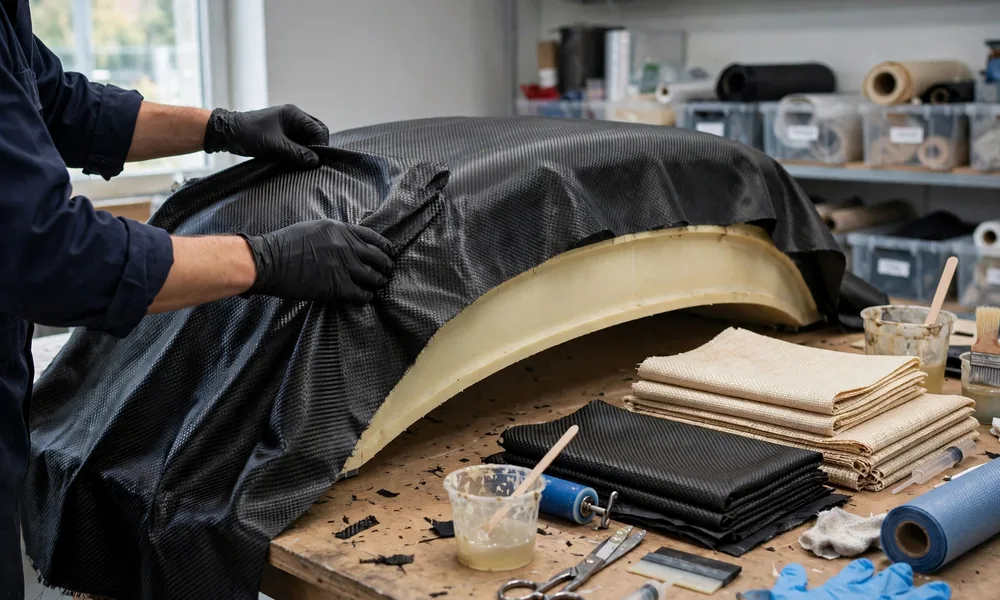
5. Hand Layup: Hours of Skilled Work per Part
There is no fast way to turn cloth into a part. Skilled laminators lay the prepreg into a mould ply by ply, each layer turned to the angle the engineers specified — often zero, 45 and 90 degrees, so the part is strong in every direction — pressing out air bubbles and wrinkles as they go. The people who do this work train for years, and their hands are the most expensive tool in the factory. Automation helps for simple shapes, but for the curved, hollow, load-bearing parts that make carbon fibre worth using, there is still no substitute for a trained laminator.
6. The Autoclave: A Pressure Cooker the Size of a Room
Once laid up, the part is cured in an autoclave, a pressurised oven that applies heat and pressure to melt the resin, squeeze out voids and lock the fibres into a rigid composite. Autoclaves are enormous, expensive machines — a large one costs millions of dollars, uses huge amounts of energy, and ties up a part for hours per cycle. The autoclave is the bottleneck of the whole process, and its cost is spread across every part it cures. The specifications of autoclave curing show just how demanding the process is.
7. Inspection: Seeing Inside the Finished Part
A cured carbon part can look perfect and still be flawed inside, so every critical part is inspected with ultrasound, which can see voids and delaminations hidden in the laminate, and X-rayed if the stakes are high enough. The inspection equipment is costly, the operators are trained specialists, and any part that fails is scrapped — taking its hours of labour and its expensive materials with it. It is the same discipline that makes a carbon nanotube composite trustworthy, and it is why carbon fibre parts carry the safety margins they do. For the cloth itself, the materials behind the carbon fibre weave explain what each layer is doing.

Carbon Fibre Weave at a Glance
| Specification | Detail |
|---|---|
| Precursor material | Polyacrylonitrile (PAN) polymer fibre |
| Filament diameter | About 5–10 micrometres |
| Tow sizes | 1K to 24K filaments, commonly 3K, 6K and 12K |
| Weave patterns | Plain, twill and satin |
| Carbonisation temperature | Up to 1,500°C, graphitisation above 2,000°C |
| Matrix resin | Epoxy, usually supplied as prepreg |
| Strength vs steel | Stronger per unit weight, but brittle in impact |
What Does It Cost?
Woven carbon fibre cloth typically costs tens of dollars per square metre (estimate) for standard grades, with aerospace-grade cloth costing several times more (estimate). The finished part is where the numbers jump: a carbon fibre car body panel can run into thousands of dollars (estimate), a racing bicycle frame into the low thousands (estimate), and a full carbon monocoque for a racing car into the hundreds of thousands (estimate). The price is not the cloth. It is the furnaces, the looms, the freezer, the hours of hand layup, the autoclave time and the ultrasound inspection — a chain in which every link is expensive and none can be skipped.
A Rare Fact
Carbon fibre is stronger than steel by weight, but it has a strange weakness: it barely stretches before it breaks. Steel bends and warns you; carbon fibre holds and holds, then fails suddenly, with almost no warning. The most advanced structural material in everyday use is also one of the least forgiving, and the weave that makes it so strong is the same weave that makes it so brittle.


