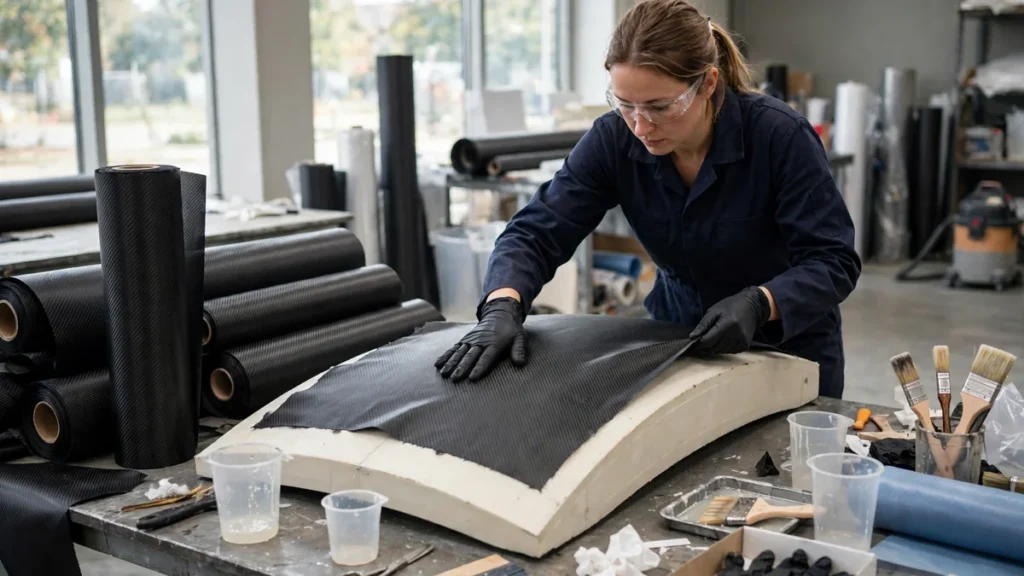
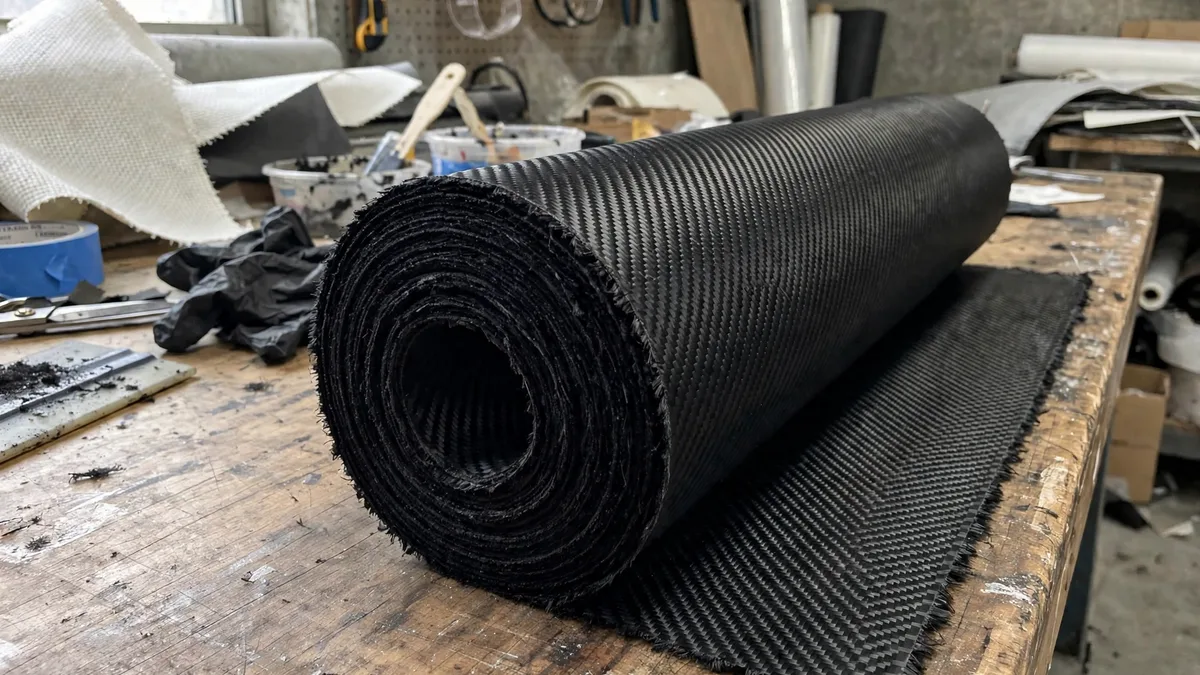
Pick up a sheet of carbon fibre cloth and it feels wrong. It is light as paper, flexible as fabric, and cool to the touch — yet woven into a panel and baked hard, it becomes stronger than steel at a fraction of the weight. This is the material that holds together racing cars, aircraft wings, bicycle frames and the masts of superyachts, and it all starts as a roll of black cloth on a workbench.
Carbon fibre weave is the product of an extraordinary chain of materials science: a plastic thread is baked until almost nothing is left but pure carbon, spun into filaments thinner than a human hair, and woven on looms much like the ones that make cotton shirts. The result is a fabric that looks simple and behaves like nothing else on Earth.
The Materials Behind the Carbon Fibre Weave
At the heart of the weave is the carbon fibre itself: filaments made by heating a polymer called polyacrylonitrile, or PAN, until it becomes almost pure carbon. Those filaments are gathered into tows of thousands of strands, and the tows are woven into cloth in patterns — plain, twill or satin — that balance strength, flexibility and looks. The cloth is then combined with resin, laid into a mould, and cured into a rigid part. Every step, from the chemistry of the fibre to the geometry of the weave, shapes what the finished part can do.
Step 1: From plastic thread to carbon
Almost all carbon fibre starts life as PAN, a white acrylic polymer not unlike the fibre in a cheap sweater. The PAN is spun into thread, then heated in air to around 200 to 300 degrees Celsius, where it oxidises and turns dark. It is then heated far hotter — up to 1,500 degrees or more — in an oxygen-free furnace, driving off everything that is not carbon. What comes out is a black filament that is mostly pure carbon, with a stiffness and strength no plastic could match.
Step 2: Spinning filaments thinner than hair
A single carbon filament is about five to ten micrometres across — roughly a tenth the width of a human hair — and far too fragile to use alone. Thousands of filaments are gathered into a tow, a flat ribbon of fibre that can be handled, wound onto bobbins and fed into a loom. The size of the tow is measured in thousands of filaments: a 3K tow holds 3,000, a 12K tow holds 12,000. The filaments are coated with a sizing — a thin chemical layer that protects them and helps them bond to resin later.
Step 3: Carbonisation and the price of purity
The baking stage, called carbonisation, is where the fibre gains its strength. As the PAN is heated, its atoms rearrange into flat sheets of carbon, stacked like graphite, aligned along the length of the filament. The more aligned the sheets, the stiffer the fibre. The highest-grade fibres are heated hotter still, in a graphitisation step above 2,000 degrees Celsius, producing fibres so stiff they are used in spacecraft.

Step 4: Weaving the cloth
Weaving is where the fibre becomes a fabric. In a plain weave, each tow passes over one tow and under the next, making a stable, tight cloth that resists fraying but is stiff to drape around curves. In a twill weave, tows pass over two and under one, creating the diagonal pattern most people recognise as carbon fibre — it drapes better and looks better, which is why it is used for visible panels. In a satin weave, tows float over several others before diving under, making the most flexible cloth of all. The choice is a trade-off between strength, handling and appearance, and the weavers who run these looms are as skilled as any textile workers. The cloth they make is the starting point for inside the carbon fibre weave production lines around the world.
Step 5: Sizing, cutting and handling
Fresh carbon cloth is delicate. The sizing applied to the filaments keeps them from fraying, but the cloth still sheds tiny black fibres, and workers wear gloves and masks to keep it clean — a speck of dust trapped in a laminate becomes a weak spot. Patterns are cut from the cloth, sometimes by hand with shears, sometimes by a computer-controlled cutter that nests the shapes to waste as little as possible.
Step 6: Prepreg and resin
Most high-performance carbon parts are made from prepreg: cloth already impregnated with resin, kept cold in a freezer until it is needed. The resin is usually an epoxy, chosen for its strength and its bond to the sized fibres, and the prepreg is laid into a mould ply by ply, each layer turned to the angle the engineers specified — often zero, 45 and 90 degrees, so the part is strong in every direction. The same fibre-and-resin partnership that makes a carbon-ceramic brake disc also makes the body of a racing car: different matrix, same idea.
Step 7: Curing, inspection and finishing
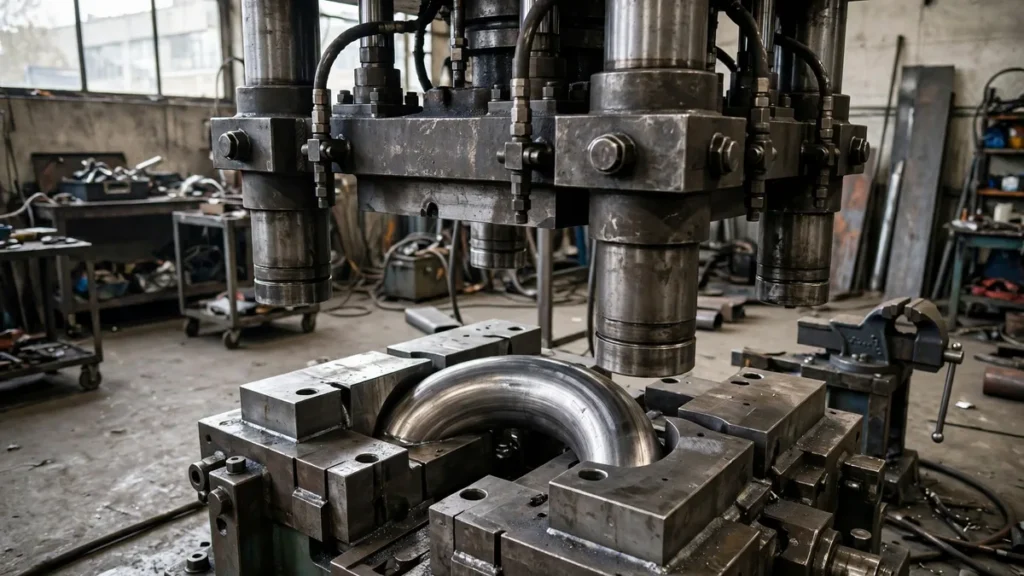
Curing is the moment of truth. Heat and pressure turn the soft stack of cloth into a rigid composite, and any mistake — a wrinkle, a bubble, a dry patch starved of resin — is locked in forever. Finished parts are inspected with ultrasound, which can see voids hidden inside the laminate, and X-rayed if the part is critical enough. The result is a part that weighs half what its metal equivalent would, and the discipline of the inspection is what keeps it trustworthy: a hypercar suspension arm made from this cloth carries loads that would snap a steel part of the same weight.

Carbon Fibre Weave at a Glance
| Specification | Detail |
|---|---|
| Precursor material | Polyacrylonitrile (PAN) polymer fibre |
| Filament diameter | About 5–10 micrometres |
| Tow sizes | 1K to 24K filaments, commonly 3K, 6K and 12K |
| Weave patterns | Plain, twill and satin |
| Carbonisation temperature | Up to 1,500°C, graphitisation above 2,000°C |
| Matrix resin | Epoxy, usually as prepreg |
| Strength vs steel | Stronger per unit weight, but brittle in impact |
What Does It Cost?
Woven carbon fibre cloth typically costs tens of dollars per square metre (estimate) for standard grades, with aerospace-grade cloth costing several times more (estimate). A finished carbon fibre part, though, costs far more than its cloth: a car body panel can run into thousands of dollars (estimate), and a full carbon monocoque for a racing car costs hundreds of thousands (estimate). The price reflects the energy-hungry carbonisation furnaces, the slow hand layup, the autoclave time and the ultrasound inspection — not the cloth itself.
A Rare Fact
Carbon fibre is stronger than steel by weight, but it has a strange weakness: it barely stretches before it breaks. Steel bends and warns you; carbon fibre holds and holds, then fails suddenly, with almost no warning. That is why engineers design carbon parts with generous safety margins and inspect them with ultrasound after any hard knock — a bicycle frame that looks perfect after a crash can be hiding broken fibres inside. The most advanced structural material in everyday use is also one of the least forgiving, and the weave that makes it so strong is the same weave that makes it so brittle.