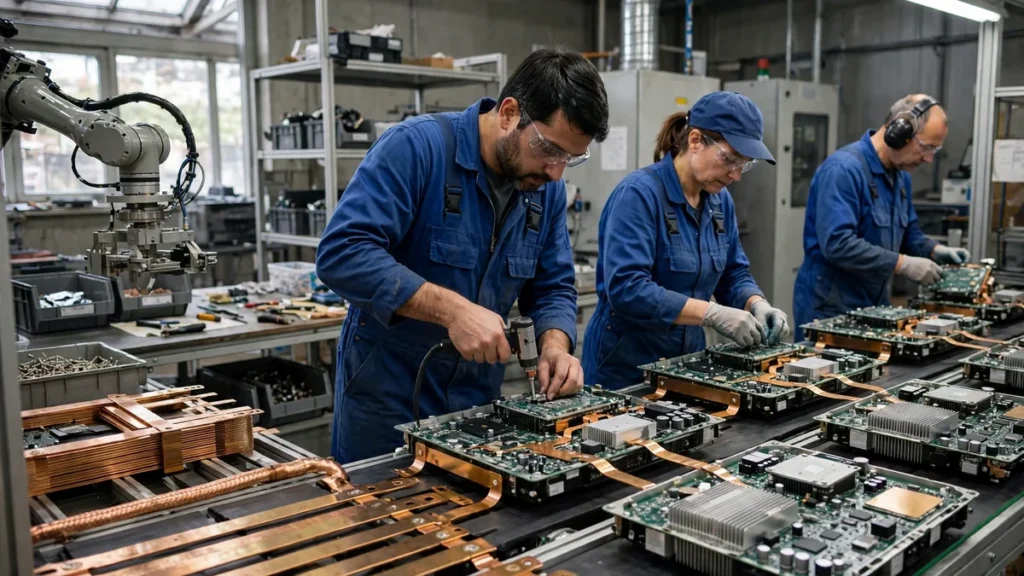
Open the bonnet of an electric car and you will not find an engine in the usual sense. You will find a battery, a motor, and between them a box that most owners never think about: the inverter. It is a quiet, sealed, unglamorous component, about the size of a shoebox, and it does a job without which the car would not move at all. It is also one of the most expensive parts of the car, and its price surprises almost everyone who learns what it does.
An EV inverter takes the direct current from the battery and turns it into the alternating current the motor needs, switching it thousands of times a second, precisely and efficiently. If it does that job badly, the car loses range, the motor overheats, and the drive feels rough. If it does it well, the car is smooth, efficient and fast. The difference is in the materials, the precision and the cooling, and that is where the money goes.

Why It Costs So Much
Reason 1: The semiconductors are exotic
At the heart of an inverter are power semiconductors, the switches that turn the current on and off thousands of times a second. Early electric cars used silicon insulated-gate bipolar transistors, but modern inverters increasingly use silicon carbide, a material that can switch faster, handle higher voltages and waste far less energy as heat. Silicon carbide is far more expensive than ordinary silicon: the wafers are harder to make, the yields are lower, and the factories that produce them are few. A single inverter may contain dozens of these chips, each one tested and graded, and the cost of the silicon carbide alone can be a large share of the total. How the finished unit is put together is covered in how an EV inverter is made.
Reason 2: It switches thousands of times a second
An inverter does not simply convert current once; it switches it on and off at frequencies of ten thousand times a second or more, shaping the output into a smooth wave that the motor can use. Each switch must be timed precisely, or the motor will shudder, whine or lose efficiency, and the switching itself generates heat and electrical noise that must be managed. The control electronics that do this are a small computer in their own right, running software that has been calibrated for a specific motor, battery and car. Developing that software, and proving it safe in every condition from a freezing morning to a motorway climb, takes years of testing. The way the system works in the car is set out in how an EV inverter works.
Reason 3: Heat is the constant enemy
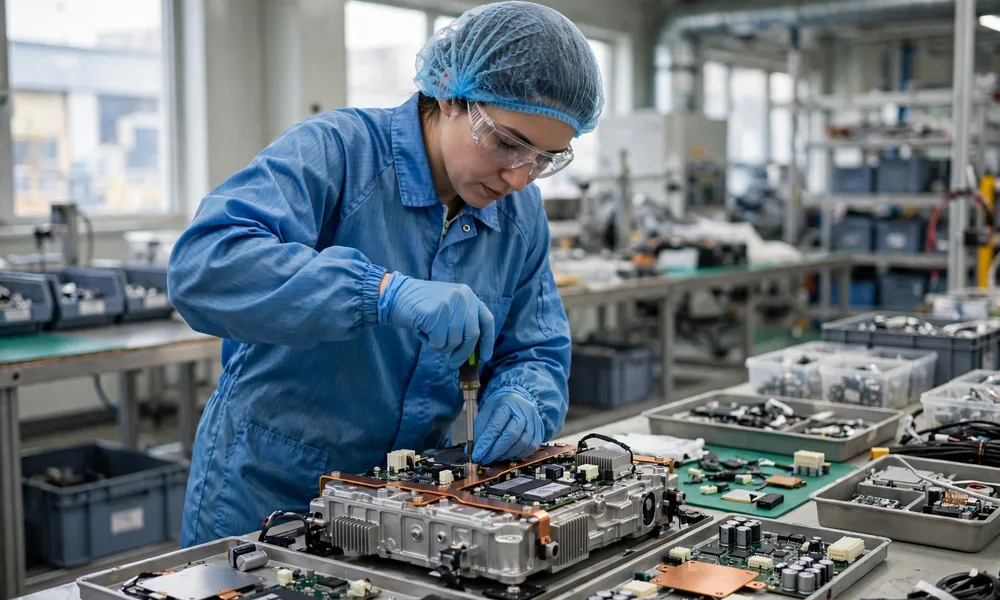
Even a very efficient inverter wastes some energy as heat, and at the power levels of a modern electric car — hundreds of kilowatts — that waste is enough to cook the electronics if it is not removed. Inverters therefore have elaborate cooling: liquid-cooled cold plates, thermal pastes, heat sinks and channels that carry coolant from the car’s main system. The power modules must be bonded to those cold plates with perfect contact, because a tiny air gap can create a hot spot that destroys a chip. The cooling system adds weight, plumbing and cost, and it must work for the life of the car without leaking or clogging. The materials that survive that heat are covered in EV inverter materials engineering.
Reason 4: It must be safe at lethal voltages
An EV battery runs at 400 or 800 volts, enough to kill, and the inverter sits directly in that high-voltage path. It must be sealed against water and dust, insulated so that no voltage can reach the car’s body, and designed so that a crash or a fault disconnects it safely in milliseconds. The housing is therefore a precision-machined, sealed enclosure, the connectors are specialist high-voltage parts, and every unit is tested for insulation, leakage and crash safety before it leaves the factory. Meeting those safety standards is not optional, and the testing, certification and documentation add a significant cost to every inverter built.

Reason 5: Efficiency is worth paying for
A one per cent improvement in inverter efficiency may sound trivial, but in an electric car it translates directly into range. A more efficient inverter means the car goes further on the same battery, or the same distance on a smaller, cheaper battery, and that trade-off is worth a great deal to a car maker. Engineers therefore spend heavily on better semiconductors, better layouts and better software, chasing fractions of a per cent. The inverter is one of the few places where spending more on a component can save money elsewhere in the car, and manufacturers are willing to pay for it, because range is the number buyers look at first.
Reason 6: Volumes are still growing
Electric cars are now built in the millions, but the inverter market is still younger and more fragmented than the engine market it replaces. Different car makers use different voltages, different motors and different inverter designs, so production runs are smaller and less standardised than they will be in a decade. The factories that make silicon carbide chips are still scaling up, and the specialist suppliers who build the power modules are few. As volumes grow and designs converge, prices will fall, but for now the inverter carries the cost of a technology that is still maturing, and of a supply chain that is still being built.
EV Inverter at a Glance
| Specification | Detail |
|---|---|
| Function | Converts DC from the battery to AC for the motor |
| Typical voltage | 400 or 800 volts |
| Power level | 150 to 400 kilowatts and beyond |
| Semiconductor | Silicon carbide or silicon IGBT |
| Switching frequency | 10,000 times a second or more |
| Cooling | Liquid-cooled cold plate |
| Main advantage | High efficiency, smooth power, long range |
| Main drawback | Expensive semiconductors and complex cooling |
What Does It Cost?
As rough estimates, an EV inverter typically costs around $1,000 to $3,000 to make, and a silicon carbide inverter for a high-performance car can cost $3,000 to $5,000 or more. Those figures are estimates, not quotes, and they vary with the power level, the semiconductor type and the manufacturer. A replacement inverter for an owner, once labour and diagnostics are included, can run to several thousand dollars, which is why it is covered by the car’s warranty for many years.
A Rare Fact
Silicon carbide, the material at the heart of the best modern inverters, was first noticed in the 1890s by a chemist trying to make artificial diamonds, and for decades it was used mainly as an abrasive for grinding wheels. It took more than a century before anyone could make it pure enough, and in large enough crystals, to use in electronics. The material that now helps an electric car travel hundreds of miles was once, quite literally, sandpaper.
An EV inverter costs so much because it is a high-voltage computer, a power station and a cooling system, all sealed into a shoebox and asked to work flawlessly for the life of the car. When it works, the driver notices nothing at all — just smooth, silent acceleration. That silence is the product, and like so much in engineering, it is expensive precisely because it is so hard to achieve.