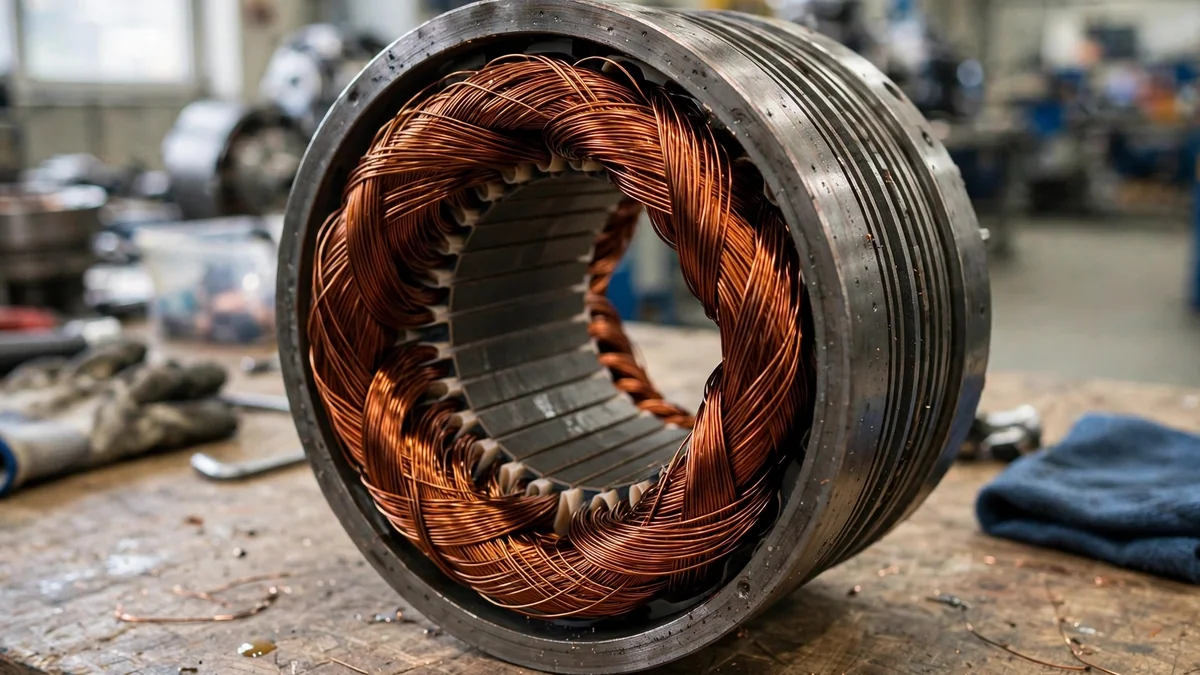
Open up an electric car motor and the first thing you see is copper. Coils of it, gleaming and precise, packed so tightly into the stator that there seems to be no room for air. Yet those copper windings are one of the most expensive parts of the motor, and the difference between a good winding and a great one is the difference between a car that goes far on a charge and one that does not.
A winding is not just wire wrapped around metal. It is a three-dimensional puzzle, shaped to squeeze the maximum amount of copper into the minimum space, cooled by oil or water, insulated against voltages that would arc through thin air, and built to survive spinning at twenty thousand revolutions a minute for the life of the car.
The cost of a winding is the cost of copper, of course, but mostly it is the cost of precision, insulation, and the machines and hands that put it all together. Here is where the money goes.
Why It Costs So Much
1. Copper is dear, and a motor needs a lot of it
Copper is one of the most expensive common metals, and an electric car motor contains several kilograms of it, wound into coils that carry enormous currents. The copper must be extremely pure, because impurities raise resistance and waste energy as heat, and it must be drawn into wire or shaped into bars with exact dimensions. The metal alone is a significant part of the winding’s cost, before any work has been done to it at all.
2. Packing copper tightly is an engineering art
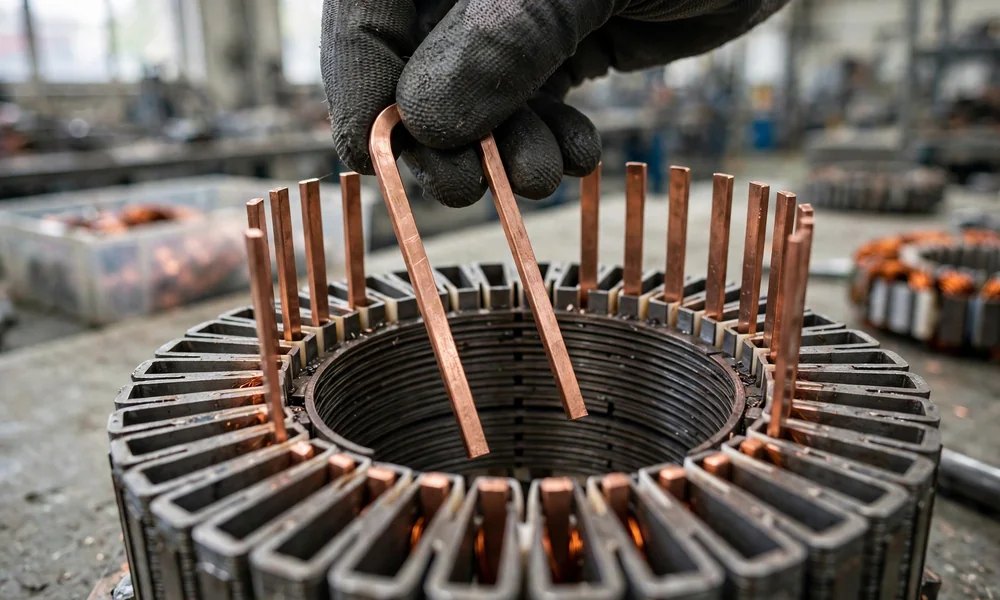
The power of a motor depends largely on how much copper can be fitted into the slots of the stator, a measure engineers call the fill factor. Ordinary round wire leaves gaps, like pencils in a box, so premium motors use flat rectangular wire, known as hairpin windings, bent into precise U-shapes and slotted in by hand or by specialised machines. Hairpins pack far more copper into the same space, but each one must be bent, inserted, twisted, and welded with exact precision. The numbers that define a winding, from fill factor to resistance, are explained in ev motor winding specs explained.
3. Insulation must survive heat, voltage, and vibration
Every turn of copper must be insulated from its neighbours, because the voltage between them can be hundreds of volts, and a single short circuit can destroy the motor. The insulation is a thin enamel coating on the wire, plus slot liners, separators, and varnish that fill every gap. It must survive temperatures over 150 degrees Celsius, constant vibration, and years of thermal cycling as the motor heats and cools. Applying it evenly and testing that no weak spot remains is slow, skilled work.
4. Heat is the enemy, and cooling is built in
A motor winding carrying hundreds of amps generates serious heat, and heat is what limits how much power a motor can make. Premium windings are cooled directly, with oil sprayed onto the copper ends or water channels cast into the housing, keeping the coils within a narrow temperature band even at full power. Designing those cooling paths, sealing them against leaks, and proving they work at every speed and load adds cost and complexity. A winding that runs cool lasts longer and makes more power, which is why the cooling is engineered as carefully as the copper itself.
5. Welding hundreds of joints without a single flaw
A hairpin winding can have hundreds of individual joints, each one welded by laser and each one a potential point of failure. The welds must be perfect: too little heat and the joint is weak, too much and the copper melts into a blob that shorts to its neighbour. Every weld is inspected, often by camera or X-ray, and a stator with one bad weld is reworked or scrapped. The laser welders, the inspection systems, and the skilled operators are all part of the winding’s price.
6. It must spin at twenty thousand revolutions a minute
An electric car motor spins far faster than a petrol engine, and the winding must hold together under forces that try to fling it apart. The coils are wedged, banded, and impregnated with resin so they cannot move a fraction of a millimetre, because movement means wear, and wear means failure. The inverter that feeds the winding its precisely timed current is part of the same story, and it is described in how ev inverter works, from battery to motor.
EV Motor Winding Specs
| Specification | Typical range |
|---|---|
| Copper per motor | About 5 to 15 kilograms, depending on motor size and power |
| Winding type | Round wire, hairpin, or concentrated windings, depending on design |
| Fill factor | About 40 to 70 percent of the slot filled with copper |
| Operating voltage | About 400 to 800 volts in a modern electric car |
| Maximum temperature | About 150 to 180 degrees Celsius for the insulation class |
| Motor speed | About 10,000 to 20,000 revolutions per minute at maximum |
| Efficiency | About 90 to 97 percent, among the highest of any motor type |
| Insulation class | Usually Class H or higher, rated for sustained high temperatures |
What Does an EV Motor Winding Cost?
A finished winding for a mass-market electric car motor is estimated at roughly $150 to $400 in materials and labour, while a premium hairpin winding for a high-performance motor is estimated at roughly $400 to $1,000. The complete motor, of which the winding is a major part, is estimated at roughly $1,000 to $3,000, depending on power and volume. The winding looks like a small part of that total, but it is the part that decides how efficient the motor is, All prices are estimates only and vary widely by design, copper price, and production volume. The winding sits at the heart of the drive unit, alongside the gears and the motor itself, as described in how ev electric axle works.
A Rare Fact
The first electric motors, built in the 1830s, were wound by hand with cotton-covered wire, The hairpin winding, now the premium standard, was actually used in early twentieth-century generators before being forgotten for decades, because the machines to make it did not exist. It came back only when electric cars demanded more power from smaller motors, and engineers realised the old idea, built with lasers and robots, could pack in far more copper than round wire ever could. A technique from the age of steam now powers the fastest electric cars on the road.

An EV motor winding is expensive because it is copper shaped to the millimetre, insulated to survive fire-level heat, welded joint by perfect joint, and built to spin faster than any engine while wasting almost no energy. It is a coil of wire that decides how far your car goes, how fast it accelerates, and how long it lasts — and the price reflects it.


