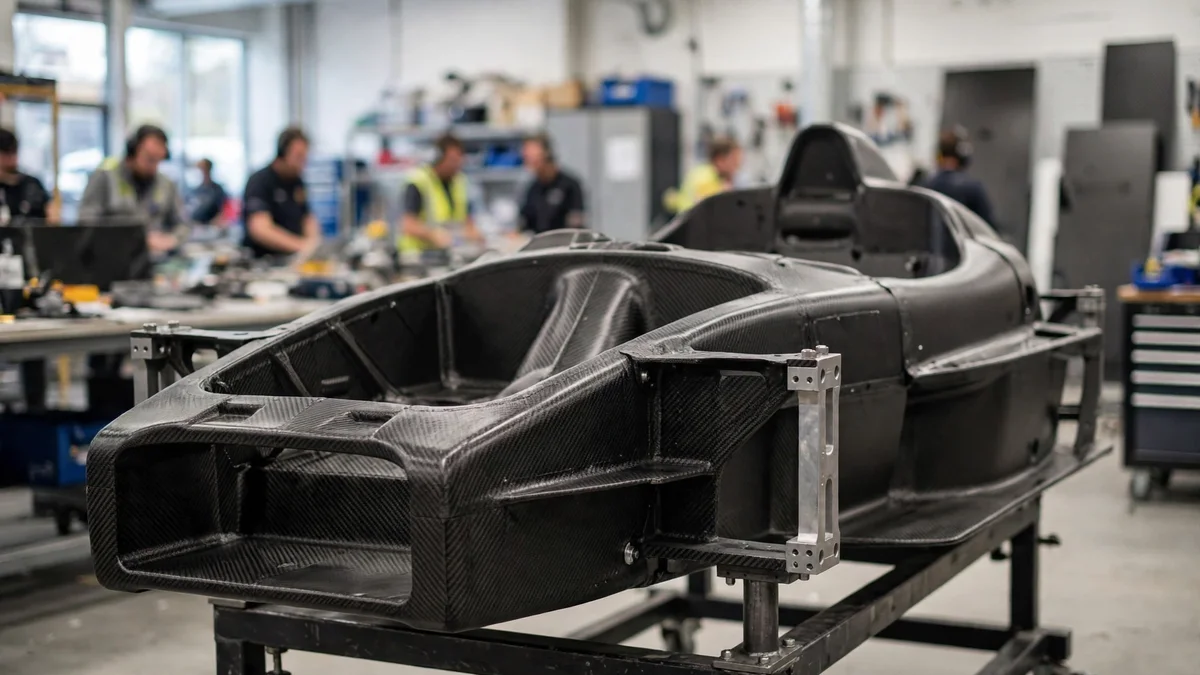
The workshop is quiet except for the soft sound of gloved hands smoothing fabric over a mould. There is no hammering, no welding sparks, no smell of hot metal. On the bench lies a shape that looks more like a sculpture than a car part: a black, woven tub, light enough for one person to lift, strong enough to protect its occupants at two hundred miles an hour. It is the chassis of a hypercar, and it is the single most expensive piece of structure in any road car ever built.
A hypercar chassis is not a frame with panels bolted on. It is the car: a single carbon fibre monocoque that carries the engine, the suspension, the driver and the passenger, and that must survive a crash that would fold a steel car in half. It is built by hand, layer by layer, over weeks, then baked in an oven the size of a small room. The price is the price of that time, that skill, and that risk.
Why It Costs So Much
A hypercar chassis looks like a single piece of black plastic, but it is hundreds of layers of carbon fibre, each one placed by hand in a precise direction, bonded with resin, and cured under heat and pressure. A mistake in any layer can weaken the whole structure, and a failed chassis is scrapped entirely. The cost comes from the material, the labour, and the fact that almost nothing about the process can be automated.
Reason 1: The fibre itself is aerospace grade
Carbon fibre is not a single material. The fibre used in a hypercar chassis is the same grade flown in fighter jets and satellites, woven into cloth with a precise pattern, and impregnated with resin that must be kept refrigerated until the moment it is used. A single chassis can consume many kilograms of it, costing thousands of dollars in raw material alone. The fibres are laid in different directions, a discipline described in inside hypercar chassis production, where each layer has a job and a place.
Reason 2: It is laid up entirely by hand
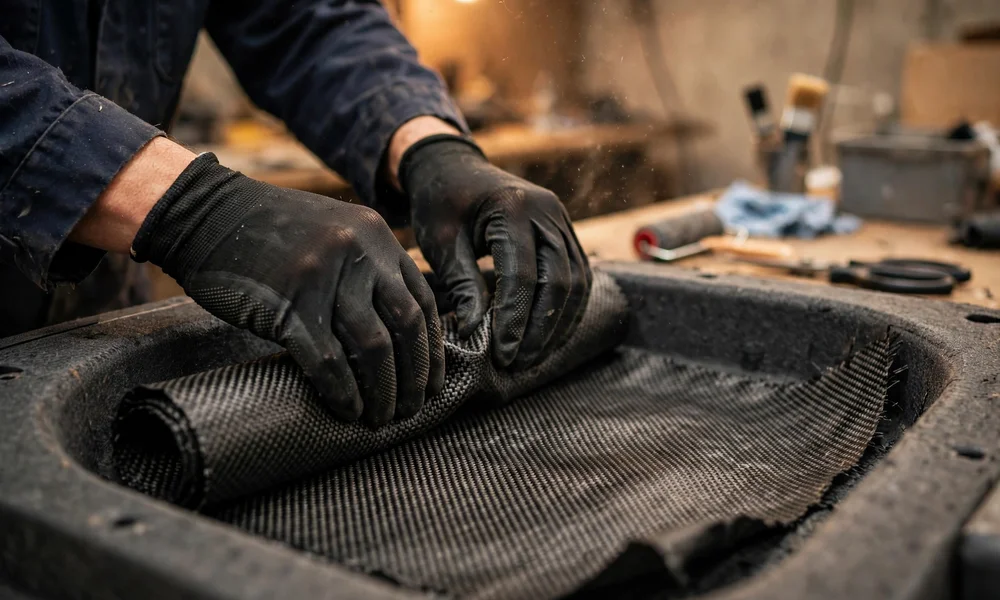
No machine can lay carbon fibre into the complex curves of a monocoque. Skilled technicians, called laminators, place each sheet by hand, smoothing it into the mould, cutting it to shape, and checking the fibre direction before the next layer goes on. A single chassis can take several hundred hours of hand work, because a wrinkle or a trapped air bubble in one layer becomes a weak point. The same philosophy runs through hypercar chassis materials engineering.
Reason 3: It is baked in an autoclave the size of a room
Once the layers are laid, the whole mould goes into an autoclave, a pressurised oven that heats the resin to cure it while squeezing out any trapped air. The autoclave must hold a precise temperature and pressure for hours, and a power cut or a faulty sensor during the cure can ruin a chassis worth tens of thousands of dollars in material and labour. The ovens cost millions to build and run, and a maker may own only one or two.
Reason 4: Metal inserts must be bonded, not bolted
A carbon fibre tub cannot simply be drilled and bolted like steel. The suspension, the engine and the seatbelts attach through titanium and aluminium inserts that are bonded into the structure during the layup, and each insert must be positioned to within a fraction of a millimetre. If an insert is misplaced, the suspension geometry is wrong, and the chassis cannot be fixed by drilling a new hole; it must be rebuilt. The same problem is solved in how a Formula 1 monocoque works, under the pressure of a racing season.
Reason 5: Every chassis is scanned and tested to destruction’s edge
After curing, each chassis is inspected with ultrasound and X-ray, hunting for voids, delamination, or trapped air that the eye cannot see. Then it is measured against its design to tolerances measured in tenths of a millimetre, because a chassis that is a millimetre out of true will never handle properly. Some chassis are deliberately crashed in testing, and the cost of those destroyed tubs is carried by the survivors. A chassis that fails inspection is not repaired; it is cut up and discarded.
Reason 6: The design is a one-off, not a platform
A normal car shares its chassis with dozens of models, spreading the development cost across millions of vehicles. A hypercar chassis is designed for one model, built in a run of a few hundred cars at most, and sometimes fewer than a hundred. The cost of designing it, of building the moulds, of crash-testing it, and of certifying it for the road is divided among a tiny number of cars, so each chassis carries a share of the development bill that would be unthinkable in a mass-market car. The moulds alone can cost millions of dollars, and they are used only for that one model.
Reason 7: It must be light, stiff, and safe all at once
A hypercar chassis must weigh less than a hundred kilograms, be stiffer than a steel frame many times its weight, and protect its occupants in a crash at racing speed. Those three demands fight each other: making it lighter usually makes it weaker, and making it stronger usually makes it heavier. The result is a structure that weighs about as much as a person and is stronger, per kilogram, than almost anything else on the road.
Specifications
| Specification | Detail |
|---|---|
| Construction | Carbon fibre monocoque, hand-laid prepreg |
| Weight | Typically 70 to 100 kilograms for the bare tub |
| Torsional stiffness | Often over 40,000 Nm per degree |
| Material | Aerospace-grade carbon fibre, epoxy resin, honeycomb cores |
| Curing | Autoclave, several hours at controlled heat and pressure |
| Inserts | Bonded titanium and aluminium suspension and engine mounts |
| Production | Hand-built, often fewer than 500 cars per model |
| Inspection | Ultrasound and X-ray scanning of every chassis |
Price
A hypercar carbon fibre chassis alone typically costs from around $150,000 to $400,000 (estimate) to produce, and it is a major part of a car that sells for $2 million to $4 million or more (estimate). There is no cheap version: the material, the hundreds of hours of hand layup, the autoclave cure, the scanning, and the development cost divided among a few hundred cars all stack up.

Rare Fact
The first carbon fibre monocoque in motorsport was built for a Formula 1 car in 1981, and it was so strong that when its driver crashed at 170 miles an hour, he walked away from a wreck that would have killed him in an aluminium car. The team had built the tub in secret, because nobody believed a plastic car could be safe, and the crash that proved them right changed racing forever. Every hypercar chassis on the road today descends from that one secret experiment.
That is the real story behind the price tag: a tub woven by hand from aerospace fibre, baked in an oven the size of a room, scanned like a patient, and built in numbers so small that each one carries the cost of its own design. It costs so much because there is no cheap way to build a structure that weighs less than a person and can survive a crash at two hundred miles an hour.