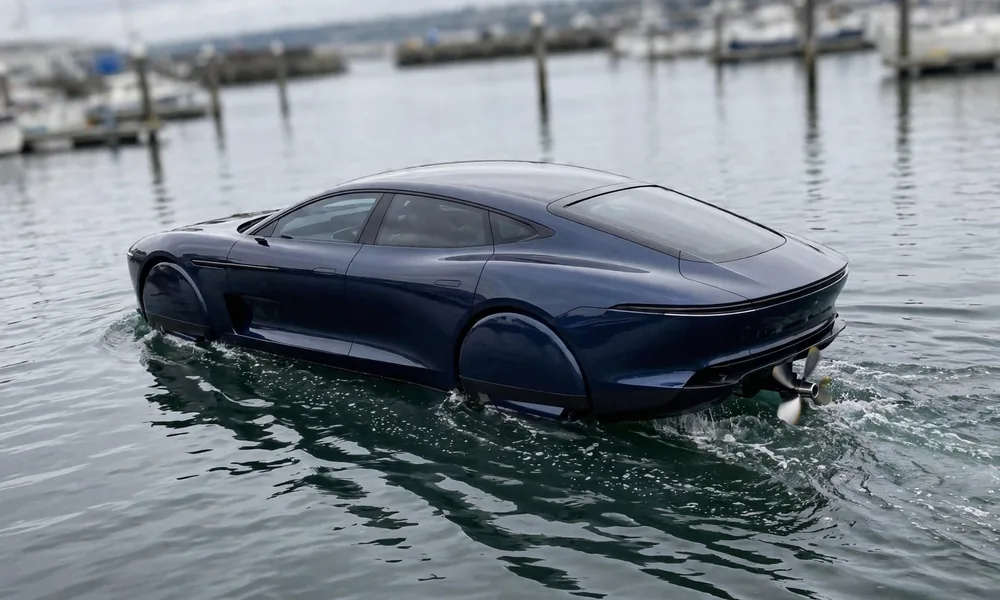
The crowd at the boat show had gathered around the car on the slipway, not because it was beautiful, although it was, but because it was about to do something cars are not supposed to do. The driver waved, pressed a button, and drove down the ramp into the harbour, while the crowd held its breath, and the car floated. A propeller unfolded at the back and the car cruised away across the water. The price on the stand read $750,000, and nobody laughed: they were looking at two machines, not one.
A luxury amphibious car is expensive because it is the hardest kind of vehicle to build, a machine that must pass the safety tests of a car and the seaworthiness tests of a boat. A car wants to be light, low, and aerodynamic, and a boat wants to be watertight, buoyant, and stable, and those two sets of demands contradict each other at almost every point. Resolving them takes engineering paid for by a few dozen buyers a year.

Two Machines in One Body
The hull is the first and largest expense, because an amphibious car does not have a car body with good seals, it has a boat hull that happens to have wheels. The hull must displace enough water to float the car, which weighs 1,500 to 2,000 kilograms, and it must do so while keeping the shape low and sleek enough to drive at motorway speeds without catching the wind like a sail. Building that hull means using marine-grade aluminium or advanced composites, shaped by hand or in small-batch moulds, and the cost of a single hull can reach an estimated $80,000 to $120,000, before the wheels, the engine, or the interior are fitted. A conventional car body, stamped by the thousand in a factory press, costs a fraction of that, and the difference is entirely due to volume.
The sealing system is the second great expense, and it is the one that keeps engineers awake at night. Every door, every window, every cable that passes through the hull, and every wheel arch must be sealed against water under pressure, and the seals must survive years of opening and closing, heat and cold, and the flexing of the hull as it moves between road and water. A single failed seal can sink the car, so makers use multiple redundant seals, automatic bilge pumps, and sensors that warn the driver the moment water is detected inside the hull. The sealing system alone can cost an estimated $20,000 to $40,000, and it is tested by floating the car for hours, then driving it, then floating it again, in a cycle that would destroy a normal car.
The drivetrain is the third expense, because an amphibious car needs two propulsion systems, one for the road and one for the water, and they must share an engine without interfering with each other. Most designs use a single engine that drives the wheels on land and a water jet or propeller in the water, through a transfer system that disconnects one and engages the other. The wheels must retract or lift clear of the water to reduce drag, and the propeller or jet must retract on land to avoid damage, and the mechanism that does both must work reliably, every time, in salt water.
Why the Price Keeps Climbing
Certification is the cost that surprises buyers most, because an amphibious car must be certified twice, once as a car and once as a boat, and the two sets of tests have almost nothing in common. Road certification covers crash safety, emissions, braking, and lighting, while marine certification covers buoyancy, stability, watertightness, and navigation lights, and the car must pass both, in full, before it can be sold. The combined cost of certification can reach an estimated $3 million to $5 million for a new model, and on a production run of 50 to 100 cars a year, that is an estimated $30,000 to $100,000 per car, before a single part is bought. That figure alone explains why there are so few amphibious cars, and why they cost so much.
The interior is where luxury makers spend money the buyer can touch, because the car must feel like a luxury car on land and a luxury boat on water. Hand-stitched leather, marine-grade teak, and a dashboard that can survive a splash all cost more than their road-only equivalents. The machine it most resembles is explained in the amphibious car specs explained guide, which breaks down how the transition from road to water actually works.
Small Numbers, Big Bills
After-sales support is the final cost, because an amphibious car needs technicians who understand cars and boats, and there are almost none. A maker must train its own network, stock spare parts that no other vehicle uses, and honour a warranty on a machine used in two environments. That promise is priced into every car. The electric side of the story is close behind, and the best luxury electric cars of 2027 ranked shows how even a road-only luxury electric car carries a premium for its battery and technology.
Insurance is the cost buyers discover last, because insuring a machine that is both a car and a boat means satisfying two kinds of risk, and some owners report annual premiums of an estimated $10,000 to $20,000. The water side of that life is familiar to yacht owners, and the electric boat specs explained guide shows how marine engineering shapes every decision about power and range.
Luxury Amphibious Car Costs at a Glance
| Cost Driver | Typical Share or Cost | Why It Is Expensive |
|---|---|---|
| Boat hull body | Estimated $80,000–$120,000 | Marine-grade hull, small-batch moulds, hand finishing |
| Sealing and bilge system | Estimated $20,000–$40,000 | Redundant seals, pumps, sensors, repeated testing |
| Dual propulsion system | Estimated $30,000–$50,000 | Road and water drive, transfer system, retracting parts |
| Marine-grade materials | Estimated $20,000–$30,000 | Corrosion-proof chassis, brakes, wiring, connectors |
| Dual certification | Estimated $30,000–$100,000 per car | Full car and boat approval spread over dozens built |
| Luxury interior | Estimated $15,000–$25,000 | Hand-finished leather, teak, waterproof dashboard |
| Warranty and support | Estimated $10,000–$20,000 per car | Specialist technicians, bespoke spares, dual-environment care |
| Total build cost | Estimated $250,000–$400,000 | Before dealer margin, marketing, and profit |
What a Luxury Amphibious Car Costs
Retail prices for luxury amphibious cars typically start at an estimated $300,000 to $500,000 for the more accessible models and climb to an estimated $750,000 to $1,500,000 for limited-run flagships, with bespoke commissions exceeding an estimated $2 million. These are estimates based on published list prices and recent sales, not fixed prices. Running costs are high too, because the car needs servicing as a car and as a boat, and it needs cleaning and inspection after every immersion in salt water.

A Rare Fact
The rarest fact about amphibious cars is that the most successful one ever built was not a luxury toy but a military workhorse: the DUKW, built in the Second World War, carried troops and supplies from ship to shore on D-Day, and more than 21,000 were made, which is more than every luxury amphibious car built since, combined, by a factor of a hundred. The luxury machines of today are the descendants of a vehicle designed to invade a continent, and they still carry its hardest lesson: a machine that works in two elements will always cost more than one that works in one.