A hypercar that can reach motorway speed in a few seconds needs brakes to match, and the best braking setups on the fastest road cars are among the most sophisticated parts on the whole machine. They have to stop a heavy, immensely powerful car again and again, from high speed, without fading and without drama. When they work, nobody notices. When they do not, everything else about the car is irrelevant.
This ranking is different from a comparison of braking technologies. It ranks the actual braking setups fitted to today’s hypercars, car by car, on stopping power, fade resistance, pedal feel, and how well the brakes work with the rest of the car. A great setup is not just big discs: it is discs, callipers, electronics, aerodynamics, and tyres working as one system.
How the ranking works
Stopping power comes first, because a hypercar brake has one job above all others: shed speed, fast, from any speed the car can reach. Fade resistance is next, since a brake that works once and then goes soft is useless on a circuit. Pedal feel matters too, because a driver who trusts the pedal brakes later and harder. Finally, integration: the best setups blend friction brakes, regeneration, and aerodynamics so the driver feels one consistent pedal.
The 10 Best Hypercar Brakes, Ranked
1. Bugatti Tourbillon
The Tourbillon has the hardest braking job in the world: stopping a heavy, 1,800-horsepower car from more than 400 kilometres per hour. Its carbon-ceramic brakes use enormous discs and multi-piston callipers, backed by an air brake that rises from the rear bodywork under hard braking to add drag and downforce exactly when it is needed. The pedal feel is superb, and the brakes stay consistent lap after lap. Nothing else works this hard.
2. Rimac Nevera
The Nevera’s brakes are the most advanced electric setup on any road car. Four electric motors provide powerful regenerative braking that recovers energy while slowing the car, blended seamlessly with huge carbon-ceramic friction brakes through a brake-by-wire system. The driver feels one pedal, not two systems, and most drivers never notice the handover. Its aerodynamics add downforce under braking, pressing the tyres into the road. It is the future of braking, already in production.
3. McLaren W1
McLaren has always built cars that brake brilliantly, and the W1 is the best of them. Its carbon-ceramic brakes are sized for the car’s hybrid powertrain, with cooling ducts that feed air directly to the discs and a brake-by-wire system that blends regeneration with friction. The pedal is firm and consistent, with the kind of feel that lets a driver brake deep into a corner with total confidence. The brake components are as light as they can be without losing strength, and the car is sharper for it.
4. Koenigsegg Jesko
The Jesko’s brakes are built for a car that can exceed 480 kilometres per hour, and they have to be, because at that speed the brakes are the only thing between the driver and disaster. Koenigsegg uses large carbon-ceramic discs with callipers developed in-house, plus active aerodynamics that deploy a huge rear wing as an air brake. The system is designed to work at speeds where most brakes would be overwhelmed, and it stays consistent through repeated stops.
5. Ferrari F80
Ferrari’s F80 uses carbon-ceramic brakes developed alongside its hybrid powertrain, with a brake-by-wire system that blends electric regeneration and friction braking. The pedal feel is classic Ferrari: firm, progressive, and full of information about what the tyres are doing. The brakes are cooled by ducts in the bodywork, and the car’s active aerodynamics add downforce under braking to keep the tyres loaded.
6. Pagani Utopia
Pagani’s brakes are the most beautiful on this list, with callipers machined from solid aluminium and finished like jewellery, but they are also seriously capable. The Utopia uses carbon-ceramic discs with a bespoke calliper design, and the pedal feel is old-school in the best way: direct, mechanical, and full of feedback, with no brake-by-wire system in the way. Pagani keeps the electronics minimal, trusting the driver rather than the software.
7. Aston Martin Valkyrie
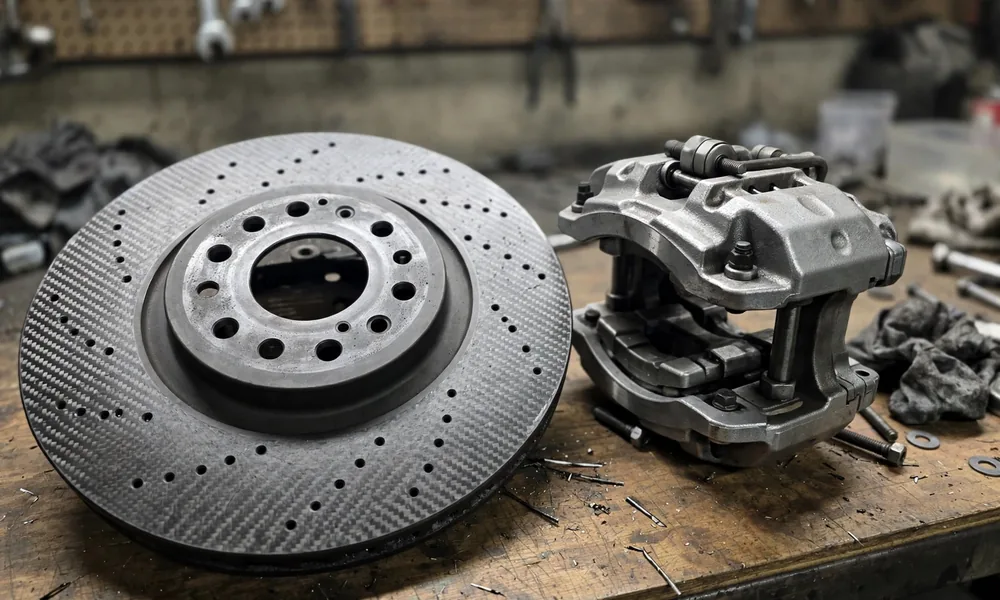
The Valkyrie is a Formula One car with number plates, and its brakes are pure racing hardware. Carbon-carbon discs, the kind used in Formula One rather than the carbon-ceramic discs of road cars, give enormous stopping power and shrug off heat that would destroy a normal brake. The pedal is brutally firm and needs real force, which is exactly what racing drivers want. They need to be hot to work properly, so they are poor on a cold morning — but on a circuit there is nothing better.
8. Lamborghini Revuelto
The Revuelto’s brakes have to handle a hybrid V12 and a heavy car, and Lamborghini’s answer is large carbon-ceramic discs with ten-piston callipers at the front, plus regenerative braking from the electric motors. The system is tuned for drama as well as performance, with a firm pedal and strong initial bite that suits the car’s character. The active aerodynamics add downforce when the driver hits the pedal. It is a setup that matches the car: loud, confident, and fast.
9. Gordon Murray T.50
The T.50 is the lightest hypercar here by a wide margin, and its brakes benefit from that lightness more than any other car on the list. A lighter car needs smaller brakes to stop, so Murray’s team could use compact, light discs and callipers that keep unsprung weight low and the steering sharp. The pedal feel is superb, with a direct mechanical connection and no brake-by-wire system, and the car’s fan-assisted aerodynamics add downforce under braking.
10. Hennessey Venom F5
The Venom F5 is built for top speed, and its brakes are built to stop a car that has just exceeded 400 kilometres per hour. Large carbon-ceramic discs and multi-piston callipers provide the stopping power, and the car’s aerodynamics add stability under braking so the driver can brake hard without the car wandering. The pedal feel is firm and reassuring, which matters when you are slowing from speeds no other road car reaches. It ranks last because the setup is simple next to the hybrid systems above — but simple and strong is what a top-speed car needs.
What makes a great hypercar brake
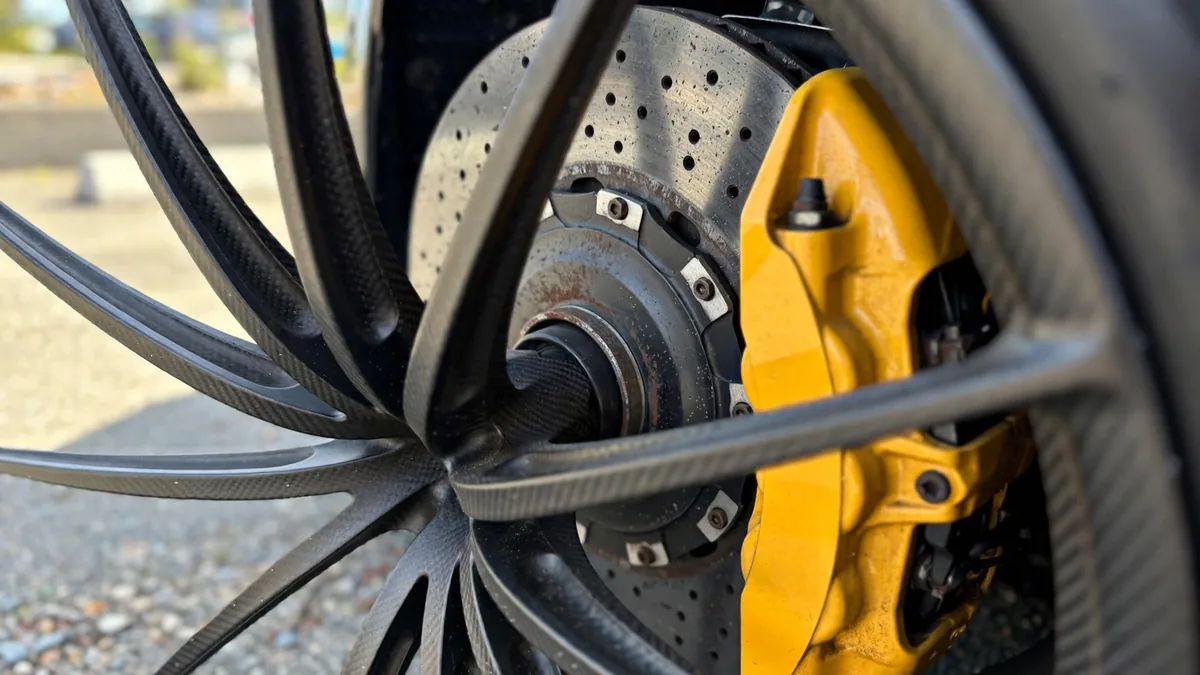
The discs get all the attention, but the callipers matter just as much. A multi-piston calliper spreads the clamping force evenly across the pad, which stops the disc evenly and resists fade, while a stiff calliper keeps the pedal firm. The best callipers are machined from solid aluminium and built to survive temperatures that would melt lesser parts. Our guide to how hypercar carbon-ceramic brakes work explains the discs and the materials that let them survive such extreme heat.
Electronics are the other half of the story. Anti-lock braking, stability control, and brake-by-wire systems all work together to keep the car stable under hard braking, and the best systems intervene only when needed, preserving the feel of the pedal. The worst systems are grabby and inconsistent, which is why brake feel is one of the first things reviewers judge. For the full picture, our comparison of the best hypercar braking systems covers the technologies themselves, and the best hypercar steering systems shows how the driver stays in control of it all.
The verdict
The Bugatti Tourbillon wins because its brakes do the hardest job in the world and make it look easy. The Rimac Nevera is second because its brake-by-wire blending is the future, already working flawlessly today. But the real lesson is that great brakes are a system, not a part: discs, callipers, electronics, aerodynamics, and tyres, all designed together.