A tandem is the most social bicycle ever made. Two riders sit in line, pedalling together, talking without turning around, sharing the work and the view. Add an electric motor, and the partnership changes: hills flatten, headwinds soften, and a couple of very different fitness can ride together at the same speed, all day, without either one waiting for the other.
That simple pleasure hides a complicated machine. A luxury electric tandem is not two bicycles bolted together. It is a single, very long frame that must carry two adults, two drivetrains, and a battery, while staying stiff enough to steer and strong enough to stop. Everything about it is doubled, lengthened, or custom-made, and almost nothing about it is mass-produced. Here is why the price climbs so high, and what the money actually buys.

How It Works
Step 1: The long frame must not flex
The frame is the first cost, and the hardest engineering problem. A tandem frame is roughly twice as long as a normal bicycle, and every extra centimetre makes it easier for the frame to twist under the pedalling of two riders. Luxury builders use oversized aluminium or carbon fibre tubes, carefully shaped and joined, sometimes with a lateral tube between the two seat tubes for extra stiffness. The frame is built in a jig that fits only a few sizes, and each one is welded or bonded by hand. The tooling and labour are spread across a tiny production run, so the frame alone can cost more than a complete mid-range bicycle.
Step 2: Two drivetrains work as one
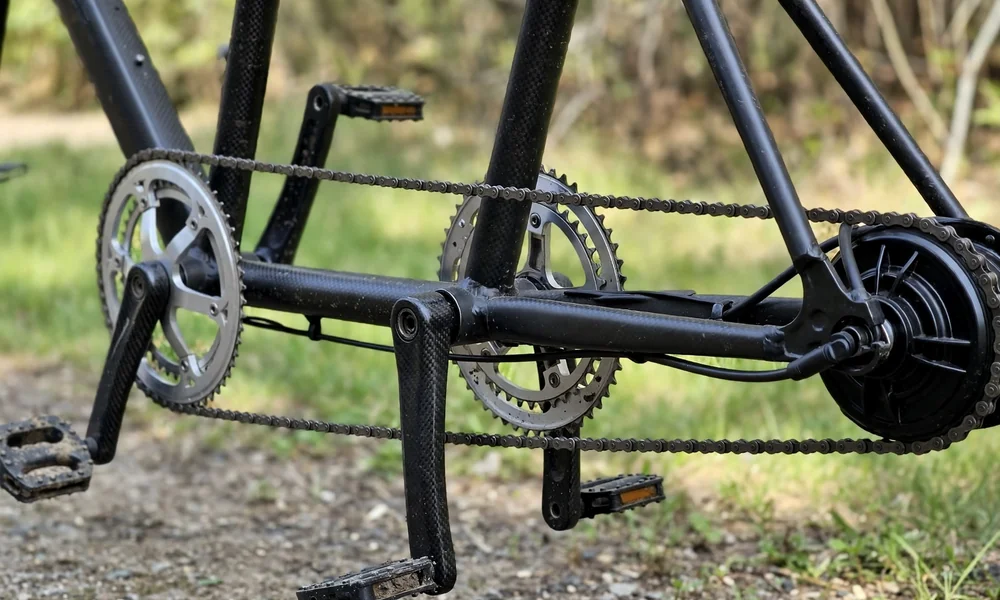
A tandem has two sets of cranks, linked by a timing chain that runs between them so both riders pedal in step. That timing chain is a part no ordinary bike has, and it must be tensioned, guarded, and maintained, because if it slips, the two riders fall out of sync and the bike lurches. The main drive chain then runs from the rear cranks to the back wheel, a long run that needs its own guides and tensioners. The whole system is fitted and adjusted by hand, because a millimetre of misalignment on a tandem is felt by both riders at once.
Step 3: The motor balances two different riders
The electric motor is what makes a modern tandem work for couples of different strength. A mid-drive motor at the cranks measures how hard both riders are pedalling and adds its own power smoothly, so the stronger rider does not drag the weaker one, and the weaker rider is not left behind on a climb. The motor must be powerful, often at the top of the legal limit, because it is moving two people and a heavy machine. Its controller is tuned for a tandem’s weight and momentum, giving gentle assistance at low speed for starts and steady power on long climbs.
Step 4: The battery must feed a heavy load
Two riders, a long frame, and a powerful motor all demand energy, so a luxury electric tandem carries a large battery, often the biggest pack a bicycle builder can fit. The battery is the most expensive single component, and its size is a direct trade: a bigger pack means longer rides together, but it also adds weight and cost.
Step 5: Brakes must stop two people at speed
Stopping a tandem is a serious job. The machine and its riders can weigh well over two hundred kilograms together, and on a descent that mass gathers speed quickly. Luxury tandems use large hydraulic disc brakes, often with four-piston callipers and oversized rotors, and some add a third brake, a drag brake on the rear wheel, that the captain can use to hold a steady speed down a long hill without overheating the main brakes. The wheels are built stronger than normal too, with more spokes, wider rims, and tougher tyres, because a wheel failure on a tandem endangers two people.
Step 6: Two cockpits, fitted to two bodies
A tandem has two cockpits, and both must fit. The captain gets handlebars, brakes, gears, and the motor controls; the stoker gets handlebars too, usually a simpler set, plus a saddle and pedals positioned for their own legs. The stoker’s position is especially sensitive, because they cannot see the road and rely on the captain’s calls, so the fit must be comfortable and secure. Fitting two people to one machine takes time, measurement, and often a second fitting after the first rides.
Step 7: Hand building and testing take time
Like the recumbent, a luxury tandem is built in small numbers by people who specialise in them. The frame is aligned and checked, the timing chain is set, the motor is tuned, the brakes are bled, and the whole machine is test-ridden, often with two test riders, before it is handed over. The builder’s knowledge is part of the price: they know how a tandem should feel, how the timing chain should sound, and how the motor should respond when two very different riders pedal together.
Key Specifications
The figures below describe a typical luxury electric tandem bike; individual builds vary.
| Specification | Typical figure |
|---|---|
| Frame material | Aluminium or carbon fibre |
| Motor power | 250 to 750 watts |
| Battery capacity | 600 to 1,200 watt-hours |
| Range | 70 to 140 kilometres per charge |
| Weight | 30 to 40 kilograms |
| Length | 2.4 to 2.7 metres |
| Brakes | Hydraulic disc, plus drag brake |
| Top assisted speed | 25 to 45 kilometres per hour |
How Much Does It Cost?
A luxury electric tandem bike typically costs from around $9,000 to $20,000, depending on the frame material, the motor, and the level of custom fitting for both riders. That is an estimate based on current specialist builders, and the top of the range usually buys a carbon fibre frame, the largest battery, and a full fitting session for captain and stoker. To see the frame technology behind it, read e-bike carbon frame specs explained for what carbon fibre does under two riders. For the frame material choice, aluminium versus carbon fibre e-bike frames compared weighs the options. And luxury electric scooter specs explained shows how the same kind of motor and battery work in a very different two-wheeled machine.

A Rare Fact
Here is something few cyclists know: the fastest bicycles in the world are tandems, and the records they hold help explain why the machines are built so strongly. A tandem’s long, low shape cuts through the air better than a single bike, and with two riders pedalling together it has more power than any solo machine. In timed trials, tandems have averaged speeds that solo riders cannot match, and the frames, wheels, and brakes built for those records are the ancestors of the luxury tandems sold today.
A luxury electric tandem is expensive because it is two bicycles engineered as one long, stiff, powerful machine, with a doubled drivetrain, a large battery, brakes built for two people, and a fitting for two bodies, all made in small numbers by hand. The money buys a machine that lets two riders share the work, the hills, and the day, at the same speed, without either one waiting.


