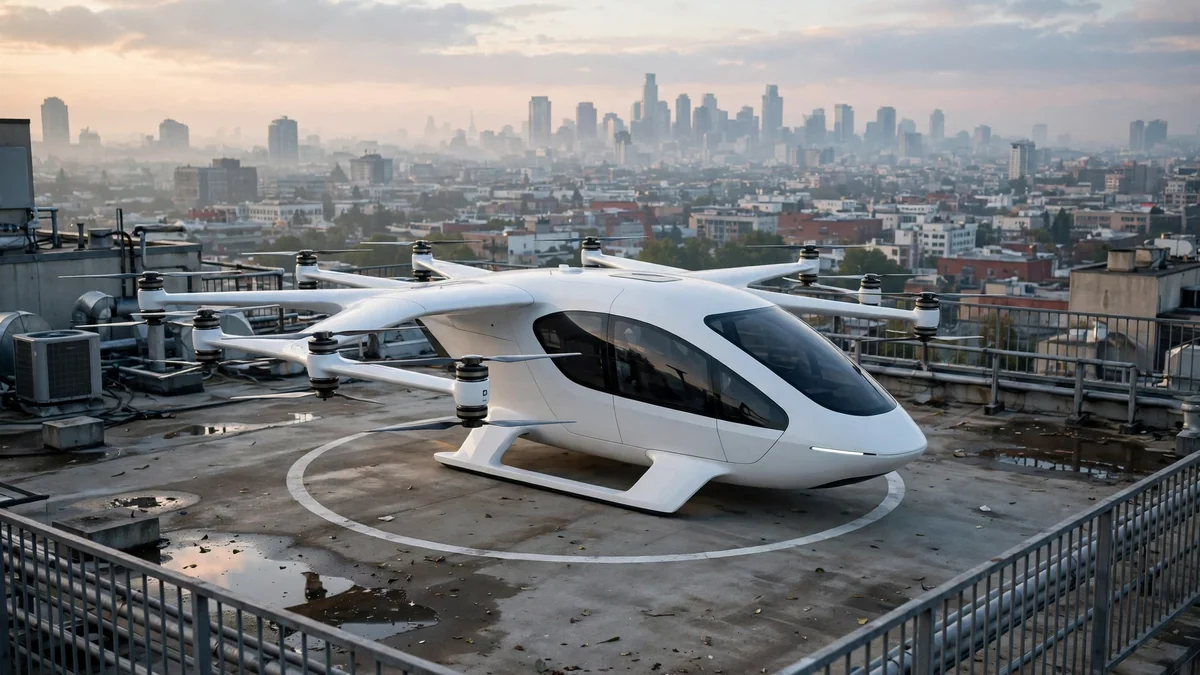
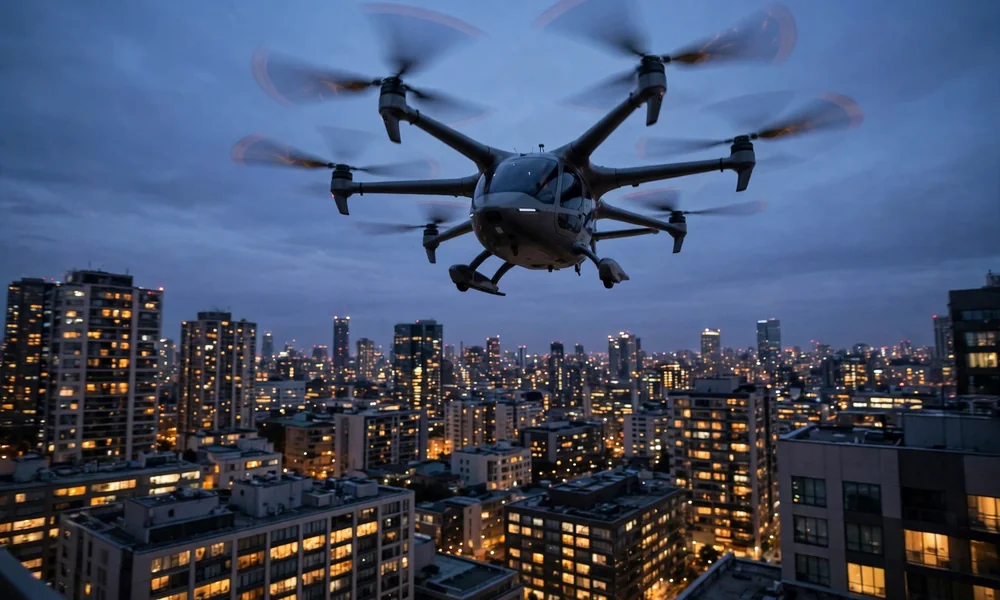
The aircraft on the rooftop pad looked like a science-fiction prop that had escaped onto a real building. It had a smooth white cabin like a small aeroplane, but instead of two big engines it carried eight small rotors on slender arms, and there was no roar, no smell of fuel, only a rising whine as the rotors spun up. The machine lifted straight off the pad, tilted forward, and flew away over the rooftops, quieter than a passing bus, leaving the watchers on the roof wondering when the future had quietly arrived.
That machine was an eVTOL aircraft, an electric vertical take-off and landing aircraft, and it is expensive because it is really several aircraft in one. It needs the batteries of an electric car, the rotors of a helicopter, the wings of an aeroplane, and the certification of all three at once. That is where the money goes.
The Batteries: The Heaviest Passenger
The batteries are the first and largest cost, because an eVTOL must carry enough energy to lift itself, fly to its destination, and still have a reserve for a missed landing. A typical luxury eVTOL carries a battery pack of 100 to 200 kilowatt-hours, similar to a large electric car, but the pack must be far lighter and far safer: it is split into separate modules so that one failure cannot take the whole aircraft down, and it is wrapped in fireproof casing because a battery fire at 2,000 feet has no good outcome. The eVTOL spec sheet lists the battery capacity because it decides the range: every extra mile needs more cells, and every cell adds weight that the rotors must then lift.
The Rotors: Many Small Wings Instead of One Big One
Most eVTOL designs use four to eight rotors instead of one big one, and that choice is both the strength and the expense of the machine. Many small rotors mean that if one fails, the others can keep the aircraft flying, and the rotors can be spread across the wings so the machine is stable in the hover. But each rotor needs its own electric motor, its own controller, and its own tilt mechanism if it must turn from vertical to horizontal flight, and each of those is a certified part with its own test programme. The rotors are also quieter than a helicopter’s, because small blades spinning fast make a different, less intrusive sound, and that quietness is a large part of why cities might allow them at all.
The Airframe and Tilt Systems: Two Aircraft in One
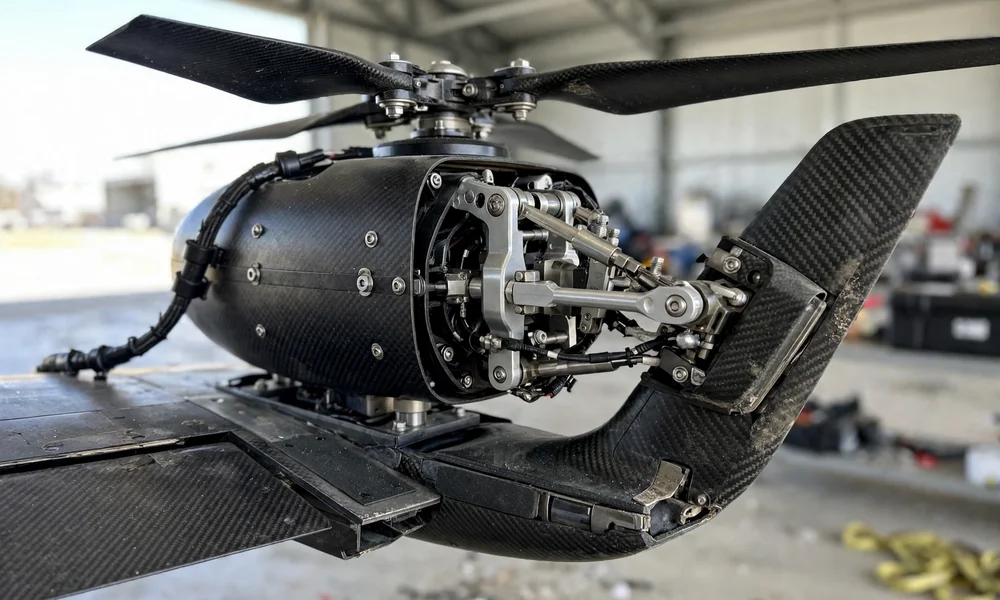
The airframe must do two jobs that normally belong to two different machines: hover like a helicopter and cruise like an aeroplane. Some designs tilt the whole wing, some tilt only the rotors, and some use separate lift rotors that stop once the wing takes over. Whichever route the maker chooses, the tilt mechanism is a complex piece of engineering, with actuators, locks and sensors that must work perfectly every time, because a rotor stuck halfway between vertical and horizontal is a serious problem. The airframe itself is built from carbon fibre, laid up by hand and cured in ovens, and it must be light enough for the batteries to lift and strong enough to survive a hard landing.
Avionics and Certification: Rules Being Written
The avionics in an eVTOL are closer to a drone than to a traditional aircraft: fly-by-wire controls, sensors that watch every rotor, and software that blends the pilot’s inputs with the machine’s own decisions. The pilot does not fly the rotors directly; the computer does, and the pilot tells the computer what to do. That software must be certified to the same standard as an airliner’s, which means every line of code is tested, reviewed and documented, and the bill for that work is enormous. Certification is the largest single cost of all, because the regulators are writing the rules for eVTOLs as they go, and the first makers are paying to prove that a whole new kind of aircraft is safe.
Manufacturing at Tiny Scale: The Volume Problem
The final cost driver is volume, or rather the lack of it. A car maker spreads the cost of a new model across millions of vehicles; an eVTOL maker spreads it across hundreds. Every mould, every test rig and every certification document is paid for by a small number of aircraft, so each one carries a large share. The supply chain is small too: there are few makers of flight-rated electric motors and battery modules, and each supplier charges for the same low-volume problem. The gyrocopter, a simpler flying machine with a free-spinning rotor, shows the contrast: with fewer systems and older rules, it costs a fraction of an eVTOL, because it asks the authorities far fewer new questions.
How It Works
- The pilot powers up the aircraft and the flight computer checks every battery module, motor and rotor before allowing take-off.
- The rotors spin up together and the aircraft lifts straight off the vertiport, rising vertically while the computer balances the thrust.
- Once clear of the pad, the rotors tilt forward, the wings begin to generate lift, and the aircraft transitions from hover to forward flight.
- At cruise the lift rotors stop or fold away, the wing carries the weight, and the aircraft flies like a small aeroplane at around 150 knots.
- The pilot follows a planned route over the city while the computer watches the battery, ready to divert to a reserve landing site if the charge runs low.
- For landing the rotors tilt back up, the aircraft slows to a hover over the pad, and the pilot lowers it gently onto the marked circle.
| Specification | Typical luxury range | Why it costs |
|---|---|---|
| Passenger capacity | 2 to 6 seats | Cabin size and certification |
| Battery capacity | 100 to 200 kWh | Range and safety systems |
| Number of rotors | 4 to 8 | Redundancy and tilt systems |
| Range | 60 to 150 miles | Battery weight and aerodynamics |
| Cruise speed | 120 to 180 knots | Wing design and motor power |
| Maximum take-off weight | 2,000 to 3,500 kg | Structure and battery weight |
| Noise at take-off | 60 to 70 dB | Rotor design and blade count |
Price and a Rare Fact
A luxury eVTOL aircraft is expected to cost an estimated 2 to 5 million dollars when certified production begins, depending on size and range, with the earliest models at the top of that range. That estimate is only the purchase price: operating it will cost an estimated 500 to 1,500 dollars per hour in electricity, maintenance and pilot time, and the battery pack, the most expensive single part, will need replacing after a set number of charge cycles. The price buys a flight across a city in minutes instead of an hour in traffic, with no fuel, no noise complaints, and a landing pad the size of a car park.
The rare fact is that the idea is older than the jet age: the first electric vertical take-off experiments flew in the 1950s, when engineers bolted electric motors to small rotorcraft and discovered that the batteries of the day were far too heavy to be useful. It took seventy years of battery progress to make the idea fly. The glider shows the other end of the same story: an aircraft that flies with no engine at all, and costs a fraction of an eVTOL, because it asks nothing of batteries, motors or software.