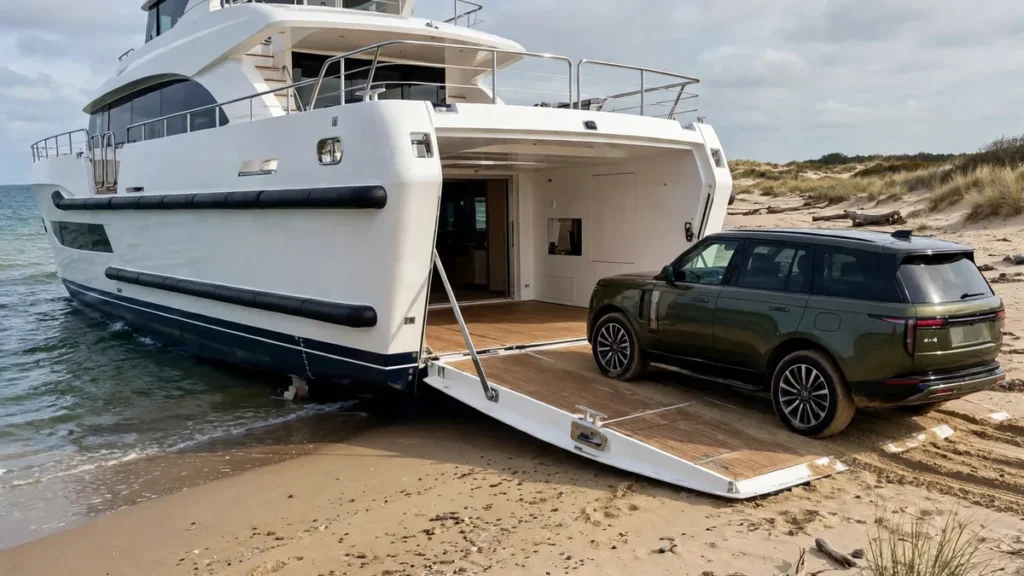
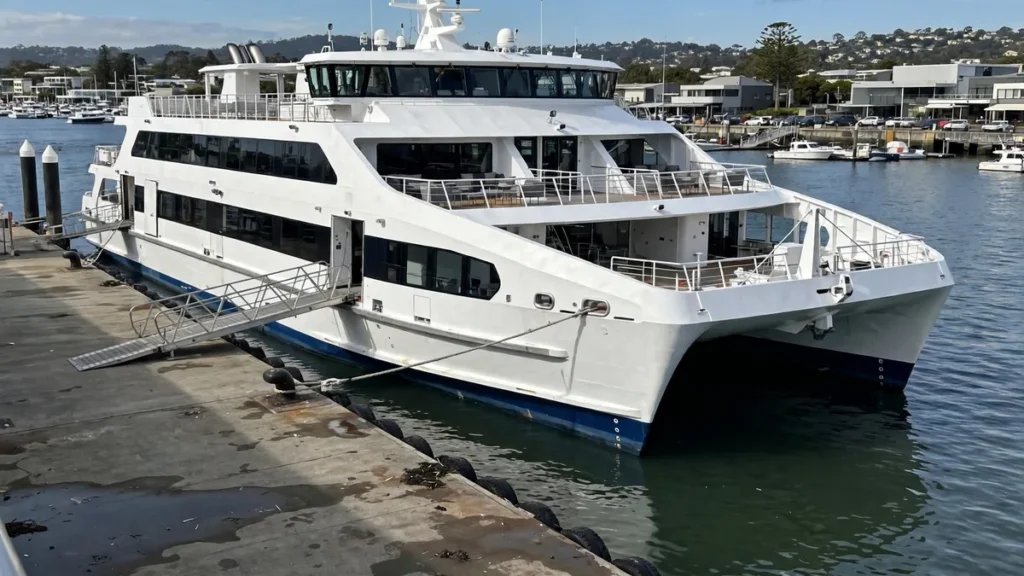
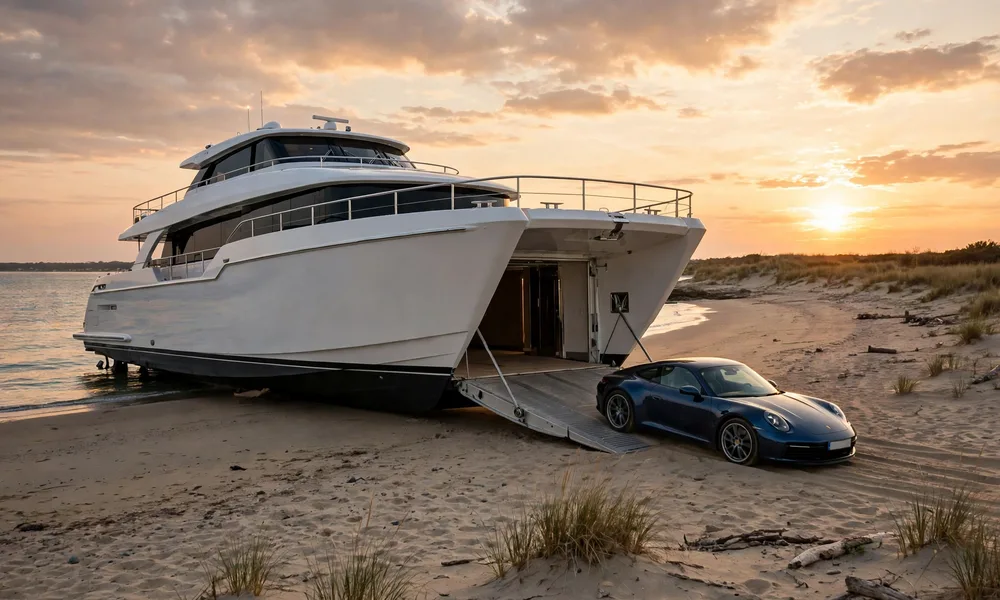
The beach is empty except for a line of white sand, a few palm trees, and a low grey shape moving slowly toward the shore. It does not look like a yacht, and it does not look like a work boat either. Its bow is flat, its deck is wide, and as it reaches the shallows the whole front of the boat swings down on hydraulic arms and settles onto the sand like a drawbridge. A small sports car rolls down the ramp, followed by a couple carrying beach bags, and behind them the crew is already unloading a table, two chairs, and a cooler. The yacht that owns this craft is anchored a mile offshore, too large to come any closer, and this is how its passengers get to the beach.
A luxury landing craft is a strange machine, half boat and half loading dock, and building one is a different job from building any other yacht tender. It has to be tough enough to grind onto sand and rock, light enough to carry a car, and finished well enough that its owners are happy to stand on it in bare feet. This is how it is made, from the first sheet of steel to the first drive up the beach. The yards that build them are small, specialist places, and a single craft can take the best part of a year to finish.

How It’s Made
Step 1: The hull is designed around the ramp, not the other way round
Every landing craft starts on a drawing board with the bow ramp, because the ramp decides everything else. The naval architect works out how wide the ramp must be to take a car or a quad bike, how far it must reach when it drops, and how much weight it can carry, and then the hull is shaped around it. The bow is flat and wide, the bottom is almost flat so the craft can sit on sand without tipping, and the sides are high enough to keep spray out when the craft is running loaded.
Step 2: Steel plate is cut, bent and welded into a shallow hull
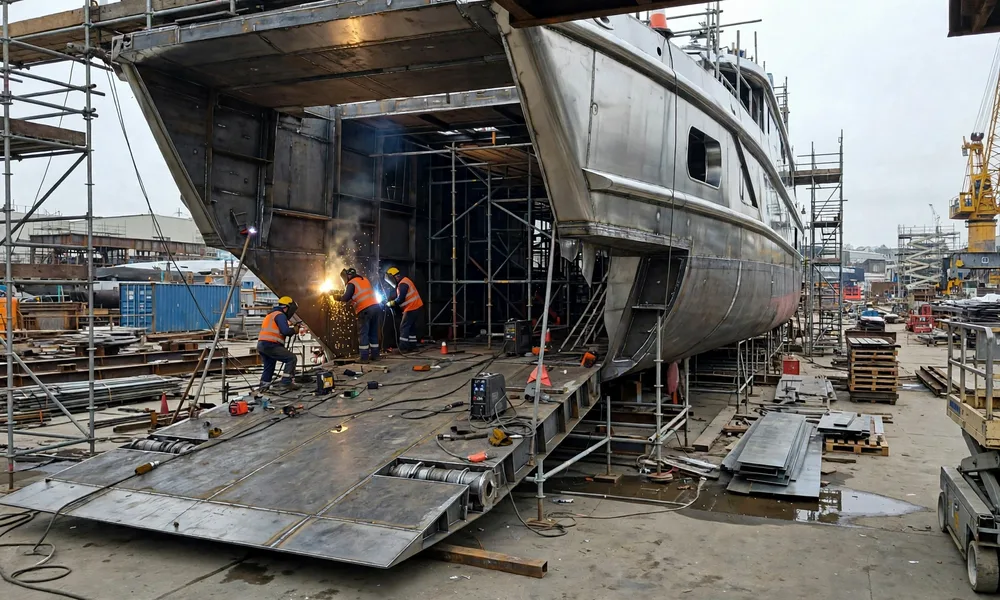
The hull is built from marine-grade steel plate, usually eight to ten millimetres thick on the bottom where it will scrape the beach, and six on the sides. The plates are cut by plasma torch to the shapes on the drawings, then bent in a press brake to form the curve of the bow and the flare of the sides, and each piece is numbered before it is moved to the building berth. Welders join the plates into a long, shallow shell, working from the keel upward, and every seam is welded inside and out so that the hull is watertight before anything else is fitted.
Step 3: The bow ramp is built, hinged and tested on dry land
The ramp is the heart of the craft, and it is built as a separate structure before it is fitted. It is a steel frame skinned with plate, stiffened with cross members, and surfaced with a non-slip deck so that cars and feet do not slide when it is wet. Two hydraulic cylinders are mounted on the hull to lift and lower it, and the hinge is made from a heavy steel pin running through greased bearings, because it has to carry the weight of a car rolling over it again and again. The way the finished craft uses that ramp in service, as how a luxury landing craft works explains, is exactly what this long dry-land test is rehearsing.
Step 4: Frames, decks and ballast give the craft its strength
Once the shell and ramp are in place, the builders weld in the frames, steel ribs that run across the hull at regular intervals and tie the bottom to the sides and the deck. Bulkheads divide the hull into watertight compartments, so that a hole in one section cannot flood the whole craft, and the engine beds are built up from heavy steel, strong enough to carry the weight of two diesel engines and their gearboxes. Builders who work on many kinds of steel boats, including the floating homes described in how a luxury barge is made, know this stage well, because it is where a bare shell stops being a shell and starts being a boat.
Step 5: Engines, steering and controls are fitted
A luxury landing craft usually has two diesel engines, each driving its own propeller, because twin engines give the skipper the fine control needed to nudge a loaded craft onto a beach and hold it there while the ramp is down. The engines are lowered into the hull on a crane and bolted to their beds, the shafts run through sealed stern tubes to the propellers, and the rudders are hung behind them. The helm is fitted at the front of the deck, often under a small canopy, with throttles, a wheel, and the hydraulic controls for the ramp within easy reach.
Step 6: The cabin, the finish and the first beaching
The last stage is the part the owners actually see. A small cabin or shaded seating area is fitted on the deck, with lockers for beach gear, a freshwater shower for rinsing off sand, and handrails polished to a yacht standard, and the whole craft is painted in the mothership’s colours, usually a deep hull colour with a pale deck. The test matters because a landing craft is judged by the moment its ramp touches the sand, and that moment is only smooth when everything before it was done properly. It is a different kind of luxury from a sailing yacht, as how a luxury yacht works shows, because the luxury here is not speed or silence, but the freedom to step ashore anywhere at all.
Luxury Landing Craft Specifications
The figures below describe a typical large luxury landing craft built for a superyacht, sized to carry a car and a dozen passengers to an undeveloped beach. Smaller tenders and military-style craft differ, but the working principles are the same.
| Specification | Typical value |
|---|---|
| Length | About 12 to 15 metres |
| Beam (width) | About 3.5 to 4.5 metres |
| Hull material | Marine-grade steel plate |
| Ramp load capacity | About 2,500 to 4,000 kg |
| Engines | Twin diesel, about 300 to 500 hp each |
| Build time | About 8 to 14 months |
What It Costs
A large luxury landing craft costs an estimated $800,000 to $2,000,000, depending on size, engines, and the standard of the finish, and the bow ramp and its hydraulics are a large share of that. Those are estimates, not quotes, and they reflect months of steelwork and fitting, much of it done by hand, plus the cost of twin diesels and the custom ramp.
A Rare Fact
Here is a detail most people never guess. A landing craft can be beached on purpose, but its flat bottom also makes it surprisingly hard to steer at speed, because there is almost no keel to grip the water, so the skipper steers largely by running the two propellers at different speeds, turning the boat the way a tank turns, with one side pushing harder than the other.