The beach is empty except for gulls and a line of wet sand, and then the bow of a boat noses towards it, slows, and stops with a soft crunch. A horn sounds, a ramp at the front of the boat swings down and thuds onto the sand, and a four-wheel-drive rolls down it and onto the beach, followed by a stack of crates, a generator, and two crew with a dog. The boat has not anchored, it has not docked, and it has not needed a harbour at all. It has simply driven itself onto the shore and opened its front door.
That is a landing craft, a boat built around one idea: the bow opens. It was invented to put soldiers and tanks on beaches, but the luxury version puts guests, cars, and supplies on islands that have no quay, no marina, and sometimes no road. It is a flat-bottomed, tough, practical boat, and its luxury is not marble or chrome but freedom, the freedom to land anywhere the water is deep enough to float it. This is how a luxury landing craft works, from the ramp at its bow to the engines at its stern.
How It Works
Step 1: The flat hull lets the boat beach itself
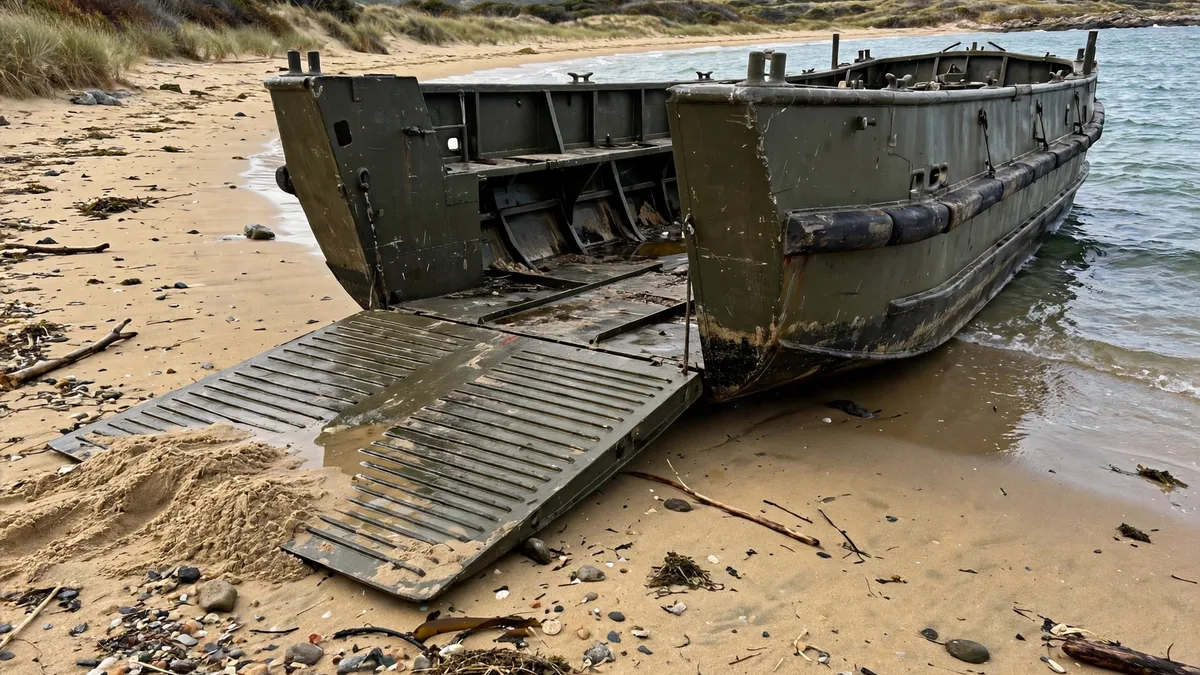
A landing craft has almost no keel, the deep fin that most boats carry underneath. Instead its bottom is nearly flat, like a barge, so it can run up onto a beach and sit upright on the sand as the tide falls. The hull is built from steel or thick aluminium plate, with extra plating on the bottom where it will grind against sand and gravel, and the flat bottom also gives the boat huge stability, because its weight is spread wide. But for a boat whose job is to touch land, the flat hull is the whole point, and everything else in the design follows from it.
Step 2: The bow ramp opens the boat like a door
The most important part of a landing craft is the ramp, a huge steel door hinged at the bottom of the bow, held closed by hydraulic rams while the boat is under way. When the boat beaches, the crew releases the rams and the ramp swings down to the sand, becoming a bridge between the deck and the shore. Vehicles drive straight on and off, and cargo is rolled or carried down the ramp without a crane. On the luxury version the ramp is wider, its surface is fitted with a non-slip deck, and it can be operated from the wheelhouse at the push of a button. A boat that works in shallow water needs this kind of thinking, and a craft that pushes through shallows with a different trick, as how a luxury hovercraft works shows, solves the same problem by floating on air instead.
Step 3: The open deck carries cars, cargo and guests
Behind the ramp is an open deck, a flat steel floor with tie-down points, low bulwarks, and space for one or two vehicles, or a stack of pallets, or a group of guests with their luggage. The deck is the working heart of the boat, and it is built to be hosed down, loaded with a forklift, and driven on by vehicles weighing several tonnes. On a luxury landing craft the deck is finished more carefully, with a painted non-slip surface, a small covered seating area, and rails that fold down for loading, and the crew can set it up as a tender garage, a dive platform, or a beach-landing ferry in an afternoon.

Step 4: Twin engines and a shallow draught keep it moving
Most landing craft carry two engines, either outboards on the transom or inboard diesels driving propellers in tunnels, shallow channels cut into the flat bottom that protect the propellers from the sand. Twin engines give the boat the power to push itself off a beach, and they give it a backup if one engine fails, which matters when the nearest help is an island away. The draught, the depth of water the boat needs to float, is often less than a metre, so the craft can work over sandbanks and into river mouths that no yacht could enter.
Step 5: The wheelhouse runs the boat like a small ship
From the wheelhouse the skipper has radar, a chartplotter, a depth sounder, and a VHF radio, and on a luxury craft there is also a small galley, a toilet, and seating for guests who would rather watch the landing from inside. The wheelhouse is built to take a pounding, with windows of toughened glass and a roof that can carry a tender or a stack of kayaks. The crew’s job is a mix of seamanship and logistics: reading the tide, judging the beach, and timing the landing so the boat grounds gently and floats off again on the rising tide. A craft that spends its life working hard for a bigger vessel, as how a luxury support vessel works explains, shares the same plain, tough philosophy, and the landing craft is the most direct version of it.
Step 6: Beaching, unloading and floating off again
The landing itself is a careful manoeuvre. The skipper approaches the beach slowly, watching the depth sounder, and eases the bow onto the sand at a gentle speed, then uses the engines to push the boat a little further up until it is firm. The ramp comes down, the cargo rolls off, and the crew unloads while the tide is still high enough to float the boat off again. Floating off is the reverse: the ramp is raised and sealed, the engines are put astern, and the boat slides back into deeper water. A hard-working boat of a different kind, as how a luxury tugboat works shows, uses the same low-speed power and patience, but the landing craft’s trick is that it never needs a harbour at all.

Luxury Landing Craft Specifications
The figures below describe a typical luxury landing craft built for yacht support and island work. Sizes vary by builder, but the working principles are the same.
| Specification | Typical value |
|---|---|
| Length | About 12 to 20 metres |
| Beam (width) | About 4 to 6 metres |
| Hull material | Steel or marine aluminium |
| Draught | About 0.6 to 1 metre |
| Engines | Twin diesels, 400 to 800 hp total |
| Payload | About 10 to 30 tonnes |
What It Costs
A new luxury landing craft costs an estimated $500,000 to $2,000,000, depending on size, engines, and finish, and a custom build for a superyacht can cost more. Those are estimates, not quotes, and they reflect the heavy steel or aluminium construction, the hydraulic ramp, and the twin-engine installation. Running costs are modest for a boat of its size, since the engines are simple diesels and the deck is built to be hosed down rather than polished, but the ramp hydraulics and the bottom plating need regular attention, because sand is abrasive and salt water is unforgiving. Most landing craft are bought as working tools, not toys, and they earn their keep by reaching places no other boat can.
A Rare Fact
Here is a detail most people never guess. The first landing craft were designed in the 1920s by a boatbuilder in Louisiana who wanted a boat that could carry timber across shallow swamps, and his flat-bottomed design with a bow ramp went on to land troops on the beaches of Normandy on D-Day.


