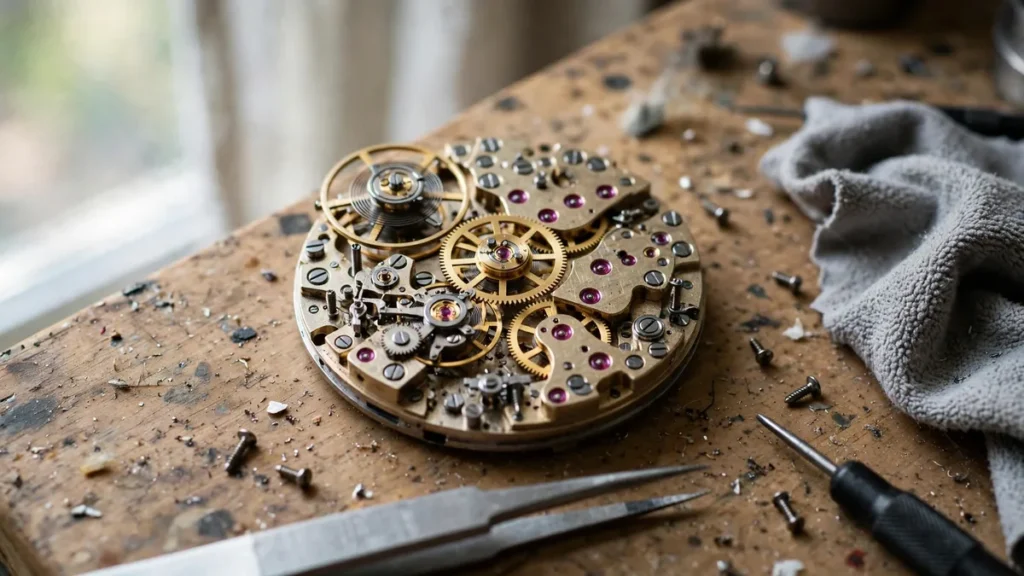
In a small workshop in the mountains, a watchmaker leans over a bench lit by a single lamp and fits a gear the size of a grain of rice into a movement no bigger than a coin. She has been working on this one watch for weeks, and it will take weeks more before it is finished. There is no battery inside it, no circuit board, and nothing that needs charging. When she winds it, a coiled spring stores the energy, and a hundred tiny parts pass that energy along, one tick at a time, until the hands on the dial show the time.
A luxury mechanical watch can cost as much as a car, and the most exclusive ones cost as much as a house, while a quartz watch that keeps better time costs a few hundred dollars. The mechanical watch is not expensive because it is accurate. It is expensive because of what is inside it, who made it, and how few of them exist. Here is where the money goes, reason by reason.

1. A movement built by hand, part by part
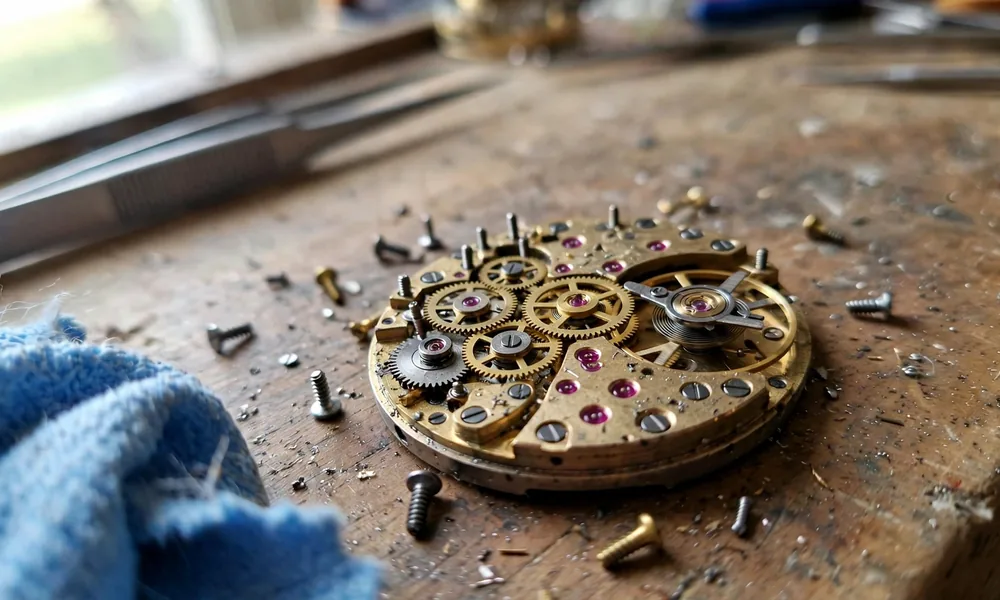
The first reason is the movement, the engine of the watch. A luxury mechanical movement contains 150 to 350 separate parts: gears, screws, springs, levers and jewels, each one made, finished and fitted by hand. The plates are polished, the edges are bevelled by hand with a file, and the screws are heated until they turn a deep blue. A single movement can take a watchmaker days to assemble, and the most complicated ones take months, because every part must fit its neighbours to within a few thousandths of a millimetre. The precision starts long before the bench, and how precision CNC machining works explains how the raw parts are cut to the tolerances a watchmaker then finishes by hand.
2. Materials that are rare, hard and beautiful
The second reason is the materials. A luxury watch case is often made from 18-karat gold, platinum, or a steel alloy that is harder and brighter than ordinary steel, and the dial may be enamel, fired in a kiln in layers until it is as smooth as glass, or meteorite, cut from a rock that fell from space.
The materials are expensive before a watchmaker ever touches them, and they are hard to work with. Gold is soft and marks easily, platinum is dense and resists every tool, and enamel can crack in the kiln after days of work, sending the dial back to the start. A watch made of ordinary materials can tell the time just as well, but it cannot feel like this one does on the wrist.
3. The labour of one person, over weeks
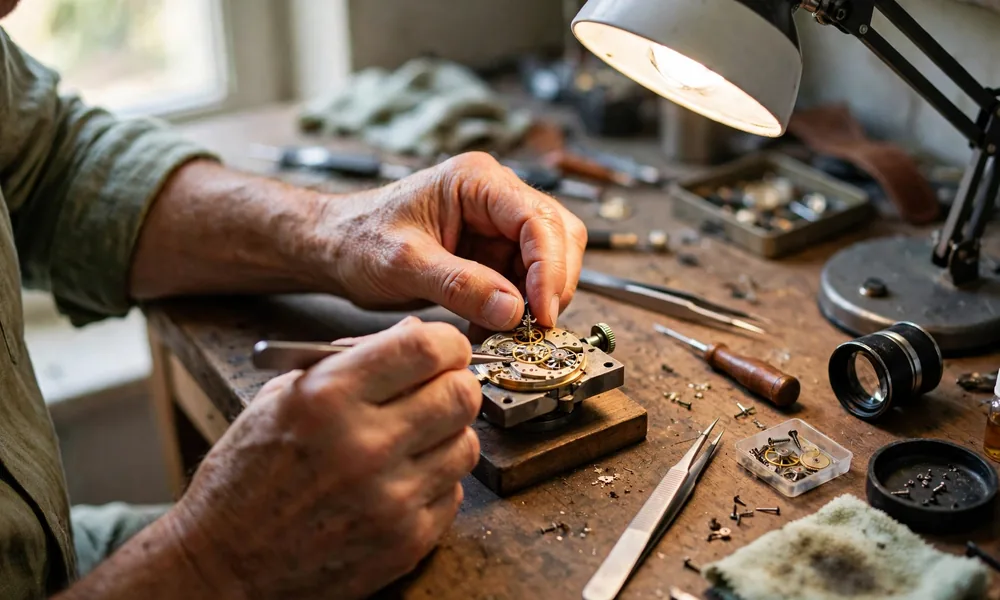
The third reason is time, measured in the watchmaker’s hours rather than the watch’s seconds. A luxury mechanical watch is assembled by one person, or by a small team, and that person is the product of years of training. In Switzerland, a watchmaker studies for three or four years before touching a luxury movement, and a master watchmaker may have twenty years of practice before she is trusted with the most complicated watches.
The assembly is slow because it has to be. Each part is fitted, tested, taken apart, adjusted and fitted again, and the finished movement is run for days or weeks while its accuracy is measured in different positions: face up, face down, on its side, warm and cold. Only when it keeps time within a few seconds a day in every position is it allowed into a case.
4. Complications: the watch that does more than tell the time
The fourth reason is complications, the extra functions a luxury watch can carry beyond hours and minutes. A tourbillon is a tiny cage that rotates the balance wheel to cancel out the effect of gravity, a perpetual calendar knows the length of every month and the leap years, a minute repeater chimes the time on tiny gongs when a lever is pressed, and a chronograph times events to fractions of a second. Each complication adds dozens or hundreds of parts, and each one must be made and fitted by hand. A smartwatch does all of this with software, and the luxury smartwatch spec sheet shows what an electronic watch measures itself by: screens, sensors and battery life, not gears and springs.
5. Scarcity, heritage and the name on the dial
The fifth reason is scarcity. A luxury watchmaker may make only a few thousand watches a year, and the most exclusive models are made in the tens, not the thousands. The waiting lists for the best-known models stretch for years, and the second-hand price of some watches is higher than the shop price, because demand far exceeds supply. Scarcity is not an accident. It is the result of a workshop that refuses to make more watches than its watchmakers can finish properly.
Heritage adds to the price as well. The oldest watchmakers have been making watches for more than two centuries, and the name on the dial carries the reputation of every watch they have ever made. Buyers pay for that history, for the knowledge that the watch on their wrist was made by a company that has survived wars, depressions and the quartz crisis, and for the certainty that the same company will still exist to service it in fifty years. The smartwatch makers tell a different story about value, and why a luxury smartwatch is so expensive explains what makes an electronic watch costly, from its screen to its sensors.
| Specification | Typical luxury figure |
|---|---|
| Movement | Mechanical, automatic, hand-finished |
| Parts | 150 to 350 |
| Power reserve | 48 to 72 hours |
| Accuracy | Within a few seconds a day |
| Case material | 18k gold, platinum or steel |
| Case size | 38 to 42 millimetres |
| Dial | Enamel, meteorite or lacquer |
| Crystal | Sapphire, scratch-resistant |
| Water resistance | 50 to 100 metres |
| Strap | Alligator leather or metal bracelet |
| Complications | Date, tourbillon or perpetual calendar |
| Service interval | 5 to 7 years |
The price, and a rare fact
A luxury mechanical watch costs an estimated $10,000 to $100,000, depending on the maker, the materials and the complications, with the most exclusive pieces costing far more at auction.
Here is the rare fact the price tag never mentions. The most accurate mechanical watches in the world are still less accurate than a cheap quartz watch, and their makers know it. A quartz watch loses a few seconds a month, while a fine mechanical watch loses a few seconds a day, yet collectors pay a hundred times more for the mechanical one. A mechanical watch asks its owner for a little attention in return, a wind every day or two, and it repays that attention by running without a battery, a charger or a software update. They are not buying accuracy. They are buying the hundred tiny parts, the weeks of handwork, and the knowledge that the watch on their wrist will still be ticking, wound by hand, a century from now.