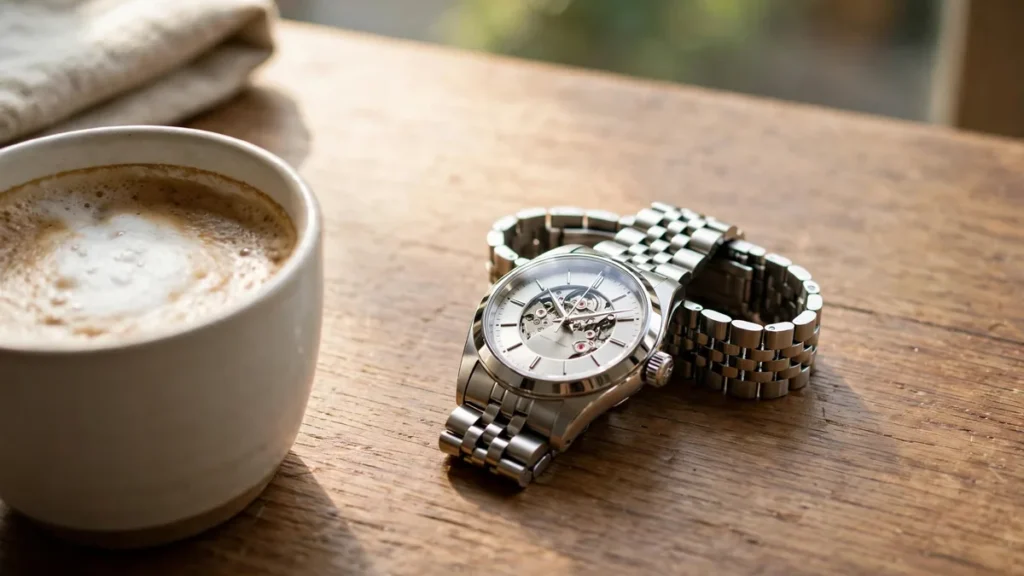
The watchmaker held the case up to the light. It was 41 millimetres across, thinner than a coin stack, and inside it there were more parts than in the engine of a small car. Inside were gears, springs, a tiny electric motor, and a battery that had to last for weeks, all fitted into a space the size of a bottle cap. The back was sapphire crystal, so clear you could watch the movement working.
That is the paradox of a luxury smartwatch. It is the smallest machine most people will ever own, and the price has very little to do with the electronics inside. A phone has more computing power and a bigger screen, and it costs a tenth as much. A luxury smartwatch costs what it costs because it is not a gadget. It is jewellery, engineering, and branding, squeezed into a case that must survive a swim, a fall, and a decade of daily wear.
What follows is why a luxury smartwatch costs so much, from the materials in its case to the name on its dial.
Small Case, Huge Bill: Why a Luxury Smartwatch Costs So Much
1. The case is made from materials that belong in a spacecraft
The first reason is the case. A luxury smartwatch case is made from grade five titanium, ceramic, or a gold alloy, machined from a solid block and polished by hand until it reflects like a mirror. Titanium is light, strong, and kind to skin, but it is difficult to machine, because it work-hardens under the cutting tool. Ceramic is scratch-proof and beautiful, but it is brittle, and a single mistake in the furnace can crack a case that took hours to shape. The frame that holds a phone together uses the same titanium, and the craft behind it is described in how a smartphone titanium frame is made, where a block of metal becomes a frame through machining, polishing, and a great deal of patience.
2. The screen is a sapphire window
The second reason is the screen. A luxury smartwatch uses a sapphire crystal cover, not glass, and sapphire is the second hardest material on Earth after diamond, which means it will not scratch against keys, coins, or a brick wall. Growing a sapphire crystal takes weeks in a furnace, and then it must be cut and polished to a thickness of less than a millimetre. Under the sapphire sits an OLED display, a panel so small and bright that it can be read in direct sunlight. The display technology is the same family as the panels in the best phones, and the numbers behind those panels are explained in OLED display panel specs explained, where brightness, resolution, and power consumption are all traded against each other in a space the size of a postage stamp.
3. The sensors are a laboratory on the wrist
The third reason is the sensors. A luxury smartwatch carries a heart-rate sensor, an electrocardiogram sensor, a blood-oxygen sensor, a temperature sensor, an accelerometer, a gyroscope, a barometer, and a compass, all of which must work while the wearer is running, swimming, or sleeping. Each sensor must be calibrated and sealed against water, and all of them must share a battery smaller than a fingernail. The lens that focuses the light for those sensors is a piece of optics in its own right, and the cost of precision optics is covered in why a smartphone camera lens is so expensive, where a lens smaller than a pea can cost more than the phone around it.
4. The battery must last for weeks in a space the size of a coin
The fourth reason is the battery. A luxury smartwatch battery holds only a few hundred milliamp-hours, a fraction of a phone battery, yet it must power a bright display, a dozen sensors, a processor, and a wireless radio, sometimes for weeks at a time. The battery is a custom shape, curved to fit the case, and built with a chemistry that prioritises safety over capacity, because a battery that overheats on a wrist is a medical emergency. The power management software that stretches that tiny battery is as important as the battery itself, turning sensors off when they are not needed and dimming the display when the wrist is down.
5. The movement is still finished by hand
The fifth reason is the hand finishing. Even a smartwatch from a luxury house is assembled and finished by hand, with a watchmaker fitting the movement into the case, sealing the gaskets, and testing the water resistance. The final inspection is done by eye, under a loupe, by someone who has spent years learning what a perfect watch looks like. That labour is expensive, and it is also the point, because a luxury watch is sold as craftsmanship.
6. The software is a medical device in disguise
The sixth reason is the software. A luxury smartwatch is not just a watch, it is a health monitor, and the software that reads a heart rhythm, detects a fall, or warns of an irregular heartbeat must be accurate enough to be trusted with a life. That software is tested in clinical trials, certified by regulators, and updated for years after the watch is sold. That ongoing support is built into the price, and it is why a luxury smartwatch keeps getting new features while a cheap watch is abandoned after a year.
7. The name on the dial is the most expensive part
The seventh reason is the name. A luxury watch house spends decades, sometimes centuries, building a reputation, and that reputation is what the buyer pays for. The name on the dial says the watch was made by a company that has survived wars, depressions, and the quartz crisis, and that it will still be there in twenty years to service the watch. That promise is worth money, because a watch is expected to outlive its owner. The brand, the heritage, and the after-sales service are all part of the price.
Luxury Smartwatch Costs
| Cost | Typical estimate |
|---|---|
| Entry luxury smartwatch | About $1,000 to $2,000 |
| Mid-range luxury smartwatch | About $2,000 to $5,000 |
| High-end luxury smartwatch | About $5,000 to $15,000 |
| Gold or ceramic case | About $10,000 to $30,000 |
| Sapphire crystal | About $100 to $300 per watch |
| Battery capacity | About 300 to 600 milliamp-hours |
| Battery life | About 7 to 30 days, depending on use |
| Water resistance | About 50 to 100 metres |
| Sensors | Heart rate, ECG, blood oxygen, temperature, GPS |
| Case materials | Titanium, ceramic, gold, or stainless steel |
What Does a Luxury Smartwatch Cost?
A luxury smartwatch is estimated to cost roughly $1,000 to $15,000, depending on the maker, the case material, and the complications, with gold and ceramic models estimated well beyond that. Servicing is estimated at roughly $200 to $500 every few years, covering a new battery, new gaskets, and a water-resistance test.
A Rare Fact
Some luxury smartwatches are tested by being frozen, heated, dropped, and submerged before testers wear them for months. One watch was even taken to the top of Mount Everest, where it kept tracking its wearer’s heart rate in temperatures cold enough to freeze a phone solid.
A luxury smartwatch is expensive because it is a spacecraft material, a sapphire window, a laboratory, a tiny battery, a hand-finished movement, a medical device, and a century-old name, all fitted into a case the size of a bottle cap.