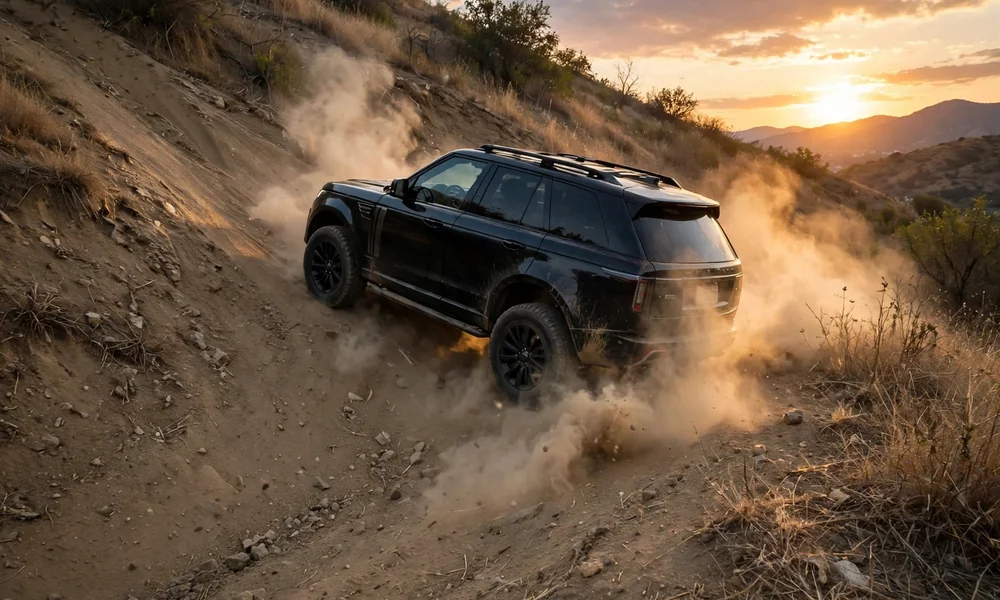
The track climbed out of the valley on loose rock, and the rain had turned the ruts into small streams. A normal car would have turned back at the first ford, but the off-roader ahead kept climbing, its wheels finding grip where there seemed to be none, its body level while the ground tilted beneath it.
A luxury off-roader is expensive because it must be two cars at once: a comfortable luxury car on the road and a near-unstoppable machine off it. This guide explains why a luxury off-roader is so expensive, and where the money goes.

Reason 1: The chassis is built like a truck
The first reason is underneath the car. A luxury off-roader usually sits on a separate ladder-frame chassis, a heavy steel frame like a truck’s, rather than the single body shell of a normal car. The frame is strong enough to twist over rocks without bending, to carry a heavy towing load, and to survive years of punishment on rough ground. Building it costs far more than stamping a car body, and it adds hundreds of kilograms that the engine and suspension must then carry.
The chassis also has to be protected. The underside is armoured with steel plates over the engine, the gearbox, and the fuel tank, because a single rock strike in the wrong place can end a journey hundreds of kilometres from help.
Reason 2: The suspension and the drivetrain are extraordinary
The second reason is the suspension and the four-wheel-drive system. A luxury off-roader has air suspension that can raise the body by more than ten centimetres to clear rocks, then lower it again for the motorway. It has locking differentials front, centre, and rear, low-range gearing for crawling down steep slopes, and a terrain system that reads the ground and adjusts the throttle, the brakes, and the suspension for mud, sand, rock, and snow.
How a luxury off-roader works shows how the drivetrain divides power between the wheels, and the price reflects the engineering: the car carries the complexity of a specialist off-road vehicle and the refinement of a luxury saloon in the same body.
Reason 3: The engine must pull a very heavy car
The third reason is the engine. Pulling a car of this weight up a steep, rocky slope demands enormous torque, so luxury off-roaders use large V8 engines or powerful hybrid systems producing 500 to 700 horsepower and more than 800 newton-metres of torque. The engine is tuned to deliver that pull at low revs, where it is needed most, and it is cooled and sealed to keep working when the car is wading through water up to its doors.
The engine is also built to last. It must survive dust, heat, cold, and altitude, and it is tested in deserts and arctic winters before the car is sold. Power like this, built to survive anything, is never cheap.
Reason 4: The cabin is a luxury car inside a truck
The fourth reason is the cabin, which is a luxury car in its own right. The seats are wide, heated, cooled, and massaging, the leather is thick and soft, and the wood and metal trim are finished by hand. The cabin is sealed against dust and water, so the doors close with a heavy, airtight thunk, and the windows are thick enough to keep the wind out at motorway speed. The rear seats have room for tall adults, and the boot swallows luggage for a family expedition.
The makers add insulation, acoustic glass, and active noise cancelling to keep the cabin calm, and every one of those measures adds cost. The luxury electric car specifications, explained show how electric rivals chase the same quiet cabin with a simpler drivetrain, and the off-roader pays more to achieve it with a heavy frame underneath.
Reason 5: The parts are rare and the numbers are small
The fifth reason is scarcity. Luxury off-roaders are built in small numbers, and many of their parts are unique to the model: the air suspension, the locking differentials, the armoured underbody, and the wading seals are shared with almost no other car. Each part is designed, tooled, and tested for a few thousand cars a year, and the cost of that work is divided among a small fleet, so every car carries a large share.
The tyres alone tell the story. A luxury off-roader’s tyres are large, heavy, and built to grip rock and mud while still riding quietly on tarmac, and a single set can cost more than a small used car.
Reason 6: The testing is brutal and long
The final reason is testing. Before a luxury off-roader is sold, prototypes are driven for millions of kilometres across deserts, jungles, mountains, and frozen lakes, and they are waded through rivers, winched out of mud, and dropped off ledges to prove the suspension can take it. The testing takes years, and the test cars are often destroyed in the process, which is the point: better to break a prototype than a customer’s car in the wilderness.
The electric vehicle battery pack specifications, explained show how the newest hybrid off-roaders protect their batteries in the same brutal tests, and the old lesson holds: a luxury off-roader is proven where there are no roads, and the proof is priced into every car.

Key specifications at a glance
| Item | Typical figure |
|---|---|
| Chassis | Ladder frame, steel, armoured underbody |
| Engine | V8 or hybrid, 500 to 700 horsepower |
| Torque | 800 newton-metres or more |
| Kerb weight | 2,500 to 2,800 kilograms |
| Ground clearance | Up to 300 millimetres, suspension raised |
| Wading depth | Up to 900 millimetres |
| 0 to 100 km/h | 5 to 6 seconds |
| Towing | Up to 3,500 kilograms |
What a luxury off-roader costs
As an estimate, a luxury off-roader typically costs between 120,000 and 300,000 dollars, depending on the engine, the trim, and the options. The chassis, the suspension, and the drivetrain account for much of the price, the hand-finished cabin for more, and the years of brutal testing for the rest.
A rare fact
Here is a rare fact: the wading depth of a luxury off-roader is tested by driving the car through a pool with its doors sealed and a snorkel on the roof, while engineers inside watch for the first drop of water. The test is repeated until the seals hold, and the car is rated to cross water nearly a metre deep, which is deeper than most rivers it will ever meet. It is a strange test for a luxury car, but it is the one that owners remember when the road disappears under water.
The expense of a luxury off-roader is the cost of building two cars in one body: a truck that can climb a mountain and a luxury car that can cross a continent in comfort. Take the chassis away and it becomes a soft-roader; take the cabin away and it becomes a work truck. The price is both, built together, and the mud on the tyres is the proof.