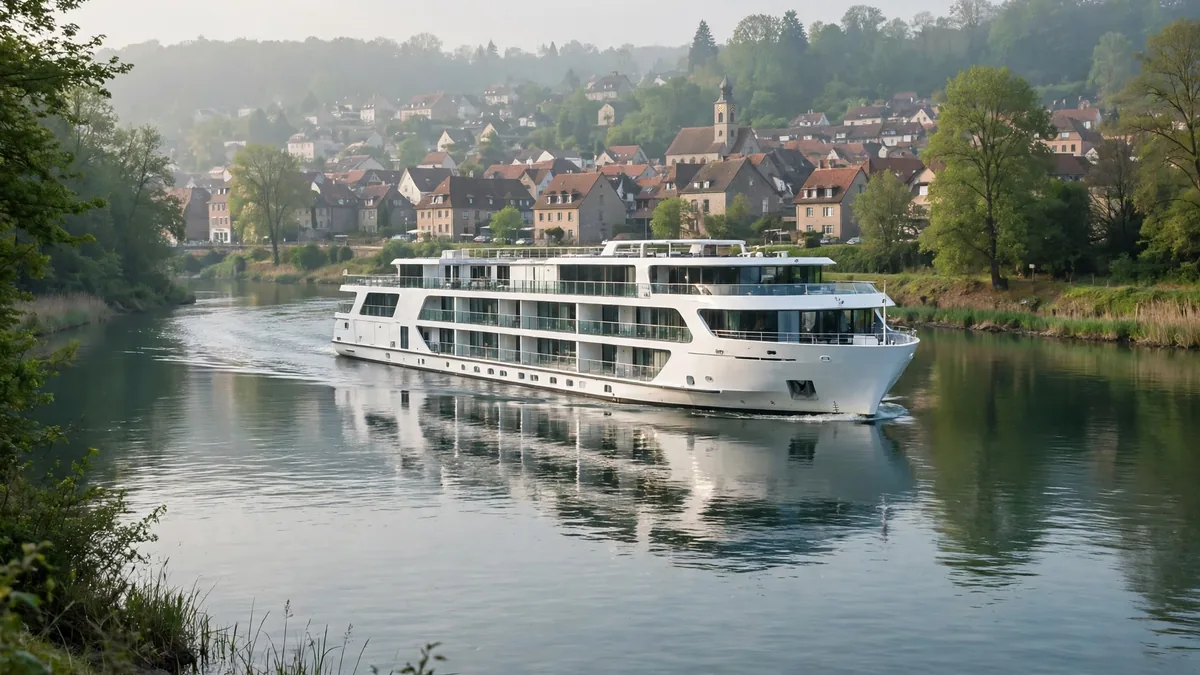
The river cruise ship slipped under the old stone bridge with less than a metre to spare, its wheelhouse lowered flat against the roof, and the passengers on the sun deck ducked without being asked. On the bank, a walker watched the ship glide past, all glass and brass and white paint, and wondered how a vessel that small could cost so much. It was shorter than a football pitch, it carried fewer people than a village hall, and the price tag had more zeroes than the walker expected.
A luxury river cruise ship is expensive for reasons that are easy to miss, because most of the cost is hidden in the shallow hull, in the low bridges, and in the fact that a ship built for a river cannot be built like a ship built for the sea. This guide follows the money, from the draught to the dining room, so the price reads like a list of reasons instead of a mystery.
Shallow draught: a ship that floats on very little water
The first and largest cost is the shallow draught. A river cruise ship must float in water that is sometimes only two metres deep, so its hull is wide, flat and carefully shaped to spread the weight. Designing a hull that carries 150 passengers and a full hotel on less than two metres of water is a specialist job, and the naval architects who can do it charge accordingly. The guide to how a luxury river cruise ship works explains how the flat hull, the ballast and the twin propellers work together to keep the ship steady in shallow water.
Locks and low bridges: a ship that folds itself up
The second reason is the locks and the bridges. A river cruise ship passes through locks that are barely wider than the ship itself, and under bridges that are sometimes only a few metres above the water. To fit, the wheelhouse lowers on hydraulics, the funnel folds flat, the sun deck furniture is designed to collapse, and even the radar mast drops down.
Every folding part is a piece of engineering. The hydraulic system that lowers the wheelhouse has to work perfectly, every time, in rain and in heat, because a wheelhouse that will not lower means the ship cannot pass the next bridge. The guide to luxury cruise ship specs explained covers the same ideas on an ocean ship, and the contrast shows why a river ship is harder to build: the ocean ship never has to fold itself in half.
Small ship, full hotel: luxury per guest
The third cost is the luxury itself, squeezed into a small ship. A river cruise ship carries 100 to 200 passengers, but it still needs a restaurant, a lounge, a spa, a sun deck and cabins with balconies, and every one of them has to fit inside a hull that is only about 11 metres wide. The cabins are smaller than ocean cabins, but they are finished to the same standard, with marble bathrooms, fine linen and floor-to-ceiling glass.
The cost per guest is the number that shocks people. An ocean cruise ship spreads its build cost across 5,000 passengers, while a river cruise ship spreads its cost across 150. That means each river passenger is paying for a far larger share of the ship, and the fare reflects it. The guide to how a luxury yacht is made shows the same maths on a smaller scale: fewer guests, more cost each, and a higher standard to justify it.

Custom builds in small numbers
The fourth reason is the volume. Only a handful of luxury river cruise ships are built each year, and each one is tailored to a particular river, with its own draught, its own bridge heights and its own lock sizes. A ship built for the Danube cannot simply be moved to the Rhine, because the locks are different, and a ship built for the Mekong faces different water levels entirely.
That means there is no mass production. Every river cruise ship is close to a one-off, designed, modelled and built for one river, and the design cost is spread across a single hull. A shipyard that builds ocean ships can reuse a design ten times, but a river shipyard starts nearly from scratch with every order.
River ports, fees and a short season
The fifth cost is the river itself. River cruise ships pay docking fees in every town they visit, and the popular towns charge a premium for the best moorings. The ship also needs a local pilot on some stretches, and the crew has to be trained in the rules of each river, which change from one country to the next.
A crew that does everything
The sixth reason is the crew. A river cruise ship carries 40 to 50 crew for 150 passengers, which is a ratio of one crew member for every three or four guests. The crew does everything: they drive the ship, cook the meals, clean the cabins, guide the excursions and run the bar, and many of them do several of those jobs in a single day.
The numbers at a glance
| Specification | Mid-size river cruise ship | Large river cruise ship |
|---|---|---|
| Length | 110 metres | 135 metres |
| Beam | 11 metres | 12 metres |
| Draught | 1.6 metres | 1.8 metres |
| Passengers | 150 | 190 |
| Crew | 40 | 50 |
| Suites with balconies | 60 | 90 |
What a luxury river cruise ship costs
A mid-size luxury river cruise ship costs an estimated 25 to 40 million dollars to build, while a large one costs an estimated 45 to 70 million dollars. That is far less than an ocean cruise ship, but it buys a ship that carries only a fraction of the passengers, so the cost per berth is far higher. The shallow hull, the folding wheelhouse and the custom design are the biggest drivers of the price, followed by the luxury fit-out.
The fare makes more sense when you count what it includes. A river cruise fare covers the cabin, the meals, the excursions and the transport between towns that are often unreachable by road, and the ship docks in the centre of each town rather than in a distant port. The passenger is not paying for a ticket, they are paying for a share of a small, folding, shallow-water hotel that sails.
A rare fact
Some river cruise ships carry a swimming pool on the sun deck that can be covered and turned into a cinema in the evening, because there is no room for both. The pool floor rises on hydraulics until it is level with the deck, the loungers are wheeled away, and by nightfall the passengers are watching a film where they were swimming that afternoon.

The next time a river cruise price tag makes you blink, count the passengers, then count the bridges, then count the centimetres under the hull. A shallow draught, a folding wheelhouse, a custom design and a crew that does everything add up to a ship that costs far more than its size suggests, because in every way that matters, it is doing a harder job than a ship ten times its size.