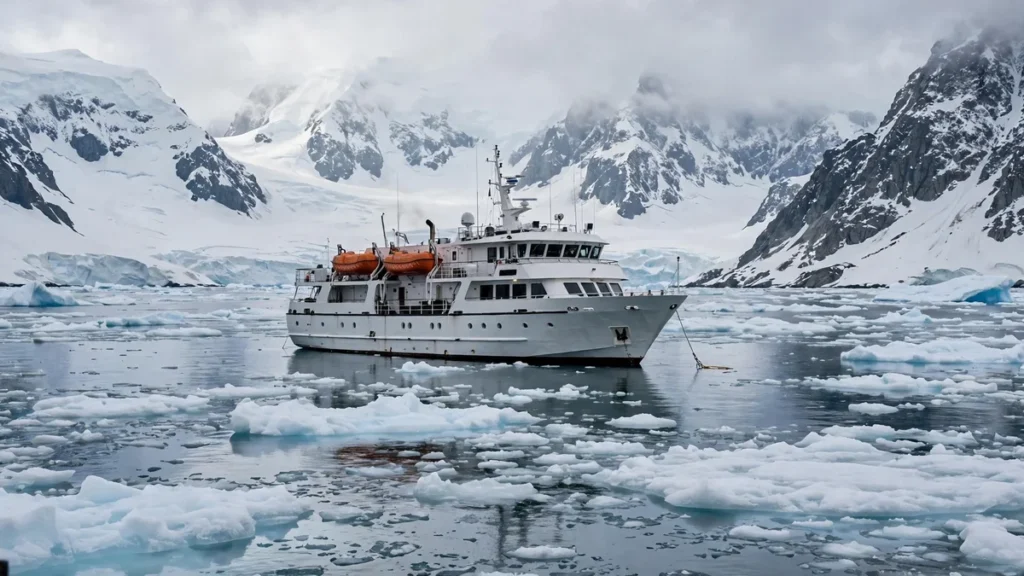
From the harbour wall, the ship looked less like a vessel and more like a small town that had learned to float. Balconies stacked fifteen decks high, lights coming on in the cabins as evening fell, and a thin line of smoke rising from the funnel. Somewhere inside, two thousand people were sitting down to dinner, and the ship was already moving, so smoothly that the glasses on the tables did not tremble.
A luxury cruise ship is a floating city, and its spec sheet is the only honest way to compare one ship with another. Gross tonnage, service speed, passenger space ratio and stabilisers all sound like jargon, but each one shapes the holiday you actually get. This is what a luxury cruise ship spec sheet means, number by number.

The spec sheet at a glance
- Gross tonnage: roughly 50,000 to 180,000 GT for a large luxury ship
- Length: roughly 220 to 345 metres
- Beam (width): roughly 30 to 47 metres
- Passenger capacity: roughly 600 to 5,000 guests, depending on the ship
- Crew: roughly 600 to 2,000, often close to one crew member per guest on luxury ships
- Service speed: roughly 18 to 24 knots
- Propulsion: diesel-electric or LNG-powered, driving azipod propellers
- Passenger space ratio: roughly 40 to 70 GT per guest, higher is roomier
- Stabilisers: retractable fins that cut rolling in rough seas
- Decks: roughly 10 to 20 passenger decks
- Fuel capacity: thousands of tonnes, giving a range of many thousands of nautical miles
- Price: roughly $500 million to $2 billion to build, as an estimate
Gross tonnage: size measured in volume, not weight
Gross tonnage is the number that confuses almost everyone, because it is not a weight at all. It is a measure of the enclosed volume of the ship, and it is the closest thing to a single figure for how big a cruise ship feels. A ship of 100,000 gross tonnes is roughly twice the internal volume of a 50,000-tonne ship, which means twice the space for cabins, restaurants, theatres and decks.
Luxury ships are often smaller in gross tonnage than the biggest mass-market ships, and that is a deliberate choice. A smaller ship can enter ports the giants cannot reach, and it carries fewer guests, which means shorter queues and more personal service. The tonnage figure only makes sense when it is read next to the passenger count, which is why experienced cruisers look at both numbers together. The way such a ship is put together, from steel plates to finished cabins, is described in the guide to how a luxury cruise ship is made.
Passenger space ratio: the number that predicts comfort
The passenger space ratio is gross tonnage divided by the number of guests, and it is the best single predictor of how crowded a ship will feel. A ratio of 40 means a busy, lively ship, while a ratio of 60 or 70 means wide corridors, empty sun decks and restaurants where you never wait for a table. Luxury ships aim for the high end of that range, and it is one of the main things the higher fare is paying for.
Speed and propulsion: how a floating city moves
A luxury cruise ship sails at a service speed of roughly 18 to 24 knots, which is about 33 to 44 km/h, and that modest speed is a deliberate trade-off. Going faster burns far more fuel for little gain, and cruise itineraries are planned around overnight sailing, so the ship arrives at the next port in the morning. The top speed is rarely used, and the service speed is the number that matters.
Most modern ships use diesel-electric or LNG propulsion, where engines generate electricity and electric motors turn the propellers. Many ships use azipods, propeller units mounted in pods that rotate beneath the hull, which let the ship turn, dock and even move sideways without tugboats. The system is quieter than a direct drive, and that quiet matters when cabins sit directly above the engine rooms. A smaller, faster craft shows the same ideas in miniature in the guide to luxury jet ski specs explained, where thrust, hull and speed are read together.

Stabilisers: the hidden reason the ship feels steady
Stabilisers are retractable fins that extend from the sides of the hull underwater, and they are the reason a modern cruise ship can cross rough water without the dining room turning into a disaster. Sensors detect the roll of the ship and tilt the fins to push back against it, cutting the roll by most of its force. On a calm day they stay tucked away, and in a swell they deploy automatically.
Crew ratio and decks: service measured in people
The crew-to-guest ratio is the luxury ship’s most expensive number. A mass-market ship may carry one crew member for every three guests, while a luxury ship can approach one crew member per guest, and that staffing level is what makes the service feel personal: a waiter who remembers your order, a cabin steward who knows your name, and a concierge who can arrange a table ashore at short notice.
The number of decks, roughly 10 to 20 on a large ship, decides how the ship is laid out. Public spaces sit low and central, cabins stack above them, and the top decks hold pools, sunbathing areas and open-air restaurants. A well-designed ship keeps the walk from cabin to dining room short, and the deck plan is worth studying before booking, because a cabin at the far end of a long ship can mean a ten-minute walk to breakfast.
Hull, fuel and range: the engineering underneath
The hull of a cruise ship is built from steel plates welded into a double-bottom structure, with compartments that can be sealed off if one is damaged, and the steel has to survive decades of salt water, storms and constant use. The hull form is a compromise between speed, stability and fuel economy, and naval architects spend years refining it before the first plate is cut. The same steel-hull thinking, on a smaller and grander scale, is described in the guide to how a superyacht steel hull is made.

Price: what the money buys
A large luxury cruise ship costs roughly $500 million to $2 billion to build as an estimate, and the price goes into the hull, the propulsion system, the stabilisers and the thousands of cabins and public rooms inside. The interior fit-out alone can cost hundreds of millions, because every cabin is effectively a small hotel room that has to survive constant use and salt air, and every restaurant, theatre and spa is built to hotel standards.
A rare fact worth knowing
A large cruise ship carries its own water-making plant, and it can produce hundreds of tonnes of fresh water a day by desalination, turning seawater into drinking water. The ship also treats its wastewater on board to a standard cleaner than many coastal towns, because it cannot simply discharge it. On a long ocean crossing, the ship is entirely self-sufficient for water, which is a quiet engineering feat that no guest ever sees and every guest depends on.