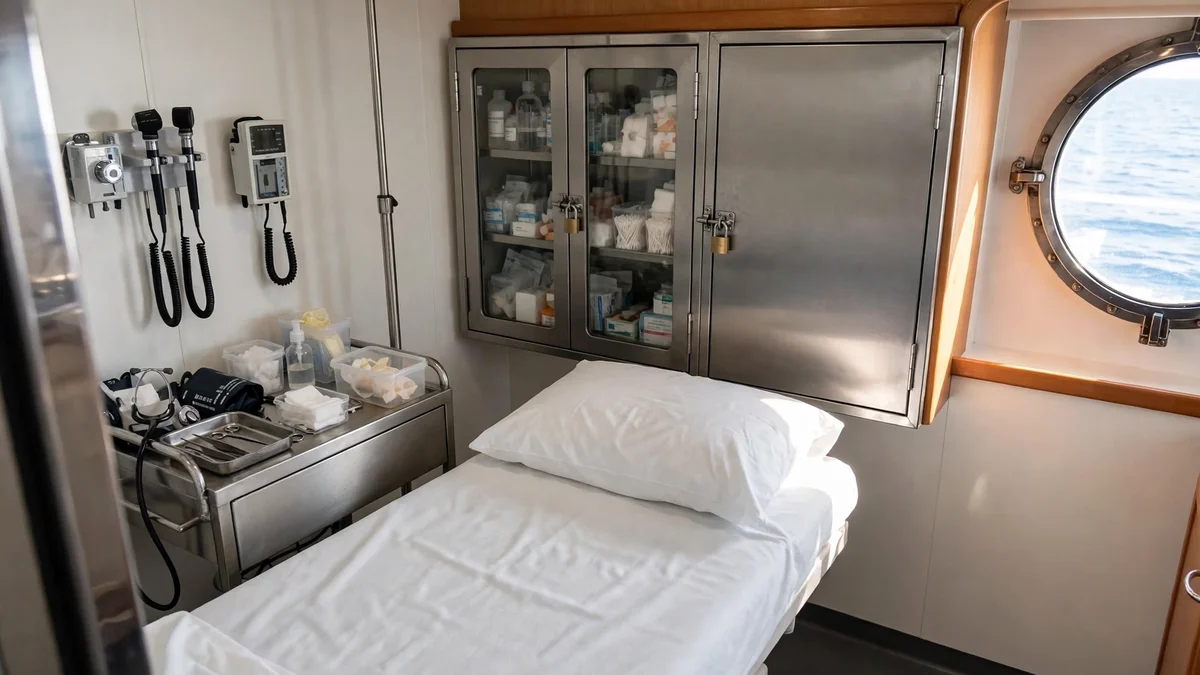
On a large ship at sea, far from any port, there is a small room with a white floor, a locked cabinet, and a bed bolted to the deck. It looks like a clinic, except its patients cannot be sent to a hospital, its doctor may be a trained officer, and the nearest help may be a helicopter hours away. This is the medical bay, and it is one of the most expensive rooms on the ship.
A medical bay on land is a room in a hospital. A medical bay at sea is a hospital in a room, built into a hull that rolls, vibrates, and may be days from shore.
1. The room itself, and the clinic it has to be
The first cost is the room, because a ship medical bay starts with a space that has to be clean, bright, and easy to wash down. Builders line the walls and floor with smooth, sealed surfaces, fit a hand basin with hot water, and lay a floor that can be disinfected after every patient. The bed is bolted to the deck so it cannot slide in a swell, and the lighting is bright and shadow-free.
The room is usually placed near the centre of the ship, where the motion is least, and close to a lift that can carry a stretcher to the deck. An isolation area, where fitted, is a second small room beside the main bay, so a contagious patient can be kept apart. The cabins around it are judged by the same rules, and luxury yacht cabin specs explained decodes the numbers that decide whether a cabin at sea is a real room or a cupboard.
2. Equipment, and the hospital in a cupboard
The second cost is equipment. A medical bay carries a defibrillator, an oxygen supply, a ventilator, a suction unit, and a monitor that tracks heart rate, blood pressure, and oxygen levels, all marine rated, which means sealed against salt air and built to work while the ship rolls. The equipment is mounted on brackets or in locked cabinets, so it cannot fall in a swell.
A small bay may also carry an ultrasound scanner, and a larger one a minor surgery kit and a resuscitation trolley. The kit is chosen for the ship’s route and passengers, and it is reviewed every year.
3. Oxygen, pharmacy, and the supplies that must never run out
The third cost is supplies. Oxygen is carried in cylinders, secured upright in a rack, with a backup cylinder that takes over automatically if the first one runs out. The pharmacy is a locked cabinet holding antibiotics, painkillers, and adrenaline, all inventoried, dated, and replaced before they expire.
Cold storage is part of the same bill. Some drugs have to be kept cold, so the bay has its own small fridge, monitored and alarmed. The quantities are set by maritime rules, which scale the medical chest to the number of people on board and the distance from shore.
4. Telemedicine, and the doctor on the end of a satellite link
The fourth cost is the link to shore. A ship medical bay is connected by satellite to a shore-based medical service, so the officer in charge can send photographs, test results, and a live video feed to a doctor on land, and receive advice in return. The link has to work in bad weather and in remote seas, which means a dedicated satellite terminal and a backup connection.
The bay is also fitted for a helicopter evacuation, with a stretcher that can be carried to the deck and a crew trained to guide a helicopter in. The crew drill it regularly, because a medical evacuation at sea is one of the hardest operations a ship ever performs.
5. People, training, and the crew who must be ready
The fifth cost is people. A large ship carries a doctor or a nurse, and a smaller one a medical officer, trained in advanced first aid and in the use of every device in the bay. That training takes weeks, is refreshed every year, and is examined, because the officer may be the only medical help on board for days.
The rest of the crew are trained too, in basic first aid and in carrying a stretcher. The cost is in the courses, the time away from duty, and the pay of the medical staff, who are among the best-paid crew on the ship. A cabin for the medical officer has to be close by, and why a luxury ship cabin is so expensive explains why even a simple room at sea costs so much to build.
6. Redundancy, rules, and why so few bays are ever built to this standard
The sixth cost is redundancy and rules. The bay needs its own power, with a backup battery that keeps the monitors and the fridge running if the ship’s power fails. It needs its own ventilation, its own water, and its own waste disposal, because medical waste cannot go into the ship’s normal system. Every one of those systems is inspected and certified.
Few ships build a bay to this standard, because few ships need to. A ferry on a short crossing carries a first-aid kit, while a luxury ship on a long ocean passage carries a clinic. The crew who keep the ship running live close by, and why luxury ship crew quarters are so expensive shows why even their quarters cost far more than a room on land.

The Specifications at a Glance
Here are the numbers that describe a typical luxury ship medical bay, and what a good figure looks like for each one.
| Specification | Typical Luxury Range |
|---|---|
| Room size | 15 to 30 square metres, plus isolation area |
| Beds | 2 to 4, bolted to the deck |
| Equipment | Defibrillator, ventilator, monitor, suction unit |
| Oxygen | Cylinders in a secured rack, with backup |
| Pharmacy | Locked cabinet, inventoried, cold storage fridge |
| Telemedicine | Satellite link with backup, live video |
| Staffing | Doctor or nurse, plus trained medical officer |
| Power | Dedicated supply with backup battery |
| Evacuation | Stretcher route to deck, helicopter winch point |
What Does a Luxury Ship Medical Bay Cost?
A luxury ship medical bay is estimated to cost roughly $300,000 to $1,500,000 to fit out. A smaller bay with two beds, a defibrillator, oxygen, and a locked pharmacy is estimated at roughly $300,000 to $600,000, while a flagship bay with four beds, a ventilator, an isolation room, and a full telemedicine suite is estimated at roughly $900,000 to $1,500,000. Staffing is separate, and a doctor or nurse is estimated at roughly $100,000 to $200,000 a year.
A Rare Fact
Under maritime rules, a ship’s medical chest is scaled to the number of people on board and how far the ship sails from shore, so a vessel on a long passage must carry far more medicine than a ferry on a short crossing.

The room buys a clinic that can be washed down, the equipment buys a hospital in a cupboard, the supplies buy medicine that never runs out, the satellite buys a doctor on land, and the redundancy buys a room that still works when the ship does not.


