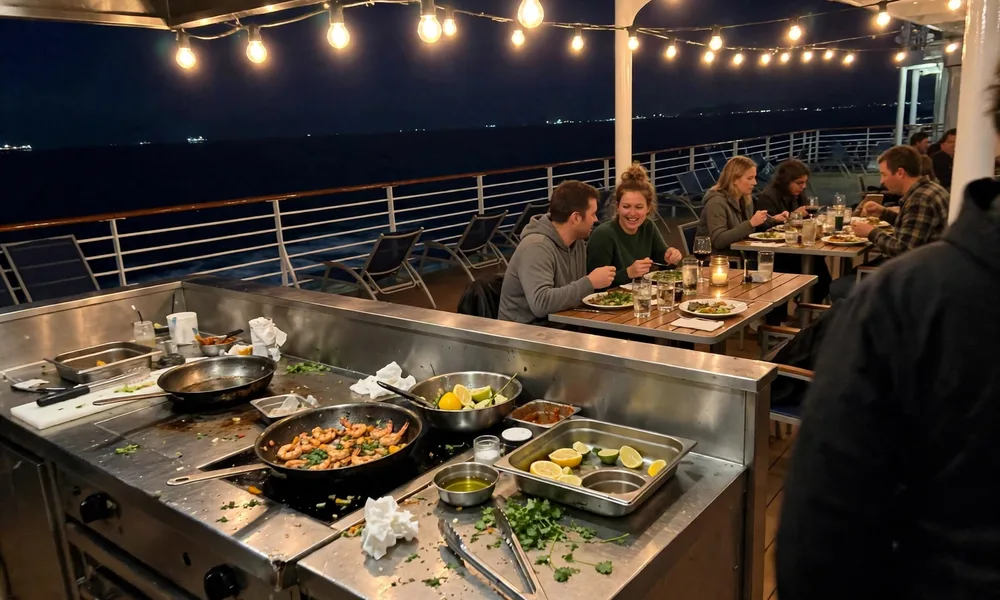
A cruise ship already feeds thousands of people a day, from galleys the size of restaurants, with staff in the hundreds. So when the ship adds a kitchen on the open deck, the first question is why, and the second is why it costs millions. The outdoor kitchen looks like a long run of steel counters with grills and trays, and the passengers use it for a few hours a day. It is for a kitchen that feeds a crowd outdoors, in salt air, on a deck that moves, and never stops.
A luxury ship outdoor kitchen is a full cooking area built into the open deck of a large ship, with grills, sinks, fridges, worktops, and a serving pass, so the chefs can cook and serve outside for hundreds of passengers at deck barbecues and buffets. It is a second galley, not a barbecue with a tap, and the price comes from the steel, the appliances, the plumbing, and the sheer scale of feeding a crowd in the open air. This is where the money goes.

1. The steel counters, and metal that survives salt and sun
The counters are the first cost. A ship outdoor kitchen is built from marine-grade 316 stainless steel, chosen because it will not rust, stain, or pit after years in salt air. The worktops are 4 to 6 millimetres thick, the cabinets are welded, not screwed alone, and every edge is folded and polished so no passenger ever catches a finger on a sharp corner.
The steelwork is typically estimated at $150,000 to $400,000, rising with the length of the run. The cost comes from the material and the handwork: each counter is cut, folded, and welded to fit one deck, and a run of 20 metres of counter is a small factory in itself.
2. The grills and the appliances, and a kitchen without a roof
The appliances are the second cost. The outdoor kitchen usually carries four to six built-in gas grills, sinks with hot and cold water, under-counter fridges, and ice makers, all of them marine-grade.
The appliances are typically estimated at $200,000 to $500,000, including the grills, the fridges, and the ice makers. The cost comes from the marine standard: a land fridge would rust in a season, and a land grill would warp. The galley below it is covered in why a ship galley costs so much, and the same marine markup applies to every appliance here.
3. Plumbing and drainage, and water for a thousand meals
The plumbing is the cost nobody sees. A ship outdoor kitchen needs fresh water to a dozen sinks, grey water away from all of them, and gas lines to every grill, all of it running through a deck that moves, flexes, and gets wet. The pipes are stainless or copper, every joint is sealed against salt spray, and the drains run to tanks below deck, never over the side.
The plumbing is typically estimated at $100,000 to $250,000, including the lines, the pumps, and the tank connections. The cost comes from the scale: a yacht kitchen has one sink, and a ship kitchen has a dozen, and every one of them must work at once, in the middle of a service, with a thousand passengers waiting.
4. The marine build, and a kitchen bolted to a moving deck
The marine build is the cost that surprises people. The whole kitchen is bolted to a steel frame tied into the deck, with a raised lip around every worktop so trays and plates stay put when the ship rolls. The fridges are strapped in, the drawers lock shut, and the serving pass has a sneeze guard that survives the wind.
The marine build is typically estimated at $150,000 to $350,000, including the frame, the fixings, and the non-slip surfaces. The cost comes from the fitting: the kitchen is built into the ship, not placed on it, and it must be removed and refitted at every dry dock. The oven beside it is measured in the ship pizza oven spec sheet, explained.
5. Power and refrigeration, and keeping food cold in the sun
The power is the fifth cost. The outdoor kitchen usually draws 30 to 60 kilowatts, with the fridges and ice makers on their own circuits so a fault at a grill does not take out the lights. The refrigeration is the hard part: it must hold 4 degrees Celsius in full sun, and it does it with thicker insulation and bigger compressors than land equipment of the same size.
The electrical work is typically estimated at $80,000 to $200,000, including the circuits, the breakers, and the refrigeration. The cost comes from the marine standard: the wiring runs through a deck that moves and gets wet, and every connection is sealed.

6. Staffing and service, and the cost that never stops
The last cost is the one that never stops. A ship outdoor kitchen needs a team of chefs, servers, and cleaners for every service, and the kitchen is washed down daily, the steel oiled weekly, and the grills serviced every voyage.
Annual staffing and maintenance is typically estimated at $200,000 to $500,000, and a full refit of the kitchen at dry dock at $300,000 to $800,000. The crew who run it are described in how a ship crew mess works.
The Specifications at a Glance
Here are the numbers that matter most on a luxury ship outdoor kitchen.
| Specification | Typical Luxury Range |
|---|---|
| Counter length | 15 to 30 metres of worktop |
| Counter material | Marine-grade 316 stainless steel, 4 to 6 millimetres |
| Grills | 4 to 6 built-in gas grills, 20 to 40 kilowatts each |
| Fridge capacity | 500 to 1,000 litres, marine-grade |
| Power draw | 30 to 60 kilowatts, own circuits |
| Sinks | 8 to 12, fresh water in, grey water to tanks |
| Meals per service | 500 to 1,500 covers |
| Build time | 3 to 6 months of yard work |
What Does a Luxury Ship Outdoor Kitchen Cost?
A luxury ship outdoor kitchen is estimated to cost roughly $1,000,000 to $3,000,000 installed, depending on size and finish. A compact run with four grills, sinks, and fridges is estimated at roughly $1,000,000 to $1,800,000, while a full kitchen with six grills, a serving pass, and a dining area is estimated at roughly $1,800,000 to $3,000,000. Annual running costs are estimated at roughly $200,000 to $500,000.
A Rare Fact
A ship outdoor kitchen is designed so the chefs never turn their backs on the passengers. The grills, the pass, and the worktops are laid out in a line facing the queue, not facing the sea, because the chefs are part of the show, and a chef with their back to the crowd is a cook in a basement. The kitchen is a stage, and the stage faces the audience.
Once you know where the money goes, the price makes sense. The steel is marine-grade and cut to fit one deck, the appliances are built to feed a thousand people in the open air, and the whole kitchen is designed to work like a restaurant while looking like a party.


