A bottle of white wine at 8 degrees tastes like a different wine from the same bottle at 18 degrees. On a yacht, where the saloon can be 30 degrees by noon and the engine room hotter still, keeping a bottle at its serving temperature is a piece of engineering, not a piece of furniture. The wine fridge does it, quietly, behind a glass door.
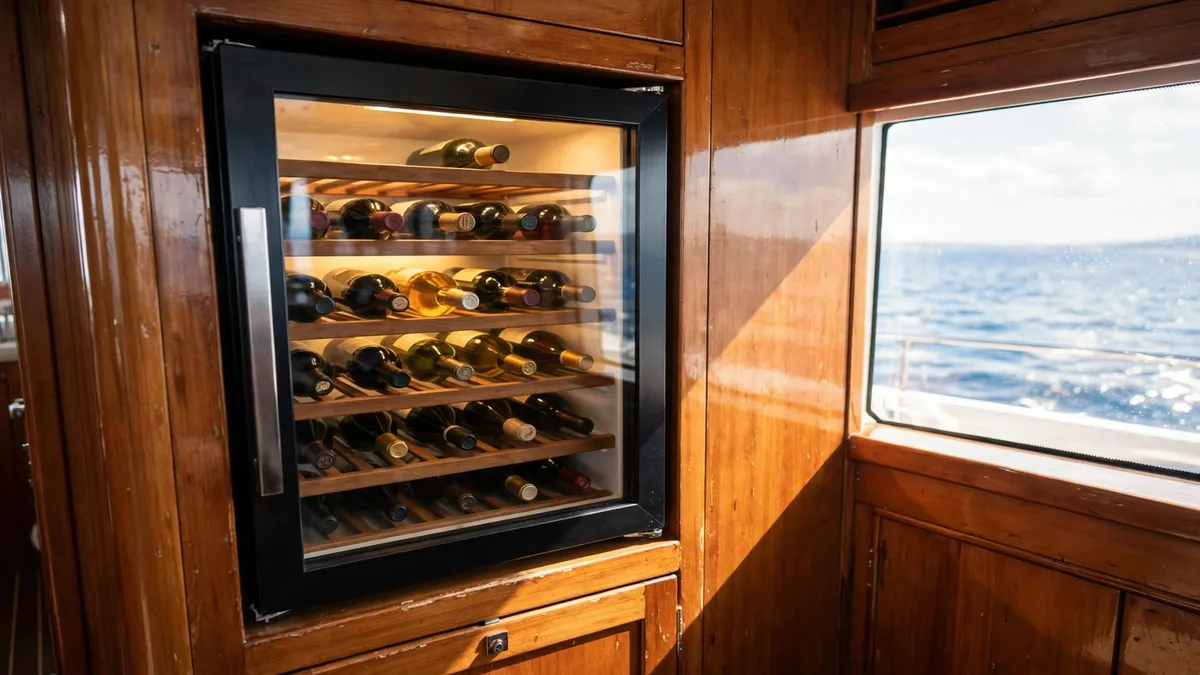
A luxury yacht wine fridge is a built-in refrigerated cabinet on a yacht, usually in the saloon or the galley, that stores wine at a steady temperature and humidity, with the bottles lying on their sides on wooden shelves. It is not a household fridge with a wine rack: it is a climate cabinet, built to hold its temperature to the degree while the yacht rolls, and the numbers on its spec sheet are about cold, quiet, and vibration. This is a plain translation of the numbers that matter.
1. Capacity and size, and the fridge drawn for a cellar
The first numbers on the sheet are the capacity and the size. A yacht wine fridge usually holds 30 to 100 bottles, in a cabinet 60 to 120 centimetres wide and 60 to 70 centimetres deep, with five to eight wooden shelves. That is enough for a week of dinners for ten guests, with reds on one shelf and whites on another, and it is the size the saloon can fit without losing a seat.
The figure to read next to the capacity is the bottle shape it accepts, usually standard Bordeaux bottles 30 centimetres tall, with a few wider slots for Champagne and Burgundy. A fridge that only fits slim bottles is a fridge that leaves the best bottles in the cellar. The bar it works beside is measured in the yacht bar spec sheet, explained.
2. Temperature zones and control, and the fridge that holds its nerve
The temperature is the second number on the sheet. A yacht wine fridge usually offers one or two zones, holding reds at 16 to 18 degrees Celsius and whites at 7 to 10 degrees, with a digital control that holds the set point to within half a degree. A two-zone fridge serves a red and a white at the same dinner without either one being wrong.
The number to check next to the zones is the recovery time, usually under ten minutes after the door closes. A fridge that takes an hour to recover after a steward takes out four bottles is a fridge that serves the second course warm. The household fridge it is often compared with is measured in the luxury smart fridge spec sheet, explained.
3. Humidity and the cork, and a fridge that never dries a bottle out
The humidity is the number the wine lover asks about first. A yacht wine fridge usually holds the humidity at 55 to 75 percent, with a small water reservoir or a humidity sensor that tops it up, so the corks stay swollen and sealed. A dry cork shrinks, air creeps in, and a bottle worth hundreds is ruined before it is opened.
The figure to read next to the humidity is the door seal, usually a magnetic gasket with a double-glazed, UV-filtered glass door. The glass keeps the light out, because sunlight is the fastest way to spoil a bottle, and the seal keeps the cold in when the yacht rolls.
4. Vibration and the compressor, and a fridge that never shakes a bottle
The vibration is where a yacht fridge earns its price. A yacht wine fridge usually uses a low-vibration compressor on rubber mounts, or a thermoelectric cooler with no moving parts at all, so the bottles are never shaken. Vibration stirs the sediment in a bottle, and stirred sediment is a wine that tastes tired before its time.
The number to check next to the compressor is the noise, usually 35 to 42 decibels, quieter than a conversation. A fridge that hums in the saloon is a fridge the guests hear all evening. The cellar it works beside is covered in why a yacht wine cellar costs so much.
5. Power and the draw, and the fridge that sips electricity
The power is the number the engineer asks about first. A yacht wine fridge usually draws 60 to 120 watts, running on 12-volt or 24-volt DC or 230-volt AC, and it uses 0.5 to 1 kilowatt-hour a day. That is a small draw next to the air conditioning, but it runs all day, every day, so a fridge that wastes power costs the yacht a generator hour a week.
The figure to read next to the draw is the start-up surge, usually two to three times the running draw, which the yacht’s inverter must cover when the compressor kicks in. A fridge that trips the inverter at midnight is a fridge the crew learns to hate.

6. Shelves and care, and a fridge built for a decade
The last number on the sheet is the service life. A yacht wine fridge usually lasts ten to fifteen years, the compressor five to eight, and the door seal three to five before it is replaced. The shelves are usually beech or oak, because wood absorbs vibration where metal would pass it on, and the crew wipes the shelves and checks the humidity every week.
The figure to read next to the life is the cleaning time, usually 20 to 30 minutes a month, a wipe of the shelves and a rinse of the humidity reservoir. A fridge that is not cleaned grows mould in the corners, and mould ruins a cabinet fast.
The Specifications at a Glance
Here are the numbers that matter most on a luxury yacht wine fridge.
| Specification | Typical Luxury Range |
|---|---|
| Capacity | 30 to 100 bottles, 5 to 8 wooden shelves |
| Cabinet width | 60 to 120 centimetres |
| Temperature zones | 1 to 2 zones, reds 16 to 18, whites 7 to 10 degrees Celsius |
| Temperature accuracy | Within half a degree of the set point |
| Humidity | 55 to 75 percent, sealed door |
| Noise level | 35 to 42 decibels |
| Power draw | 60 to 120 watts, 0.5 to 1 kilowatt-hour a day |
| Service life | 10 to 15 years for the cabinet |
What Does a Luxury Yacht Wine Fridge Cost?
A luxury yacht wine fridge is estimated to cost roughly $3,000 to $15,000 installed, depending on capacity and zones. A single-zone fridge for 30 to 50 bottles is estimated at roughly $3,000 to $7,000, while a dual-zone fridge for 80 to 100 bottles with UV-filtered glass is estimated at roughly $7,000 to $15,000. A replacement compressor is estimated at roughly $500 to $1,500.
A Rare Fact
A yacht wine fridge is the only fridge on board that is allowed to be warm. Every other fridge on a yacht holds food at 3 to 5 degrees, cold enough to keep it safe. The wine fridge holds its bottles at 16 to 18 degrees for reds, which would spoil milk in a day, because wine is not food: it is a living thing in a bottle, and it needs to be kept at drinking temperature, not storage temperature.

Once you know which numbers do the work, the sheet makes sense. Temperature decides whether the wine tastes as the maker intended, humidity decides whether the cork holds, and vibration decides whether the sediment stays put.


