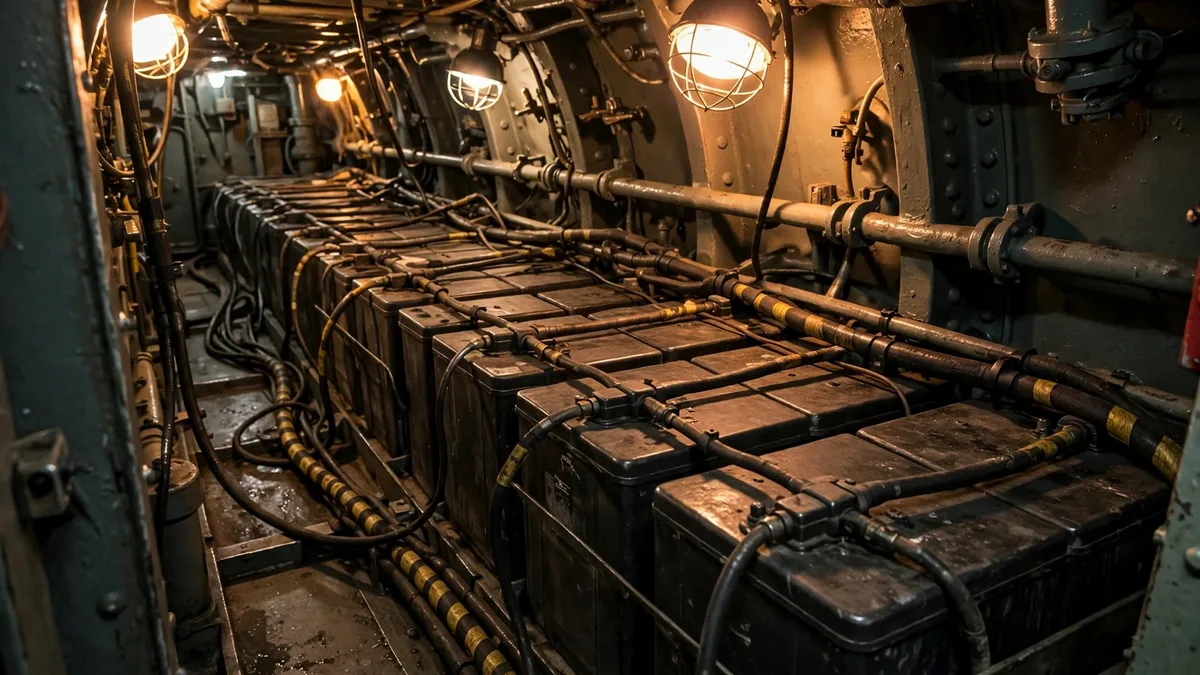
Deep under the sea, in a steel tube where the air is recycled and the crew cannot see the sky for weeks, everything runs on a battery. A luxury submarine does not have a diesel engine it can run underwater, and it cannot plug into anything, so when it dives, the battery is the only source of power for the propeller, the lights, the air system and the instruments. The battery fills a whole compartment, a room of steel boxes wired together, and it weighs more than a house. When the owner asks why that battery costs as much as a small yacht, the answer is not one thing. It is six things, and each one of them is expensive on its own.
The first thing to understand is that a submarine battery is not like a car battery, even a large one. It must work perfectly, every time, in a place where a failure cannot be fixed by calling for help. It must survive the pressure of the deep sea, the salt in the air, the vibration of the hull, and the heat of its own charging, and it must do all of that for years without a single cell failing in a way that endangers the crew. The makers build for that standard, and the price follows the standard. What follows is the list of the costs, one by one, in the order the engineers themselves would explain them.
What Makes It So Expensive
The chemistry is the first cost. A luxury submarine battery is built from lithium-ion cells of a special marine grade, far tougher than the cells in a phone or a car. Each cell must hold its charge for months, deliver huge currents without overheating, and survive thousands of charge cycles in a sealed compartment. The cells are tested individually before they are allowed into a battery, and a cell that fails any test is rejected, which means the maker buys many more cells than the battery will ever use. The chemistry is also chosen for safety: a fire in a submarine battery compartment is one of the worst things that can happen at sea, so the cells are built to be as stable as the engineers can make them, and that stability costs money.
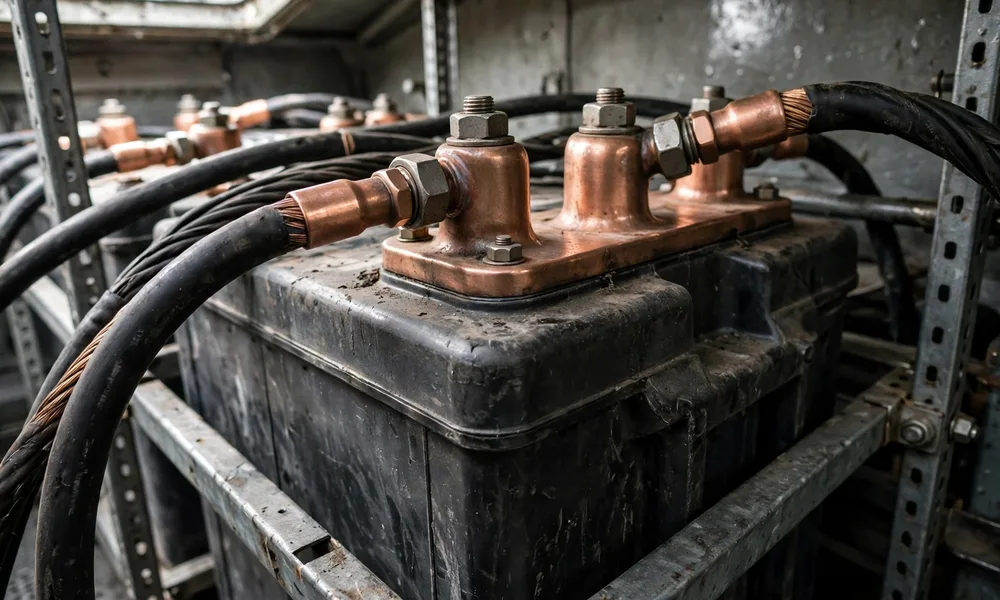
The build is the second cost. A submarine battery is not assembled on a fast production line. The cells are fitted into steel boxes, the boxes are wired with thick copper bars, and every connection is checked by hand, because a loose connection in a battery that carries hundreds of amps will heat up and fail. The whole assembly is sealed against salt water, mounted on shock absorbers so the hull’s vibration does not crack it, and fitted with cooling pipes that carry away the heat of charging. The work is done by specialists in a clean room, not by general factory labour, and their time is priced accordingly.
Testing is the third cost. Before a submarine battery is allowed near a boat, it is charged and discharged hundreds of times, shaken on a vibration table, heated and cooled, and dropped, in its case, to prove it will not leak. A single test programme can take months, and it uses up test cells that are never sold. The battery must also be certified by a marine classification society, which sends its own inspectors to watch the tests and sign the papers. That certification is not optional, and it is not cheap, but without it no insurer will cover the submarine and no port will let it in.
Rarity and development are the fourth cost. A submarine battery is not made in the millions like the batteries in electric cars. It is made in tiny numbers, for a handful of submarines each year, often as part of a programme that will build only a few boats. The development cost, the design, the simulation, the prototype testing, the safety trials, is spread across a tiny number of units, so each battery carries a large share. The makers also have to guarantee the battery for years of service under the sea, and that guarantee is priced into every unit.
The final cost is the safety system around it. A submarine battery is wrapped in sensors that watch every cell for temperature, voltage and gas, and a control system that can shut the battery down in a fraction of a second if anything goes wrong. The compartment has its own ventilation, its own fire suppression and its own monitoring, and all of it is built to work when the submarine is hundreds of metres down. The buyer is not paying for a box of cells; they are paying for a system that keeps the crew alive, and that is the most expensive part of all.
The Spec Table, in Plain Numbers
| Specification | Typical luxury submarine battery | What it means |
|---|---|---|
| Battery type | Marine-grade lithium-ion | Tougher and safer than car or phone cells. |
| Energy capacity | 500 to 2,000 kilowatt hours | How much energy the boat carries underwater. |
| Weight | 10 to 30 tonnes | Heavier than a house, fitted by crane. |
| Voltage | 400 to 800 volts | High voltage moves big power efficiently. |
| Endurance underwater | Days, at low speed | Slow cruising stretches the charge furthest. |
| Charge cycles | Several thousand | The battery is built to last for years. |
| Cooling | Liquid cooled, piped | Carries away the heat of charging. |
| Monitoring | Every cell watched for heat and gas | The system can shut down in a fraction of a second. |
| Recharge time | 8 to 12 hours, surfaced | Charged from the diesel generator on the surface. |
| Service life | 10 to 15 years | Replaced in dry dock, by a team of engineers. |
What a Luxury Submarine Battery Costs
Prices are estimates, and they vary with the size of the submarine, but a luxury submarine battery is generally estimated at roughly $1 million to $5 million, with the battery, its safety systems and its installation all included, and a large submarine battery can be estimated at $10 million or more. An electric car battery of similar chemistry might cost a hundredth as much, and even a large industrial battery is usually far cheaper.
A Rare Fact Worth Knowing
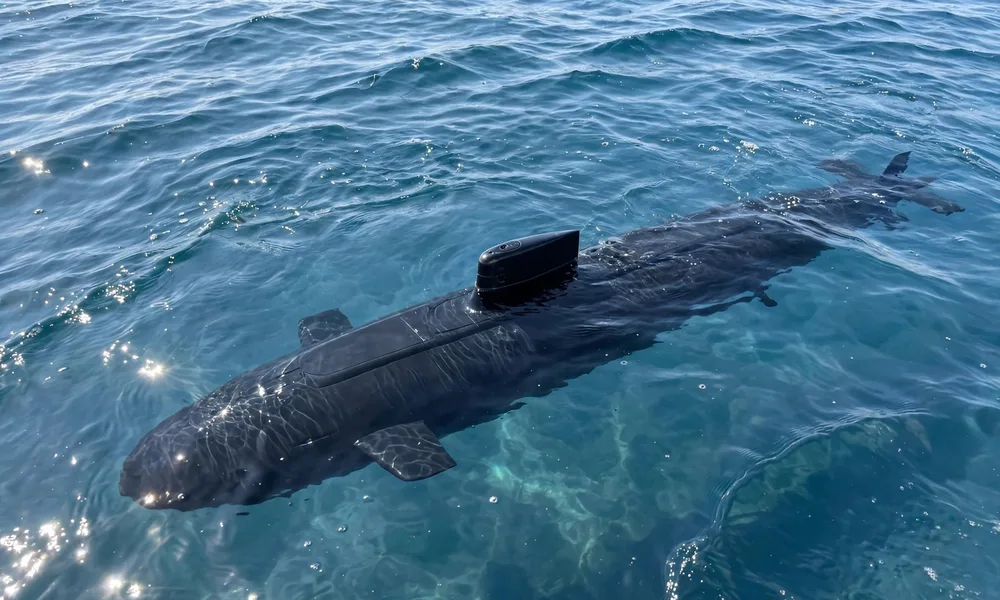
Here is the detail that puts the whole battery in perspective: a submarine battery can be so heavy that it is part of the ballast. The designers of a submarine must balance the boat so it neither sinks nor floats, and the battery, sitting low in the hull, is one of the heaviest things on board. Moving it, or even changing its weight as it ages, changes the trim of the whole boat, and the crew must adjust the water in the ballast tanks to compensate. The battery is not just the thing that powers the submarine; it is part of the reason the submarine floats the way it does.
For anyone comparing submarine batteries, the advice is to ask what the boat needs, not what the battery costs. A well-matched battery on a well-designed submarine will always beat a bigger battery fitted to the wrong boat. But when the battery, the boat and the safety systems are all designed together, the battery earns its place. The story of how a luxury submarine battery is made shows the building behind the cells, how a luxury submarine works explains the boat the battery powers, and how a luxury ship gyroscope works covers another hidden system that keeps a vessel steady at sea.


