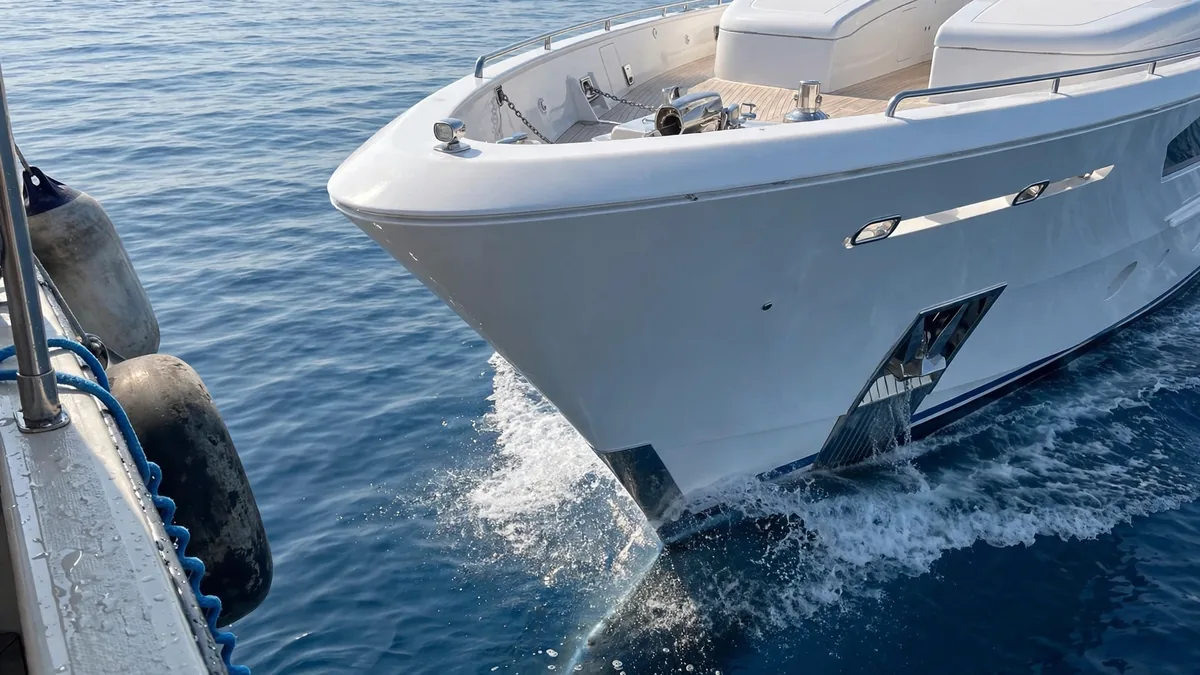
At dawn in a marina, a yacht slips out past the breakwater, and the first thing the water meets is the bow, a long white curve that parts the sea without a splash. The boat rises over a small wave and the bow cuts through it cleanly, throwing spray to either side, and the passengers on deck barely feel the motion. It looks like a simple shape, a pointed front end, but that curve is the result of months of design, tonnes of shaped metal, and hand finishing so fine that a fingernail cannot find a seam.
The bow is the forward part of a yacht’s hull, the section that meets the water first, and on a luxury yacht it is one of the most expensive parts of the whole boat. Its price comes from the shape itself, which has to be strong enough to smash through waves, smooth enough to slip through water without drag, and beautiful enough to match the rest of the yacht. Steel or aluminium must be bent into a double curve, welded without a flaw, and polished to a mirror finish, and the inside must carry the anchor, the chain, and the thruster that pushes the bow sideways in a crowded harbour.
How a Luxury Yacht Bow Works
Step 1: Designers shape the bow in a computer before steel is cut
Long before any metal is bent, naval architects design the bow on a computer, testing hundreds of shapes against simulated waves. The curve must be fine enough at the waterline to cut cleanly, full enough above it to keep spray off the deck, and flared enough at the top to lift the boat over a wave rather than ploughing through it. That design work takes months and a team of specialists, and it is billed before a single plate is ordered.
Step 2: Steel plates are bent into a double curve
The bow is built from steel or aluminium plates, and bending a flat plate into a shape that curves in two directions at once is one of the hardest jobs in a shipyard. The plates are heated and pressed in a giant machine, or bent slowly over a form by skilled workers who check the curve with wooden templates, a job that takes years to learn. Each plate must meet its neighbour exactly, because a gap of even a millimetre will show through the paint and weaken the weld.
Step 3: Welding joins the plates without a single flaw
Once the plates are shaped, welders join them with long, continuous welds that must be perfect from the inside and the outside. A bad weld on a bow is not a cosmetic problem; it is a crack waiting to happen under the pounding of the sea, so every weld is checked with ultrasound or X-rays, and any flaw is cut out and welded again. The inside of the bow is then reinforced with frames and stringers, steel ribs that spread the force of a wave across the whole structure, and those ribs are welded in by hand as well. The bow is, in effect, a small steel building, and how a luxury yacht bow is made shows how much of that building is hidden behind the smooth white skin.
Step 4: Fairing turns a steel shell into a mirror surface
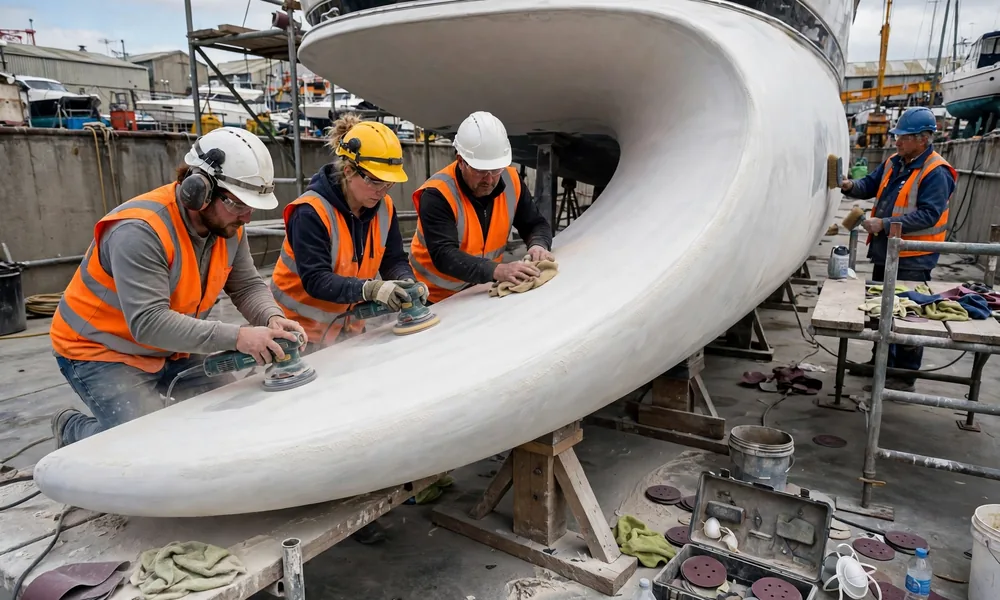
Fairing is the slow, dusty work of making the bow perfectly smooth, and it is where much of the luxury price disappears. Workers spread a special filler over the steel, sand it back by hand, spread more, and sand again, sometimes through a dozen rounds, until a long straight edge laid against the curve shows no gap at all. The work is checked by eye under raking light, which shows every ripple, and by running a hand over the surface, since a fingertip can feel a bump the eye misses. A fair bow slips through the water with less drag, which saves fuel and adds speed, but it also looks like glass, which is what a luxury owner expects to see.
Step 5: The anchor, chain, and thruster live inside the bow
The bow is not empty; it houses the anchor windlass that hauls up tonnes of chain, the chain locker where that chain is stored, and the bow thruster, a small propeller in a tunnel through the hull that pushes the bow sideways when docking. The thruster tunnel must be cut through the steel and sealed perfectly, and the windlass must be bolted to a reinforced deck that can take the shock of the anchor snagging. The anchor itself is often polished stainless steel, shaped to match the bow, and it sits in a pocket that is faired to the same mirror finish as the rest of the hull.
Step 6: Paint and polish protect the work from the sea
The final step is paint, and a luxury yacht bow gets more coats than a car, each one sanded between applications. The primer protects the steel from salt, the undercoats build up a smooth base, and the top coats give the deep gloss that makes the bow shine in the sun. The paint is sprayed in a sealed booth to keep dust out, and the final coat is polished by hand until it reflects the sky. A good paint job lasts for years with care, but a cheap one blisters in a single season, which is why owners pay for the best materials and the slowest application.
Luxury Yacht Bow Specs at a Glance
| Specification | Typical Luxury Value | What It Means for You |
|---|---|---|
| Hull material | Steel or aluminium, thick plate at bow | Strength against waves and debris |
| Bow shape | Flared, fine waterline entry | Clean cutting, dry deck, less drag |
| Weld inspection | Ultrasound and X-ray, all seams | No hidden cracks under load |
| Fairing | Hand faired, mirror smooth | Lower drag and a glass finish |
| Bow thruster | Tunnel thruster, 50 to 200 kW | Sideways control when docking |
| Anchor system | Stainless anchor, powered windlass | Reliable holding in any weather |
| Paint system | Multi-coat marine paint, hand polished | Gloss that survives salt water |
What a Luxury Yacht Bow Costs
The bow of a luxury yacht can cost an estimated $500,000 to $3 million as part of the build, depending on the size of the yacht, with the design, the thick steel, the welding, and the hand fairing making up most of the sum. A 30-metre yacht sits near the low end, while a 60-metre yacht with a fully faired steel bow, a large thruster, and a polished anchor system can push well past the middle of that range. Buyers comparing yachts should look at the bow in raking light, because a wavy surface is a sign of rushed fairing, and they should ask how the welds were tested, since the answers reveal how seriously the yard takes the front of the boat. The numbers on the spec sheet tell part of the story, and the specs of a luxury yacht bow, explained are the best place to start, while how a luxury yacht hull is made shows how the bow fits into the hull around it.

A Rare Fact
Some of the finest yacht bows are faired with a tool called a longboard, a flexible sanding board nearly two metres long that a worker pushes along the curve with both hands. The board bridges small bumps and only cuts the high spots, which is how a surface that curves in two directions can be made perfectly fair by hand.


