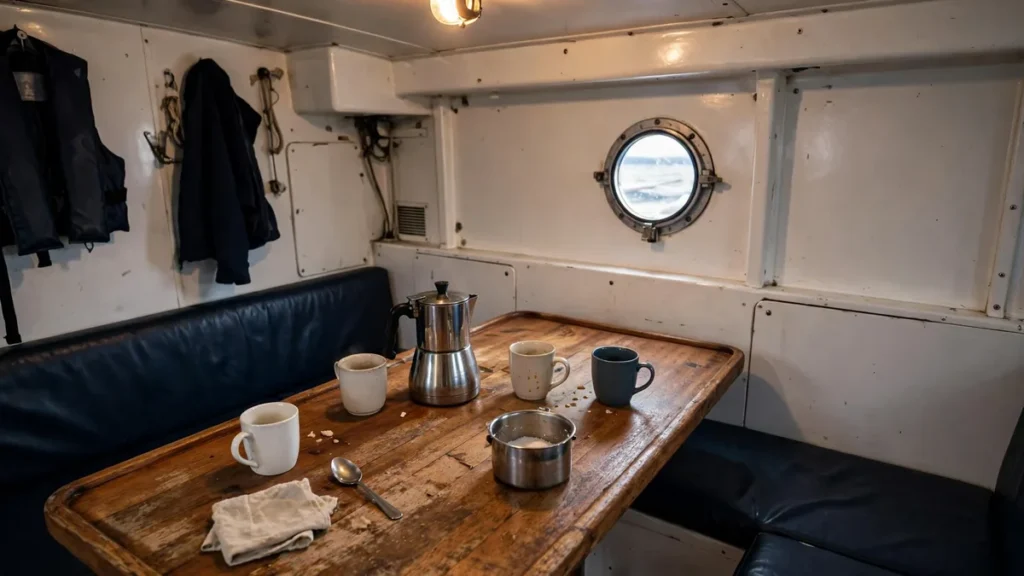
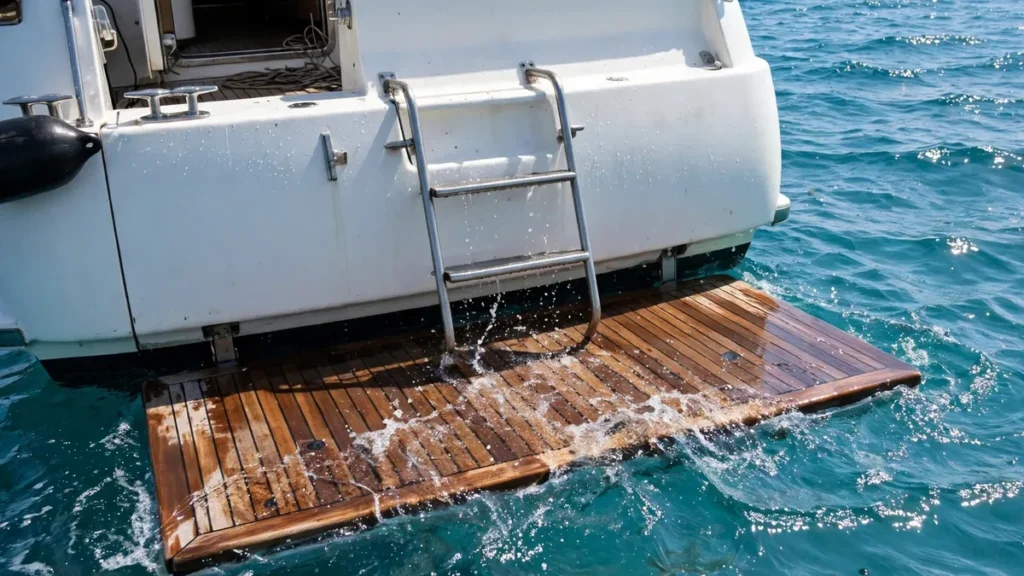
Stand in the cockpit of a luxury yacht on a calm evening and it looks like the simplest place on the boat. A stretch of teak deck, a helm wheel, a couple of throttles, and the sea spreading out behind. It is easy to forget you are standing on one of the most expensive patches of deck afloat, a space whose fittings, drains, structure and electronics can cost more than a small house. The cockpit earns that price the hard way: it is the wettest, hardest-working deck on the yacht, and everything in it has to work in a storm.
The cockpit is the open deck at the stern where the yacht is driven, where guests fish and swim, and where green water comes aboard in bad weather. It takes waves over the transom, fishing gear, diving kit and a dozen pairs of wet feet, and it has to drain fast, grip in the wet and never rot. Here is where the money goes, and why none of it can be skipped.
The Teak Deck: Timber Worth More Than Marble
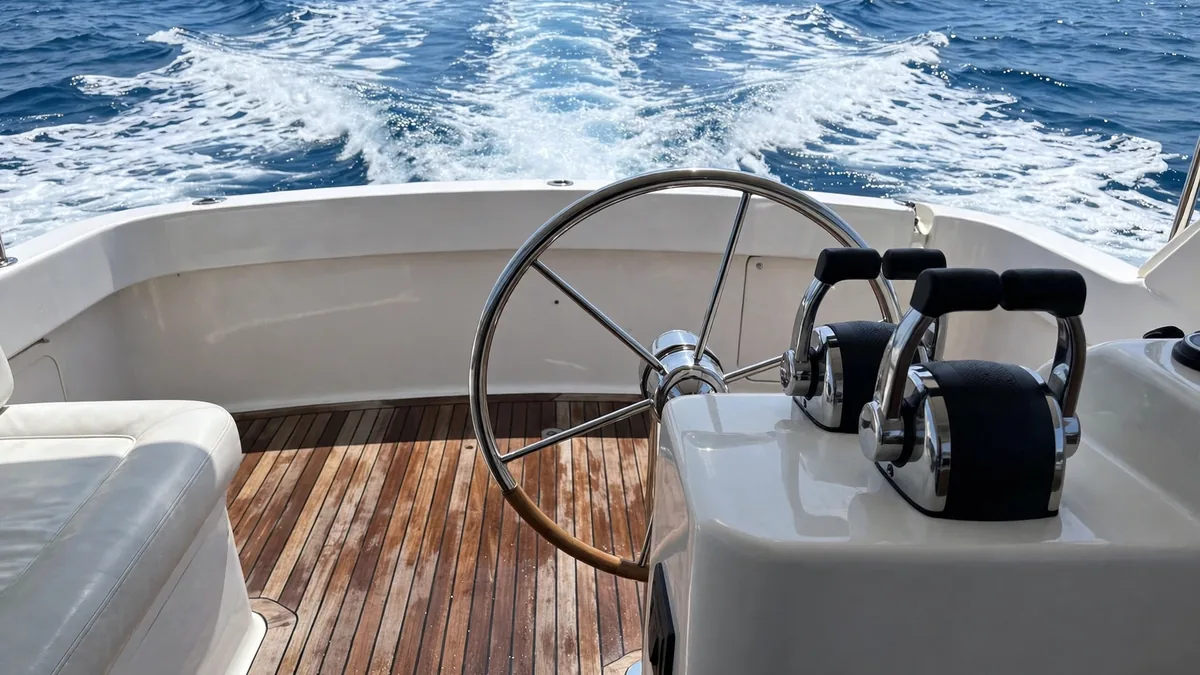
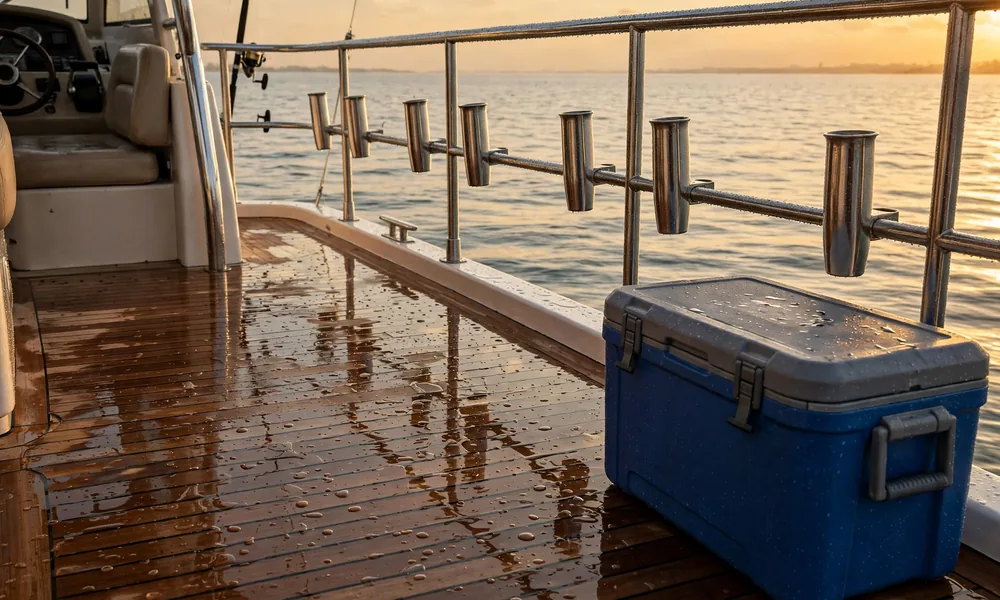
The first thing your feet meet is the teak, and it is the first shock on the bill. A cockpit deck of 15 to 25 square metres needs slow-grown Burmese teak, cut into planks, glued with black caulking seams, and screwed to the deck with thousands of fasteners, each one plugged with a wooden bung. Good teak is scarce, it is priced by the cubic metre, and the fitting is slow hand work, so a teak cockpit alone can run to an estimated $40,000 to $80,000. Cheaper woods look similar for a season, then split, grey and lift, and replacing a glued teak deck means stripping the whole cockpit back to bare fibreglass.
Teak earns its keep in ways no other decking can match. It stays grippy when wet, it does not get burning hot in the sun, and it flexes with the hull instead of cracking. Underneath, the deck is cambered, sloping gently towards large scuppers at the corners, so a wave that comes over the stern drains in seconds rather than pooling around the helm. The drains themselves are oversized and fitted with non-return valves, because a cockpit that cannot empty itself is a cockpit that can sink a boat, and the plumbing runs are built from bronze and stainless steel that will outlast the yacht.
The Helm: A Wheel, Two Throttles and a Fortune in Electronics
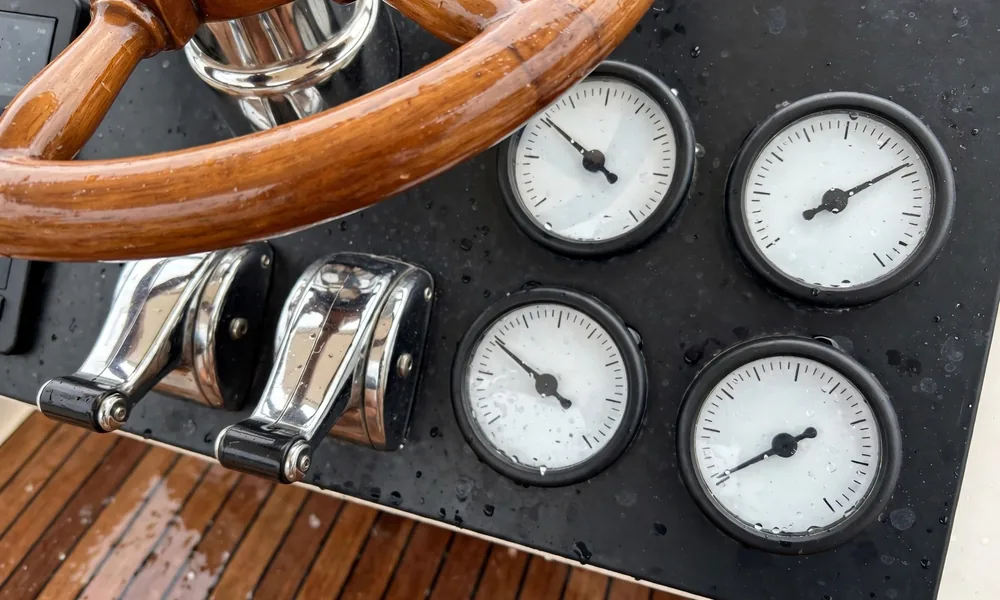
The helm station looks simple, a wheel and a set of levers, but the hardware behind it is anything but. The wheel is usually a stainless steel or polished wood rim on a hydraulic steering system, and the throttles are precision-machined controls that talk to the engines through electronic cables, with a backup mechanical link for emergencies. The console holds engine displays, a chartplotter, radar, depth sounders, autopilot controls and a joystick for docking, and the screens alone can cost an estimated $30,000 to $60,000 once the sensors, antennas and wiring are counted.
Every piece of it must survive salt spray, direct sun and being hosed down, so the electronics are sealed to marine standards and the console is built from materials that will not corrode. The wiring runs through sealed conduits to the engine room, and the whole station is positioned so the helmsman can see over the transom, past the swim platform, and down both sides of the yacht. A badly placed helm is a danger, not an inconvenience, and moving one after the yacht is built means cutting into the deck and starting again.
Structure and Drainage: The Part Nobody Sees
Under the pretty teak, the cockpit is a structural box that carries the loads of the whole stern. The transom, the deck and the cockpit sole are laminated together into a single rigid unit, reinforced with a grid of frames and stringers, because the cockpit takes the twisting forces of the hull and the impact of waves hitting the stern. The sole, the floor you stand on, is often a sandwich of fibreglass and foam core, light enough to keep the yacht’s centre of gravity low and stiff enough not to flex underfoot, and it is sealed so completely that a leak anywhere in the cockpit cannot reach the cabins below.
Fishing, Diving and Living: Fittings That Add Up Fast
Then come the fittings, and they add up with frightening speed. A cockpit built for fishing carries rod holders, a bait station, a live bait well with its own pump and plumbing, a fighting chair on a reinforced base, and an ice box that can hold a day’s catch. A cockpit built for diving carries tank racks, a shower, and a compressor line. Add the rails, the gates, the seating, the table, the sunshade and the lighting, all in polished stainless steel and marine-grade upholstery, and the fittings alone can reach an estimated $50,000 to $100,000, before a single fish has been caught.
The Price, in Plain Terms
Add it up, and a luxury yacht cockpit typically costs an estimated $150,000 to $400,000 to build, depending on the size of the yacht and how it will be used. The teak accounts for a large share, the helm electronics for another, and the structure, drainage and fittings for the rest. On a superyacht the figure climbs higher still, because the cockpit grows, the electronics multiply, and the finishes become more exotic. The labour is a large part of it: a cockpit is built by hand, by people who fit teak planks one at a time and polish stainless steel until it is smooth enough to hold in a storm.
A Rare Fact About the Yacht Cockpit
On the largest sportfishing yachts, the cockpit floor is sometimes fitted with a mezzanine, a raised step around the helm that gives the captain a better view over the transom, and the step itself hides a refrigerated fish box big enough to hold a marlin. The box is insulated, drained and plumbed like a small cold room, and it is one of the few places on a yacht where a fish worth thousands of dollars is stored in a compartment that cost almost as much to build.
What the Price Means for You
If you ever stand in a yacht cockpit, look down before you look out. The teak should lie flat, with tight black seams and no lifted corners. The scuppers should be large and clear, not choked with leaves or paint. The throttles should move smoothly, the wheel should turn without a notch, and the rails should be cool, smooth and free of rust spots. If the deck is dry a minute after a hose is played over it, the drainage is working, and if the fittings feel solid under your hand, the money was well spent.
The cockpit is the yacht’s working heart, and its price makes sense once you see what it does. The same thinking runs through the rest of the boat, from the bridge where the yacht is navigated, to the navigation bridge with its own array of instruments, and down to the engine room that powers everything the cockpit controls. A cockpit is not an expensive patch of deck. It is a helm, a drain, a workshop and a terrace, built into one small space that has to work in the worst weather the sea can offer.