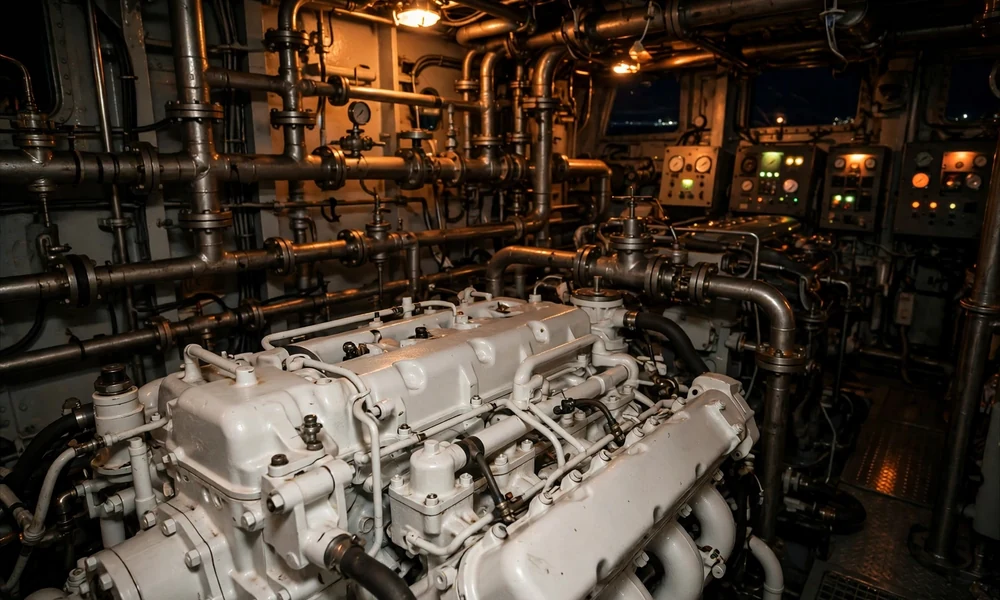
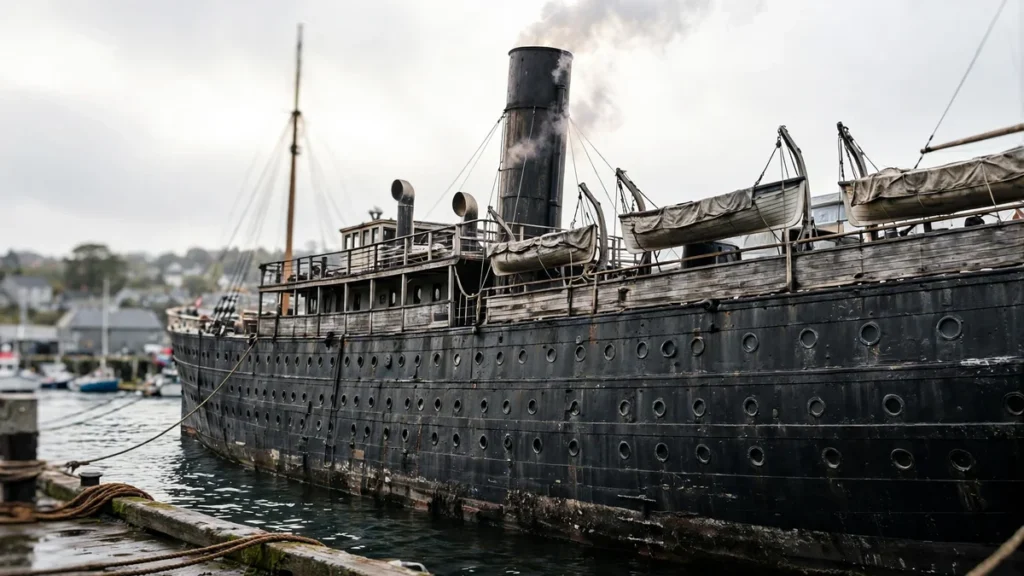
Stand on the sunlit deck of a 50-metre yacht and everything feels calm: polished teak underfoot, a soft hum you barely notice, and the horizon sliding past at a relaxed twelve knots. Step through a heavy steel door, climb down a steep ladder, and the calm disappears. Down here the air is warm, the floor vibrates gently under your shoes, and two main engines the size of small cars are doing the real work of the voyage. This is the engine room, the hardest-working space on any yacht, and its specifications decide almost everything about how the boat behaves at sea.
Most buyers obsess over cabins, deck space and the size of the beach club. Experienced captains look at the engine room first. Its numbers set the yacht’s top speed, its range, how quietly it runs at anchor, how much fuel it burns on a crossing, and even how long it can stay away from a marina. A well-specified engine room is the difference between a yacht that cruises happily for weeks and one that spends its life waiting on spare parts.
Yacht Engine Room Specs at a Glance
| Specification | Typical 30 m Yacht | Typical 50 m Yacht | Typical 70 m Superyacht |
|---|---|---|---|
| Main engines | 2 x 1,900 hp diesels | 2 x 2,600 hp diesels | 2 x 4,000 hp diesels |
| Top speed | 22–25 knots | 16–18 knots | 16–17 knots |
| Cruising speed | 18–20 knots | 12–14 knots | 12–13 knots |
| Generators | 2 x 25 kW | 2 x 80 kW | 2 x 150 kW |
| Fuel capacity | 10,000 litres | 45,000 litres | 120,000 litres |
| Range at cruise | 800–1,000 nm | 3,000–4,000 nm | 5,000–6,000 nm |
| Fresh water | 2,000 litres | 6,000 litres | 15,000 litres |
| Engine room volume | 25 cubic metres | 60 cubic metres | 120 cubic metres |
These are typical figures, not rules: a performance yacht carries far more power per tonne than a long-range explorer of the same length. Length alone tells you very little.

How a Yacht Engine Room Works
The engine room is a system of systems. The main engines turn the propellers, but around them sits support machinery that keeps the whole yacht alive: generators, fuel and cooling pumps, air conditioning, water makers, and the hydraulics that drive stabilisers and thrusters. Follow the energy and the logic becomes clear.
- Fuel is drawn from the tanks. Day tanks feed the main engines and generators, while larger storage tanks hold the bulk supply. Filters strip out water and dirt before a drop reaches an injector.
- Main engines burn the fuel. Large marine diesels turn at a relaxed 1,500 to 2,300 revolutions per minute. Torque passes through a gearbox and shaft to the propeller, or to a pod drive that steers as well as pushes.
- Cooling keeps temperatures in check. Seawater is pumped through heat exchangers, cooling the engine’s closed freshwater circuit. A yacht at full speed can swallow thousands of litres of cooling water every minute.
- Generators make the electricity. Separate smaller diesels drive alternators, powering lighting, the galley, air conditioning and navigation. Most yachts carry two, so one can be serviced while the other runs.
- Exhaust and ventilation clear the heat. Insulated trunks carry hot gases up through the funnel, while fans pull fresh air in and push hot air out. A big engine room can move its entire volume of air several times a minute.
- Stabilisers and thrusters draw on the same systems. Hydraulic pumps power fin stabilisers that cut rolling, and bow thrusters that let the captain slide sideways into a berth.
- Alarms and monitoring tie it together. Sensors watch temperature, oil pressure, vibration and bilge water, feeding displays on the bridge and in the crew mess. A good engineer spots a problem in the numbers hours before it becomes a breakdown.
Main Engines: Power, Torque and Fuel Burn
The headline number on any engine is horsepower, but torque and fuel burn matter just as much. A yacht engine pushes a heavy hull through water, a grinding continuous load quite unlike a car’s stop-start life. That is why marine diesels are built big, slow and tough, with cast blocks and service intervals measured in thousands of hours rather than miles.
Fuel burn is where the spec sheet gets honest. A 50-metre yacht at a 12-knot cruise might burn 250 to 350 litres of diesel per hour across both engines, while pushing to 16 knots can double that figure or worse, because the power needed rises steeply with speed. This is why experienced owners cruise slowly: dropping two knots can add hundreds of miles of range and save thousands of litres on a long passage.
Propulsion choice shapes the whole room. Traditional shaft drives are simple and robust. Pod drives package the propeller into a steerable unit beneath the hull, improving efficiency and manoeuvrability at the cost of complexity. Hybrid setups add batteries and electric motors, letting a yacht glide silently into an anchorage. Each choice changes the space, the weight and the maintenance schedule, which is why the hydrogen fuel cell yacht specs now being tested are so interesting: they promise quiet, clean power, though the supporting systems still take up serious room.
Generators, Batteries and the Hotel Load
A yacht at anchor is a floating hotel, and its “hotel load” is the electricity needed for everything that is not propulsion: air conditioning, refrigeration, cooking, lighting and the water maker. On a 50-metre yacht this can reach 60 to 100 kilowatts on a hot evening, which is why the generators are specified as carefully as the main engines.
Two generators are the standard, and the logic is redundancy. One runs while the other rests or is serviced, and if one fails, the other can carry the essential loads. Some larger yachts add a large lithium battery bank that lets the crew switch the generators off entirely for a few hours of silence. Battery capacity is now a selling point in its own right, and the electric yacht battery specs explain how those banks are sized and why lithium chemistry changed what is possible at anchor.
A Rare Fact From the Engine Room
Here is a detail few guests ever learn: on many large yachts, the engine room has its own workshop, and the chief engineer can machine a replacement part at sea. Aboard a yacht crossing an ocean, a broken pump bracket cannot wait for a marina. So the room carries a lathe, a drill press, a welder and shelves of spares, and the engineer is part mechanic, part machinist and part electrician. The best engine rooms are designed with this in mind, with clear floor space, good lighting and lifting beams overhead so a heavy component can be hoisted out without dismantling half the room.
That workshop is also why engine room access matters. A room you can only reach by crawling through a hatch will be serviced less often than one with a proper stairway and standing headroom. The engine room also hosts the yacht’s nervous system: how a yacht radar system works depends on the power and cooling supplied from below deck, and every sensor on the bridge traces back to a cable, a breaker or a pump in this one hot, humming space.
What the Specs Mean for You
If you are reading a yacht listing, start with four numbers: total main engine power, generator capacity, fuel capacity and range at cruising speed. Those four tell you how fast the yacht goes, how comfortably it lives at anchor, how far it can travel and how often it needs fuel. The engine room will never be the prettiest part of a yacht, but every quiet night at anchor depends on the machinery humming away below.