It looked like a bed that had been left outside. A low platform, a thick white cushion, a headrest that tilted up at one end, and nothing else. I had seen the same shape on a hotel terrace for a few hundred dollars, and I had seen it in a garden centre for less. This one, on the sun deck of a yacht, cost more than my sofa, my bed, and my dining table put together, and the owner had ordered four of them. I sat down on it and tried to work out where the money had gone, because it was not in the shape. It was in everything the shape had to survive.

1. The foam and the fabric, and the materials that refuse to rot
The first cost is inside the cushion, where nobody looks. A yacht sunbed is filled with a marine-grade foam, usually a quick-dry reticulated foam, that lets water drain straight through instead of soaking in like a sponge. An ordinary foam cushion left in the rain stays wet for days, grows mould, and starts to smell. A marine foam cushion dries in hours, even after a wave comes over the deck, and it keeps its shape after years of being sat on, sunbathed on, and left out in the weather.
2. The frame, and the teak and carbon underneath
The second cost is the frame, and it is the part that carries the weight. A yacht sunbed frame is usually built from teak, stainless steel, or carbon fibre, and often from a combination of all three. Teak is used because it is naturally oily, so it resists rot and salt, and it stays cool enough to touch in the sun. Stainless steel is used for the fittings and the adjustable back, because it will not rust, and carbon fibre is used on the lightest and most expensive beds, where every kilogram saved matters to the yacht’s balance.
3. Bespoke sizing, and the bed that fits one deck
The third cost is that nothing on a yacht is standard size. The sun deck of a yacht is a curved, sloping surface, built around hatches, skylights, and the curve of the hull, and a sunbed has to fit into the space left over without blocking a walkway or covering a hatch that the crew needs to open. The bed is therefore measured, drawn, and built for one deck, and if the owner changes the layout of the deck, the beds have to be rebuilt too.
4. Labour and fitting, and the hands that build it twice
The fourth cost is labour, and it is the largest single cost on the most expensive beds. A yacht sunbed is built by hand, and it is effectively built twice: once in the workshop, where the frame is cut and the cushion is sewn, and once on the yacht, where it is fitted to the deck, adjusted, and adjusted again. The fitter has to work around the yacht’s schedule, often while the yacht is in a yard with a dozen other trades working around him, and every adjustment takes time that is billed by the hour.
The fitting is slow because the tolerances are tight. A sunbed that rocks on a deck that is not quite flat will drive its owner mad, and a cushion that does not sit flush against the frame will lift in the wind. The fitter sands, shims, and re-sands until the bed sits perfectly, and then he does the same for the next one. The best sun decks on the biggest yachts are ranked by how well they use their space, and the best yacht sun decks ranked shows how the beds, the shade, and the walkways are arranged.
5. Certification, and the small numbers that keep the price high
The last cost is the one that never appears on a price tag: certification and low volume. The materials used on a yacht have to meet fire and safety rules that do not apply to garden furniture, and the foam and the fabric have to be tested and certified, which costs money that is spread across very few beds. A fabric mill will certify a fabric for a run of ten thousand metres. A yacht sunbed uses a few metres, and the certification still has to be paid for.
Low volume is the deeper reason the price stays high. The whole world builds only a few hundred large yachts a year, and each one needs only a handful of sunbeds, so no maker can spread its costs across a mass market. The deck as a whole is priced the same way, and why a luxury yacht sun deck is so expensive adds up the same costs at the level of the whole deck. The deck it sits on is built to the same standard, and how a luxury yacht sun deck is made shows how teak, steel, and drainage are put together.

Yacht Sunbeds at a Glance
Here are the typical specifications of a luxury yacht sunbed, and the price range each feature usually falls into.
| Feature | Typical Luxury Specification | Indicative Price Contribution |
|---|---|---|
| Length | About 190 to 210 centimetres | Included in base price |
| Foam | Quick-dry reticulated marine foam | Roughly $1,000 to $3,000 |
| Fabric | Solution-dyed acrylic, mildew resistant | Roughly $800 to $2,000 |
| Frame | Teak, stainless steel, or carbon fibre | Roughly $3,000 to $15,000 |
| Headrest | Adjustable, multi-position, stays put in a swell | Roughly $500 to $1,500 |
| Weight | About 25 to 45 kilograms | Included in base price |
What Does a Luxury Yacht Sunbed Cost?
A luxury yacht sunbed typically costs roughly $8,000 to $35,000, depending on its size, its frame, and how much of it is bespoke. A well-made teak and stainless steel sunbed, with marine foam and a weatherproof cover, typically costs roughly $8,000 to $15,000, while a larger carbon fibre bed, built to fit a curved deck, typically costs roughly $20,000 to $35,000. The price is usually quoted per bed, not per set, because no two beds on the same yacht are quite the same.
A Rare Fact
The foam inside a yacht sunbed is the same kind of open-cell foam used in aquarium filters, because both jobs need the same thing: water that passes straight through instead of pooling. A cushion made from that foam can be hosed down, left in the sun, and sat on the same afternoon, while an ordinary cushion would still be wet the next day, and that one property, drainage, is what makes the difference between furniture that lives outdoors and furniture that only visits.
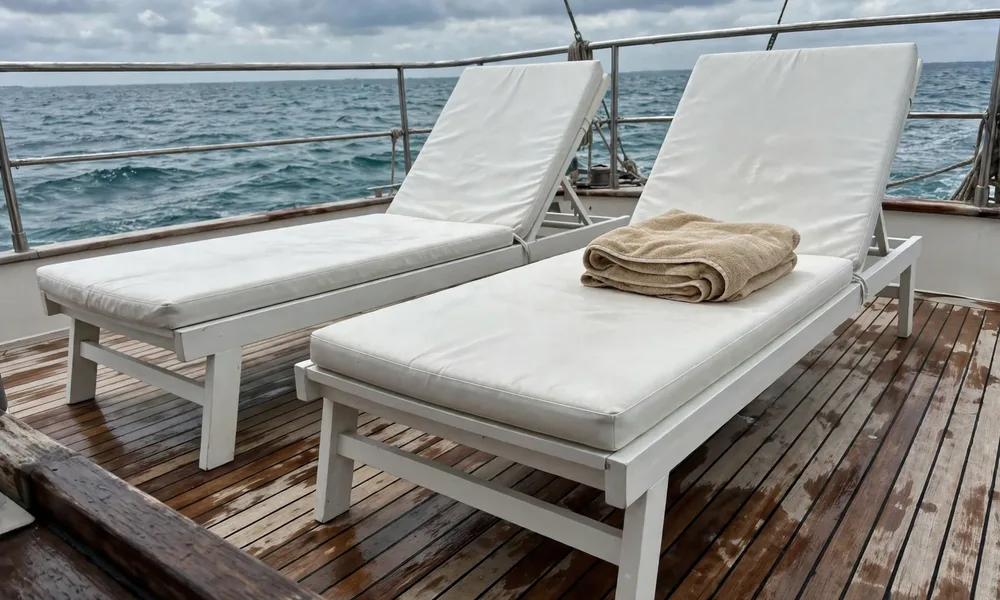
The yacht sunbed costs what it costs because it is not garden furniture. It is a bed that has to drain, dry, resist salt and sun, fit a deck that was built by hand, and do it all without rocking, fading, or smelling of mildew after a season at sea. The shape is simple. The survival is not, and the price is the cost of that survival, counted one bed at a time.


