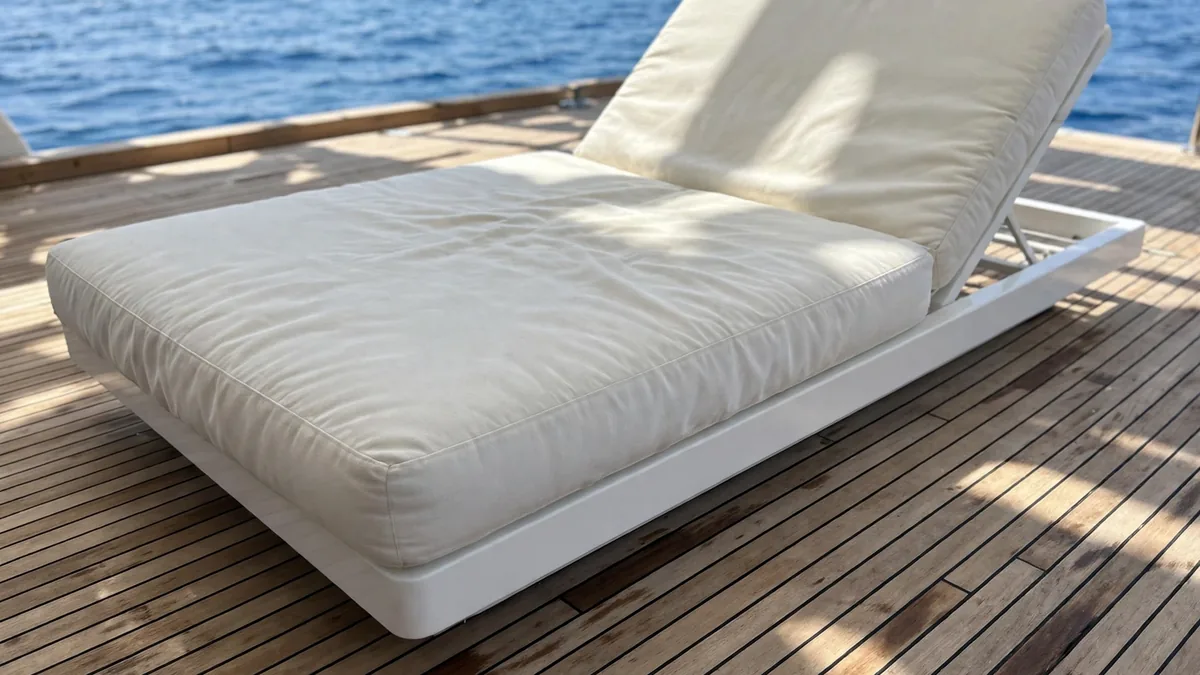
It looks like a bed that someone left outside: a low platform, a thick white cushion, a headrest that tilts up at one end, and nothing else. A guest lies down on it after lunch and does not get up again until the sun moves, and the sunbed takes the weight, the heat, and the salt spray without complaint. It is the simplest shape on the yacht, and one of the hardest to make well, because there is nowhere to hide a mistake.
A luxury yacht sunbed is a low outdoor bed built for the sun deck, with a flat platform frame, a thick quick-dry cushion, and a headrest that adjusts to several angles. It is made by building a rigid platform that will not flex, cutting foam that drains instead of holding water, and sewing a cover that can be taken off and washed. Every part has to survive sun, salt, and spray that would ruin a hotel lounger in a single season.
How It’s Made
Step 1: Building the low platform frame
The sunbed starts as a low rectangular frame, usually teak, powder-coated aluminium, or marine-grade stainless steel, built only a hand’s breadth off the deck. The frame is a grid of rails and cross-members, glued and screwed so it cannot twist, because a platform that flexes will crack its cushion and creak under every guest. Small adjustable feet level it on a deck that is never quite flat.
Step 2: Fitting the headrest hinge
At one end of the platform sits the headrest, a shorter panel hinged to the main frame so it can tilt from flat to almost upright. The hinge is a stainless steel ratchet with five or six notches, built heavier than a lounger hinge, because the headrest carries the weight of a person’s whole upper body. The maker bolts it through the frame with stainless fasteners and tests it by lifting the headrest through every notch a hundred times.
Step 3: Cutting the foam that drains
The cushion is where a cheap sunbed gives itself away, and it is where the maker spends the most time. The foam inside is reticulated, an open-cell foam full of tiny channels that let water drain straight through instead of pooling inside, so a sunbed soaked by a wave is dry again within the hour. The maker cuts the foam in two halves joined by a hidden hinge, so the cushion folds for stowing, and cuts shallow channels across the underside so any water that does get in runs out sideways. The yacht sunbed price explains why that foam costs more than ordinary foam, and the answer is in the draining: a cushion that holds water grows mildew, and mildew is the end of a white sunbed.
Step 4: Sewing the cover
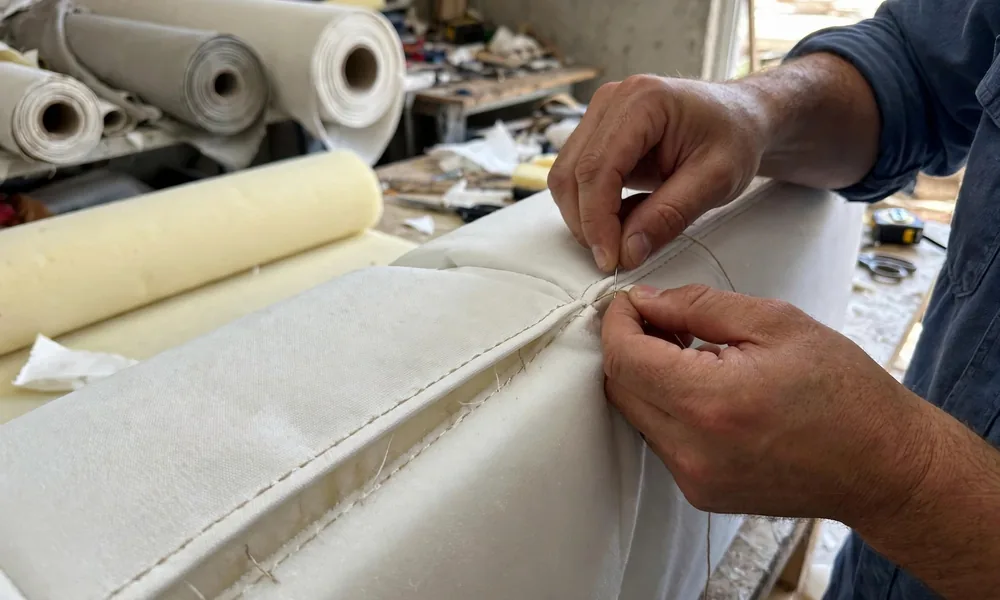
The cover is sewn from solution-dyed acrylic, a marine fabric that resists sun, salt, and sunscreen, with the colour dyed into the fibre before weaving so it cannot bleach. The maker cuts the cover to fit the folded foam exactly, sews a hidden zip along the underside where the sun never reaches it, and double-stitches the seams that take the most strain. The cover lifts off in seconds so the crew can wash it, and it is cut slightly loose, because a cover pulled tight will split at the seams when the foam swells with heat. A good cover feels smooth and cool to bare skin even at midday, and it never sticks, which is more than can be said for most outdoor furniture. The crew keeps two covers per bed, so one can be in the wash while the other is on the bed, and a stained cover is swapped in minutes rather than ending the sunbed’s day.
Step 5: Adding the base, drainage and fixings
Under the cushion, the platform is not solid: it is a row of slats or a mesh panel with gaps between them, so rain and spray drain straight through to the deck below. The maker spaces the slats so water cannot pool anywhere, and fixes them with stainless screws that will not stain the frame. Tie-down points lash it to the deck in heavy weather, and small wheels at one end let two crew members move it without dragging it across the teak.
Step 6: Testing, weathering and the first lie-down
Before the sunbed goes aboard, it is tested the way guests will use it: loaded with sandbags, rained on, hosed down, and left in the sun for days to prove the cushion dries and the headrest still clicks. The yacht beach club below deck stores the spare covers and cushions, and the maker lies on it last, checking that the headrest holds at every angle and that the cushion does not bottom out on the slats.
A yacht sunbed earns its place by being the most comfortable thing on the boat. It is low, wide, dry, and always in the sun, and it asks for nothing more than a rinse with fresh water and a cover when the weather turns. Rinsed down after every use and covered when the yacht is under way, the bed is ready again by morning, and the next guest will never know how much work went into doing nothing at all.
Yacht Sunbed Specifications
| Feature | Typical Detail |
|---|---|
| Frame | Teak, powder-coated aluminium or 316 stainless steel, low platform grid |
| Headrest hinge | Stainless steel ratchet, five or six locking positions |
| Cushion foam | Reticulated open-cell foam, cut in two folding halves, drainage channels |
| Cover | Solution-dyed acrylic, hidden underside zip, double-stitched seams |
| Platform | Slatted or mesh base, gaps for drainage, stainless fixings |
| Size | Around 2 metres long, 80 to 100 centimetres wide, 25 centimetres high |
| Weight | Around 20 to 35 kilograms, wheels or handles for moving |
How Much Does a Yacht Sunbed Cost?
Prices are estimates and vary with size, materials and maker. A single luxury yacht sunbed typically costs an estimated $3,000 to $15,000, with teak and stainless steel models at the top of the range and aluminium models lower. A matched pair with cushions, covers, and a storage cradle can run an estimated $8,000 to $30,000. It sounds like a lot for a bed left outside, but a cheap one sags, holds water, and fades within a season.
A Rare Fact About Yacht Sunbeds
Here is a detail most guests never notice: the cushion on a yacht sunbed is made in two halves that fold, and the fold is the reason the bed survives. A single solid cushion would have to be dragged below deck whole when the weather turns, but a folding cushion comes off in two light pieces that one crew member can carry down the companionway alone. The best superyacht sunpads ranks sunpads by the same kind of practical detail, and the folding cushion is the quietest part of it: a bed that looks like one solid piece, built to come apart in seconds when the sky changes.

The best yacht sunbeds are the ones guests fight over at breakfast. They are in the sunniest spot, the cushion is dry, the headrest clicks into place, and the sea is right there. Everything else on the yacht can wait; the sunbed has done its job before lunch.


