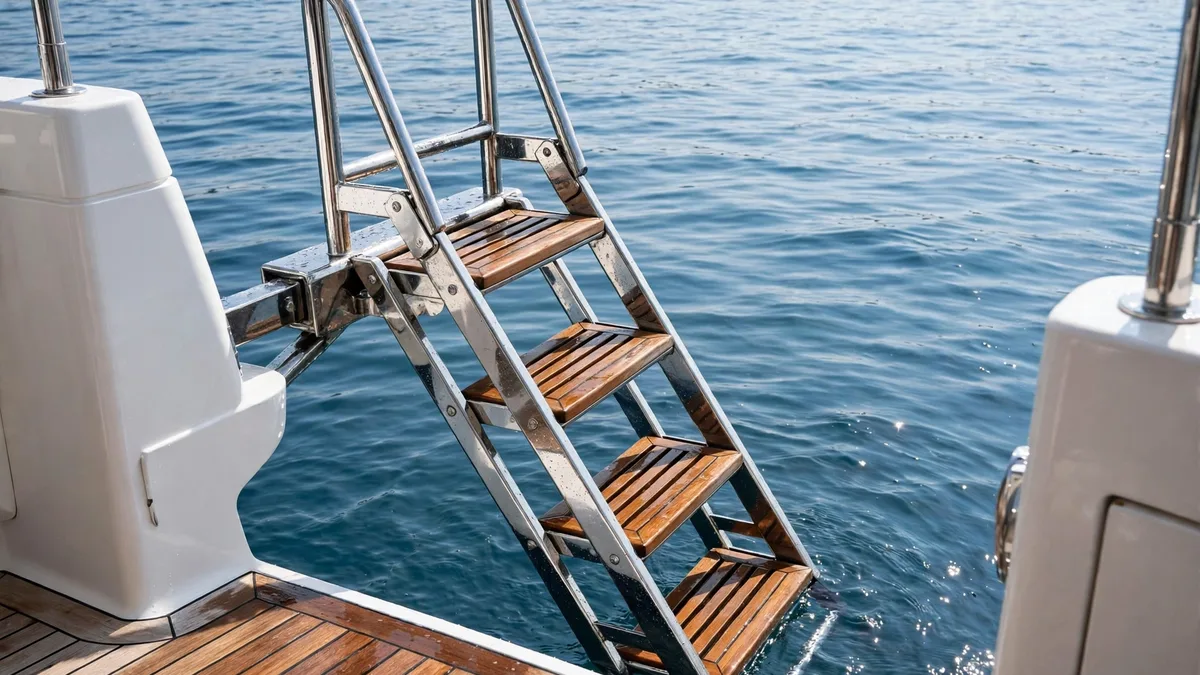
It is a ladder. A few steps, two handrails, a hinge. A hardware store sells something that looks similar for the price of a dinner out, and a keen owner can bolt it to a transom in an afternoon. So the first time a yacht owner sees the invoice for a proper luxury swim ladder, the reaction is almost always the same: disbelief, followed by a long stare at a piece of equipment that seems far too simple to cost as much as a small boat. The ladder on a superyacht can run to tens of thousands of dollars, and on the largest yachts the bill is higher still.
The disbelief fades once you understand what the ladder actually is. It is not a household ladder that happens to be near the sea. It is a piece of marine engineering that lives permanently in salt water, carries wet people in rough conditions, folds away into a hull worth tens of millions of dollars, and must work perfectly every time, for years, without ever failing, rusting, jamming or injuring anyone.
This article follows the money. It looks at the materials, the marine-grade hardware, the custom fitting, the safety engineering and the certification that turn a simple ladder into a luxury item, and it explains why each one costs what it does. By the end, the price will still seem high, but it will no longer seem mysterious. A swim ladder is the cheapest way back aboard a yacht, and it is priced like the most important one, because on a dark night in a rough sea, it is.
Where the Money Goes
1. Marine-grade stainless steel, and lots of it
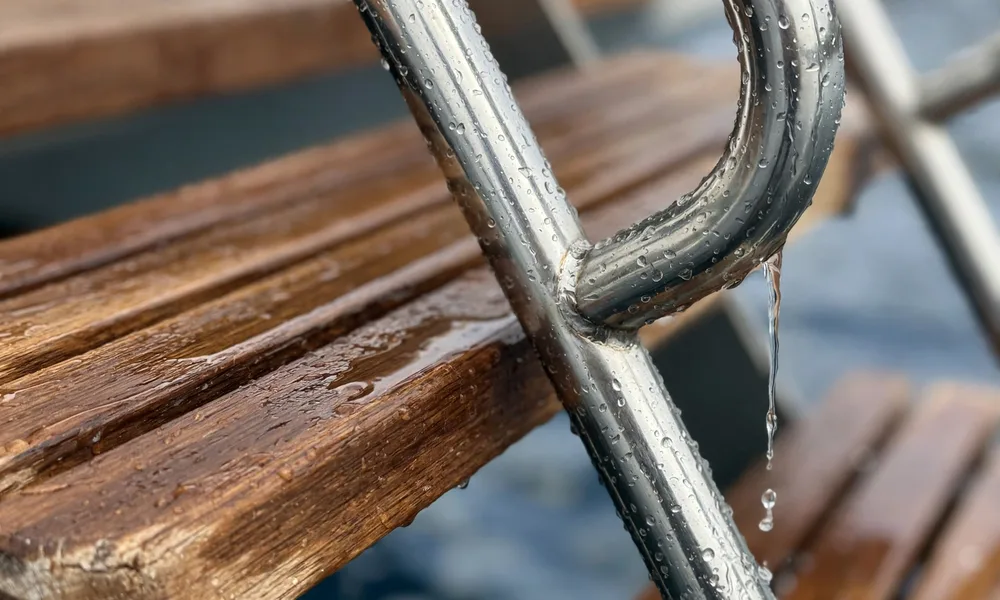
The first cost is the metal. A luxury swim ladder is built from marine-grade stainless steel, usually 316L, the grade that can live in salt water without rusting. It is far more expensive than the steel in a household ladder, and it is harder to work: it needs specialist welding, careful polishing and passivation, a chemical treatment that restores the invisible layer that keeps it from corroding. A luxury ladder uses heavy-wall tube, welded by hand, polished to a mirror finish, and built to look as good in ten years as it does on delivery day. The steel alone can cost more than an entire budget ladder, before a single step is fitted.
2. Teak steps and custom woodwork
The steps are the second cost, and they are where the ladder stops looking like hardware and starts looking like furniture. Luxury ladders use solid teak treads, cut to match the yacht’s deck, shaped by hand and finished to the same standard as the rest of the boat. Teak is expensive, it is getting scarcer, and working it properly takes a skilled joiner, not a production line. The treads must be non-slip when wet, comfortable under bare feet, and strong enough to carry a heavy person climbing out of the water with diving gear. Some yachts add heated steps or custom inlays, and every variation is made by hand for one ladder. A mass-produced plastic tread costs almost nothing. A teak tread made for one yacht costs a significant sum, and a ladder has several of them.
3. The hinge, the hydraulics and the stowage
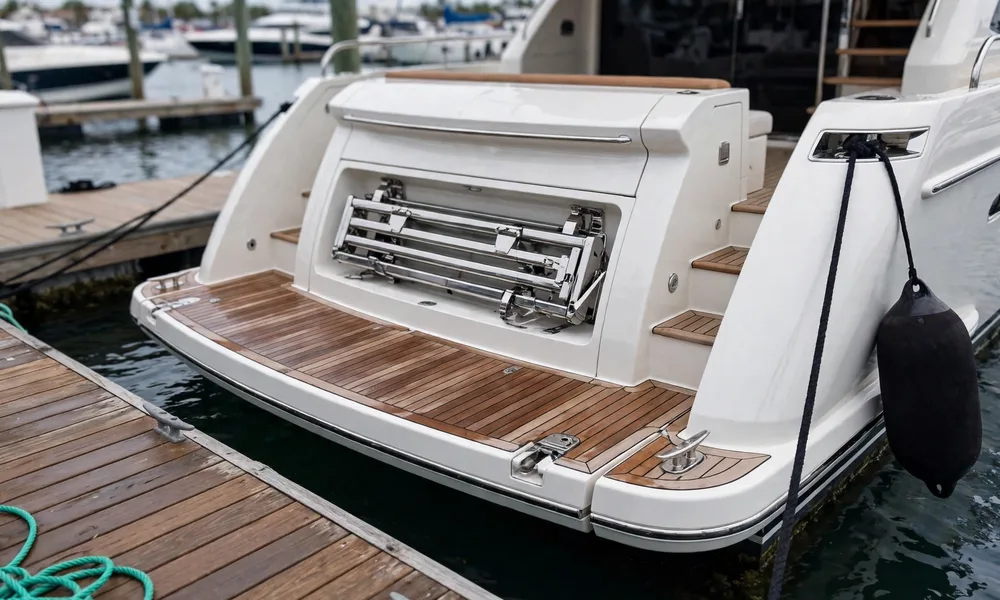
The third cost is the part you barely see: the mechanism that lets the ladder fold away. On a luxury yacht the ladder does not hang on the transom like an afterthought. It folds into a recess in the hull, or swings up into a bathing platform, or lowers on hydraulic rams at the touch of a button. That mechanism has to work in salt water, under load, after months of not being used, and it has to be strong enough that it never drops a person into the sea. Engineering a folding mechanism that disappears into a yacht’s stern is a design project in itself, and it is priced like one.
4. Custom fitting to one yacht
The fourth cost is that no two luxury swim ladders are the same. Each one is measured, drawn and built for a single yacht, to fit its transom angle, its bathing platform, its freeboard and its owner’s height. The yard sends a surveyor to measure the stern, the designer draws the ladder around those measurements, and the fabricator builds it once, by hand, with no production run to spread the cost across. That is the nature of luxury yacht building, and it is why the ladder cannot be bought off the shelf. A one-off piece of engineering always costs more than a thousand identical ones, and the owner is paying for the measuring, the drawing and the fitting as much as for the metal.
5. Safety engineering and certification
The fifth cost is safety, and it is the one owners are least likely to question once it is explained. A swim ladder is a safety device. It must carry a wet, tired or injured person out of the water, in the dark, in a swell, without breaking, slipping or trapping a hand. Luxury ladders are load-tested well beyond their rated capacity, their steps are spaced and angled to be climbable by someone with no strength left, and their handrails are placed where a person in the water can actually reach them. A ladder that fails a survey can keep a yacht in port, and no owner wants to explain to guests that the way back aboard is out of order.
What It Costs
A luxury yacht swim ladder is typically an estimate of $15,000 to $60,000 fitted, depending on size, materials and mechanism, with the largest hydraulically operated ladders on superyachts reaching $100,000 or more. The steel and teak account for a large share, the custom design and fitting for another, and the hydraulic mechanism and certification for the rest. Running costs are modest: fresh-water rinsing after use, an annual service of the hinges and hydraulics, and re-oiling of the teak.
A Rare Fact
Here is something few people outside yachting know: on many large yachts, the swim ladder is designed to be usable by a person in the water with no help from the crew. The lowest step sits deep enough to be reached from the water, the handrails extend below the waterline, and the ladder can be lowered from the water itself, by a pull cord or a lever within reach of a swimmer. That is not a convenience. It is a safety rule, born from the fear of a person falling overboard alone at night, and it is one of the reasons the design is so carefully specified. A ladder that can only be lowered from the deck is useless to the one person who needs it most.
A swim ladder looks simple because it is designed to disappear, into the hull, into the routine of a day at anchor, into the background of a beautiful yacht. The price is the cost of making something that simple work perfectly, in salt water, for years, for one specific boat. Readers who want to see how these ladders are put together can read how a luxury yacht swim ladder is made, while how a luxury yacht swim ladder works and luxury yacht swim ladder specs explained show its closest neighbours on the yacht.