The yacht in the marina is 40 metres long, and on its aft deck, where other yachts carry a tender and a jet ski, this one carries something else: a small yellow submarine, barely five metres long, sitting in a cradle like a piece of jewellery. It seats three people, it dives to a few hundred metres, and it costs more than the yacht’s main engines, its generators, and its navigation suite put together.
A private submarine is one of the rarest machines a person can own. Only a few hundred exist in the world, most of them built one at a time, and every one of them is a pressure vessel, a life-support system, and a precision instrument, all fitted into a space smaller than a family car. The price is not about luxury. It is about the engineering needed to keep people alive under the sea, and the testing needed to prove it works.
The cost drivers are the same ones that shape every submarine: the hull that resists the pressure, the systems that make the air breathable, the batteries that power everything, and the long, careful testing that certifies the whole machine safe to dive. This is where the money goes.

Why a Private Submarine Is So Expensive
1. The pressure hull
The first cost driver is the pressure hull, the steel or titanium sphere or cylinder that keeps the sea out and the crew alive. At a depth of a few hundred metres, the water pressure is dozens of times greater than at the surface, and the hull has to resist it without deforming, cracking, or leaking. The hull is machined from a single piece or welded from sections and then tested far beyond its rated depth, and the steel is inspected millimetre by millimetre, because a flaw the size of a fingernail can be fatal. The engineering of hulls built for deep water is a discipline of its own, and the deep-sea submersible specifications show how those hulls are shaped and rated.
2. Life support and air
The second cost driver is life support. A submarine is a sealed box, and the air inside has to be made breathable for hours at a time. Carbon dioxide is scrubbed out by chemical absorbers, oxygen is topped up from tanks, and the humidity, the temperature and the air quality are all controlled by systems that have to work perfectly, every dive, with no fresh air coming in. The systems are doubled where they matter most, because there is no way to open a window under water, and the crew is trained to manage them by hand if the automatic systems fail.
3. Batteries and propulsion
The third cost driver is power. A private submarine runs on batteries, usually large banks of lithium-ion cells, and they have to power everything: the thrusters, the lights, the life support, the navigation and the communications, all at once, for hours, with no engine running and no cable to the surface. The battery bank is one of the heaviest and most expensive parts of the machine, and it is built with layers of protection, because a battery fault under water is far more dangerous than one on land. The thrusters themselves are small, quiet electric motors, and the way submarine propulsion is designed is covered in the best submarine propulsion systems compared.
4. Testing and certification
The fourth cost driver is testing. Before a private submarine is allowed to carry people, it is pressure-tested in a chamber, dive-tested in stages, and inspected by an independent classification society, and every test is documented, repeated and signed off. The testing alone can take months, and it costs a large share of the build price, because the test chamber, the engineers, and the inspectors are all specialised and expensive.
5. Navigation, sonar and communications
The fifth cost driver is the electronics. Under water there is no satellite signal, so a submarine navigates by sonar, by inertial systems, and by dead reckoning, and the sonar alone is a major cost. The communications are limited too: radio does not travel through water, so the submarine talks to the surface through an acoustic link, a slow, short-range system that sends simple messages in sound.
6. Craftsmanship and small numbers
The sixth cost driver is the build itself. Private submarines are built in tiny numbers, often one at a time, by small teams of specialists, and there is no production line to spread the cost across. The hull is machined, the systems are fitted by hand, and the whole machine is assembled, tested, taken apart, and reassembled before it is delivered. The builders are a handful of companies in the world, and their order books are measured in single figures, which is why the price of one submarine carries the cost of the whole workshop behind it.
7. The support system and the yacht
The last cost driver is everything around the submarine. A private submarine needs a launch and recovery system on the yacht, a cradle, a crane or a lift, and a crew trained to operate it, and the yacht itself has to be built or modified to carry it. The submarine also needs a support team: a pilot, a technician, and a surface crew, plus spare parts, batteries, and a maintenance schedule that is followed after every dive. The air supply that keeps the crew breathing on the surface is part of the same discipline, and how a submarine snorkel works explains how submarines manage their air when they are near the surface.
Private Submarine Costs
| Cost driver | What it adds |
|---|---|
| Pressure hull | Machined steel or titanium, tested beyond rated depth |
| Life support | Carbon dioxide scrubbing, oxygen, air control |
| Batteries and propulsion | Large lithium-ion bank, quiet electric thrusters |
| Testing and certification | Months of pressure tests and independent inspection |
| Electronics | Sonar, inertial navigation, acoustic communications |
| Small-series build | One at a time, specialist workshop |
| Support system | Launch cradle, trained crew, maintenance after every dive |
What Does a Private Submarine Cost?
A private submarine is estimated to cost roughly $1 million to $5 million, depending on size, depth rating and equipment, with a small two-person tourist submarine estimated near the lower end and a larger, deeper-diving model estimated at the top end or beyond. The running costs are estimated at hundreds of thousands of dollars a year, covering the support crew, the battery replacement, the certification, and the maintenance after every dive, and the insurance alone is estimated to be a significant share of that.
A Rare Fact
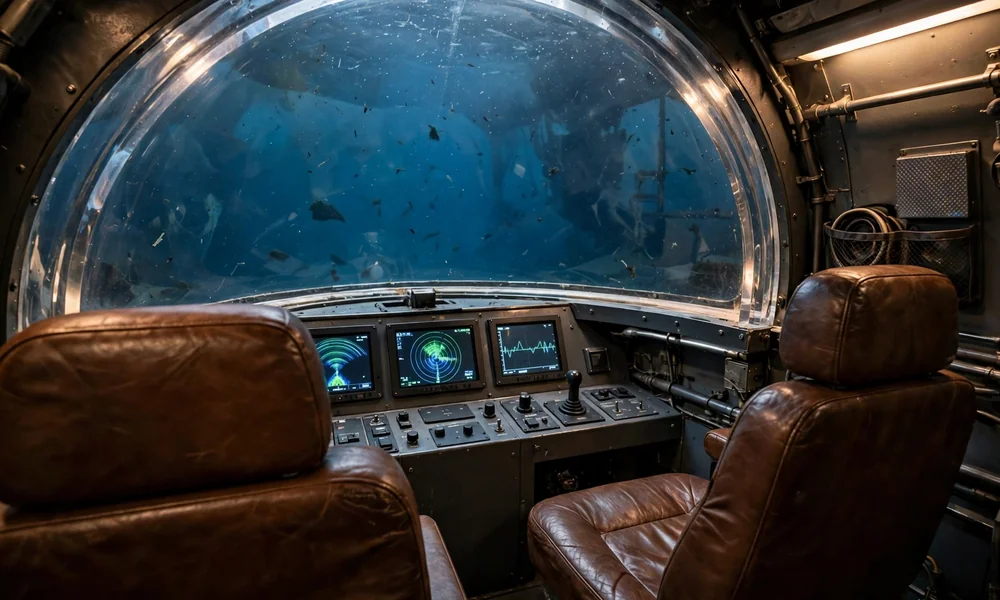
Here is a detail that surprises most people who first hear the price of a private submarine: the viewports, the thick acrylic domes the crew looks out through, are machined and polished to optical standards, and a single dome can cost as much as a family car, because it has to stay perfectly clear and perfectly strong under pressure.

A private submarine is expensive because it is a machine that has to be perfect, every time, in a place where mistakes cannot be fixed, and that is a standard no other private vehicle is held to.


