Wheels are the most honest part of a hypercar. A wheel has to do real work: carry the weight, survive the heat, clear the brakes, and still look right on a car that costs more than a house.
This ranking judges wheels on weight, strength, design, and what they do for the car they were built for. A light wheel that flexes is useless, and a beautiful wheel that adds unsprung mass is worse. The ten below are the sets that get the balance right, from forged aluminium workhorses to carbon fibre wheels that weigh less than the tyre wrapped around them.

How the ranking works
Weight matters most, because wheels are unsprung mass. Every kilogram saved at the wheel is worth several saved anywhere else, since the suspension has less mass to control and the car changes direction more willingly. A set that saves eight kilograms across four corners transforms how a hypercar rides and turns.
The 10 Best Hypercar Wheels, Ranked
1. Koenigsegg Aircore carbon fibre wheels
Koenigsegg’s Aircore wheels are the benchmark. Made from carbon fibre with a hollow core, a single front wheel weighs around six kilograms, roughly half an equivalent forged aluminium wheel. That saving is unsprung mass, so the suspension works better and the steering feels lighter and more precise. They are also strong enough for a car with more than 1,500 horsepower. No other wheel combines this little weight with this much capability.
2. McLaren W1 carbon fibre wheels
McLaren has made carbon fibre wheels for its Ultimate Series cars for years, and the W1 set is the best of them. The spokes are shaped to feed air to the brakes and cut drag at high speed, and the wheels are sized to fit the enormous brakes the W1 needs. They carry centre-lock hubs, which make wheel changes fast and keep the design clean. On a car that is all about lightness, they are the obvious choice.
3. Bugatti Tourbillon forged wheels
Bugatti’s wheels have a harder job than most, because the Tourbillon is heavy, enormously powerful, and capable of more than 400 kilometres per hour. The forged wheels are built to survive forces that would destroy a normal wheel, with thick spokes and a deep centre that handles the load. They are not the lightest wheels here, but they are among the strongest, with a horseshoe-inspired centre and a finish that looks expensive because it is.
4. Ferrari F80 carbon fibre wheels
Ferrari’s F80 uses carbon fibre wheels developed alongside its hybrid powertrain, and they show that Ferrari’s engineers care about wheels as much as its designers do. They are light enough to sharpen the steering, stiff enough to handle the car’s downforce, and shaped to cool the brakes on a car that laps circuits hard. The simple five-spoke design is restrained rather than showy, letting the car do the talking.
5. Pagani Utopia forged aluminium wheels
Pagani wheels are machined from a single piece of forged aluminium alloy into a design that looks more like jewellery than engineering. The Utopia’s wheels use Avional, an aircraft aluminium alloy that is both light and strong, and each wheel is finished by hand. They are heavier than the carbon fibre wheels above, but they are repairable in a way carbon wheels are not, and they suit a car that is as much a work of art as a machine.
6. Rimac Nevera forged aluminium wheels
The Nevera is an electric hypercar with four motors and instant torque, which puts brutal loads through its wheels every time the driver accelerates. Rimac’s forged aluminium wheels are built for that punishment, with a design that clears the car’s huge brakes and a centre-lock fitting that stays tight under hard launches. They are not the lightest set here, because an electric hypercar needs wheels that can take repeated full-power launches without complaint.
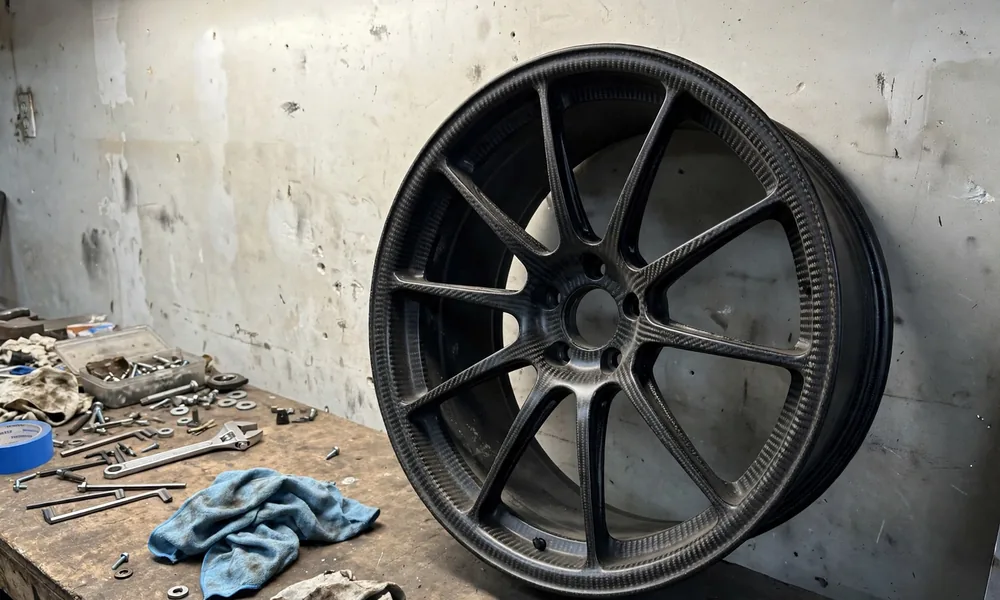
7. Aston Martin Valkyrie magnesium wheels
Magnesium is lighter than aluminium and almost as strong, which is why the Valkyrie uses forged magnesium wheels on a car built to Formula One standards. They are sized to fit the car’s tiny brakes and enormous downforce, and the forging makes them dense and tough. Magnesium wheels are expensive and need careful maintenance, because the metal corrodes if it is not protected, but on a car like the Valkyrie the weight saving is worth the trouble.
8. Lamborghini Revuelto forged aluminium wheels
Lamborghini’s Revuelto wheels are forged aluminium with a sharp, angular design that matches the car’s styling, built to handle the hybrid V12’s power and the car’s weight. The single-nut centre lock is a nod to racing, and the wheels come in several finishes, from bronze to black. They are not the lightest or the most advanced wheels here, but they are strong, good looking, and perfectly matched to the car.
9. Gordon Murray T.50 forged aluminium wheels
The T.50 is the lightest hypercar of its kind, and its wheels follow the same philosophy: forged aluminium, simple design, no wasted material. Gordon Murray’s team chose a classic multi-spoke layout that is easy to clean, easy to inspect, and light enough to keep unsprung mass low. The wheels are not flashy, and that is the point. On a car designed by an engineer who believes lightness is everything, they do their job without drawing attention.
10. Hennessey Venom F5 forged aluminium wheels
The Venom F5 is built for one thing, top speed, and its wheels are built for the same job. Forged aluminium keeps them strong at speeds beyond 400 kilometres per hour, where a wheel failure would be catastrophic, and the design is deliberately simple, with thick spokes that resist flex. They are the heaviest wheels on this list, but they also have the hardest job, holding together a car trying to go faster than any road car before it.
What to look for in a hypercar wheel
If you are choosing wheels for a hypercar, weight is the first number to check, but not the only one. A wheel that is light but flexible will make the car feel nervous, and one that is stiff but heavy will dull the steering. The best wheels balance the two, and they are always designed around the car: the brakes they must clear, the tyres they must carry, and the airflow they must not disturb.
Material matters too. Carbon fibre is lightest and stiffest, but expensive and hard to repair if damaged. Magnesium is nearly as light but needs care. Forged aluminium is the practical choice: heavier than the exotic options, but strong, repairable, and proven over decades of racing. That is why most hypercars still use it. Our guide to how hypercar carbon wheels work explains the materials and manufacturing behind these wheels.
Finally, remember that wheels are part of a system. The best wheel in the world will not save a car with poor suspension or bad tyres, and a mediocre wheel will not ruin a great car. For the rest of the car, our ranking of the best hypercar interiors shows how the cabin matches the engineering, and the best hypercar steering systems shows how the driver stays connected to it all.

The verdict
Koenigsegg’s Aircore wheels win because they do the impossible: they are dramatically lighter than anything else and still strong enough for the fastest cars on earth. McLaren and Bugatti follow because their wheels are engineered for their cars rather than bought off a shelf.


